Jump to
S2C1
Energy calculated at B2PLYP=FULLultrafine/daug-cc-pVDZ
| | hartrees |
|---|
| Energy at 0K | -151.955300 |
| Energy at 298.15K | |
| HF Energy | -151.804239 |
| Nuclear repulsion energy | 62.810366 |
The energy at 298.15K was derived from the energy at 0K
and an integrated heat capacity that used the calculated vibrational frequencies.
Vibrational Frequencies calculated at B2PLYP=FULLultrafine/daug-cc-pVDZ
| Mode Number |
Symmetry |
Frequency
(cm-1) |
Scaled Frequency
(cm-1) |
IR Intensities
(km mol-1) |
Raman Act
(Å4/u) |
Dep P |
Dep U |
|---|
| 1 |
Σg |
2116 |
2116 |
0.00 |
58.17 |
0.43 |
0.60 |
| 2 |
Σg |
930 |
930 |
0.00 |
84.02 |
0.26 |
0.42 |
| 3 |
Σu |
1574 |
1574 |
353.19 |
0.00 |
0.35 |
0.51 |
| 4 |
Πg |
145 |
145 |
0.00 |
8.25 |
0.75 |
0.86 |
| 4 |
Πg |
145 |
145 |
0.00 |
8.25 |
0.75 |
0.86 |
| 5 |
Πu |
146 |
146 |
22.78 |
0.00 |
0.75 |
0.86 |
| 5 |
Πu |
146 |
146 |
22.78 |
0.00 |
0.75 |
0.86 |
Unscaled Zero Point Vibrational Energy (zpe) 2601.2 cm
-1
Scaled (by 1) Zero Point Vibrational Energy (zpe) 2601.2 cm
-1
See section
III.C.1 List or set vibrational scaling factors
to change the scale factors used here.
See section
III.C.2
Calculate a vibrational scaling factor for a given set of molecules
to determine the least squares best scaling factor.
Geometric Data calculated at B2PLYP=FULLultrafine/daug-cc-pVDZ
Point Group is D∞h
Cartesians (Å)
| Atom |
x (Å) |
y (Å) |
z (Å) |
|---|
| C1 |
0.000 |
0.000 |
0.651 |
| C2 |
0.000 |
0.000 |
-0.651 |
| C3 |
0.000 |
0.000 |
1.973 |
| C4 |
0.000 |
0.000 |
-1.973 |
Atom - Atom Distances (Å)
| |
C1 |
C2 |
C3 |
C4 |
| C1 | | 1.3024 | 1.3214 | 2.6238 |
C2 | 1.3024 | | 2.6238 | 1.3214 | C3 | 1.3214 | 2.6238 | | 3.9452 | C4 | 2.6238 | 1.3214 | 3.9452 | |
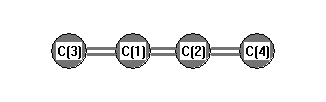 More geometry information
Calculated Bond Angles
| atom1 |
atom2 |
atom3 |
angle |
|
atom1 |
atom2 |
atom3 |
angle |
| C1 |
C2 |
C4 |
180.000 |
|
C2 |
C1 |
C3 |
180.000 |
Electronic energy levels
Charges, Dipole, Quadrupole and Polarizability
Jump to
S1C1
Energy calculated at B2PLYP=FULLultrafine/daug-cc-pVDZ
| | hartrees |
|---|
| Energy at 0K | -151.932118 |
| Energy at 298.15K | |
| HF Energy | -151.769017 |
| Nuclear repulsion energy | 62.620354 |
The energy at 298.15K was derived from the energy at 0K
and an integrated heat capacity that used the calculated vibrational frequencies.
Vibrational Frequencies calculated at B2PLYP=FULLultrafine/daug-cc-pVDZ
| Mode Number |
Symmetry |
Frequency
(cm-1) |
Scaled Frequency
(cm-1) |
IR Intensities
(km mol-1) |
Raman Act
(Å4/u) |
Dep P |
Dep U |
|---|
| 1 |
Σg |
2095 |
2095 |
0.00 |
81.56 |
0.30 |
0.46 |
| 2 |
Σg |
919 |
919 |
0.00 |
85.73 |
0.22 |
0.36 |
| 3 |
Σu |
1577 |
1577 |
387.71 |
0.00 |
0.74 |
0.85 |
| 4 |
Πg |
327 |
327 |
0.00 |
0.30 |
0.75 |
0.86 |
| 4 |
Πg |
194i |
194i |
0.00 |
10.41 |
0.75 |
0.86 |
| 5 |
Πu |
186 |
186 |
6.97 |
0.00 |
0.49 |
0.66 |
| 5 |
Πu |
111 |
111 |
36.08 |
0.00 |
0.75 |
0.86 |
Unscaled Zero Point Vibrational Energy (zpe) 2509.8 cm
-1
Scaled (by 1) Zero Point Vibrational Energy (zpe) 2509.8 cm
-1
See section
III.C.1 List or set vibrational scaling factors
to change the scale factors used here.
See section
III.C.2
Calculate a vibrational scaling factor for a given set of molecules
to determine the least squares best scaling factor.
Geometric Data calculated at B2PLYP=FULLultrafine/daug-cc-pVDZ
Point Group is D∞h
Cartesians (Å)
| Atom |
x (Å) |
y (Å) |
z (Å) |
|---|
| C1 |
0.000 |
0.000 |
0.654 |
| C2 |
0.000 |
0.000 |
-0.654 |
| C3 |
0.000 |
0.000 |
1.978 |
| C4 |
0.000 |
0.000 |
-1.978 |
Atom - Atom Distances (Å)
| |
C1 |
C2 |
C3 |
C4 |
| C1 | | 1.3077 | 1.3246 | 2.6323 |
C2 | 1.3077 | | 2.6323 | 1.3246 | C3 | 1.3246 | 2.6323 | | 3.9569 | C4 | 2.6323 | 1.3246 | 3.9569 | |
More geometry information
Electronic energy levels
Charges, Dipole, Quadrupole and Polarizability
