Jump to
S1C2
Vibrational Frequencies calculated at HF/daug-cc-pVDZ
Geometric Data calculated at HF/daug-cc-pVDZ
Electronic energy levels
Charges, Dipole, Quadrupole and Polarizability
Jump to
S1C1
Energy calculated at HF/daug-cc-pVDZ
| | hartrees |
|---|
| Energy at 0K | -2611.373554 |
| Energy at 298.15K | |
| HF Energy | -2611.373554 |
| Nuclear repulsion energy | 80.102742 |
The energy at 298.15K was derived from the energy at 0K
and an integrated heat capacity that used the calculated vibrational frequencies.
Vibrational Frequencies calculated at HF/daug-cc-pVDZ
| Mode Number |
Symmetry |
Frequency
(cm-1) |
Scaled Frequency
(cm-1) |
IR Intensities
(km mol-1) |
Raman Act
(Å4/u) |
Dep P |
Dep U |
|---|
| 1 |
A1 |
3311 |
3020 |
7.09 |
121.54 |
0.08 |
0.15 |
| 2 |
A1 |
1475 |
1345 |
34.15 |
1.43 |
0.06 |
0.12 |
| 3 |
A1 |
717 |
653 |
19.22 |
15.60 |
0.15 |
0.26 |
| 4 |
B1 |
302i |
275i |
56.46 |
0.03 |
0.75 |
0.86 |
| 5 |
B2 |
3479 |
3173 |
0.93 |
51.71 |
0.75 |
0.86 |
| 6 |
B2 |
979 |
893 |
0.33 |
0.81 |
0.75 |
0.86 |
Unscaled Zero Point Vibrational Energy (zpe) 4829.6 cm
-1
Scaled (by 0.912) Zero Point Vibrational Energy (zpe) 4404.6 cm
-1
See section
III.C.1 List or set vibrational scaling factors
to change the scale factors used here.
See section
III.C.2
Calculate a vibrational scaling factor for a given set of molecules
to determine the least squares best scaling factor.
Geometric Data calculated at HF/daug-cc-pVDZ
Point Group is C2v
Cartesians (Å)
| Atom |
x (Å) |
y (Å) |
z (Å) |
|---|
| C1 |
0.000 |
0.000 |
-1.499 |
| Br2 |
0.000 |
0.000 |
0.371 |
| H3 |
0.000 |
0.953 |
-1.998 |
| H4 |
0.000 |
-0.953 |
-1.998 |
Atom - Atom Distances (Å)
| |
C1 |
Br2 |
H3 |
H4 |
| C1 | | 1.8704 | 1.0754 | 1.0754 |
Br2 | 1.8704 | | 2.5533 | 2.5533 | H3 | 1.0754 | 2.5533 | | 1.9060 | H4 | 1.0754 | 2.5533 | 1.9060 | |
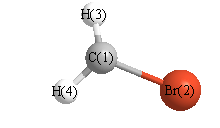 More geometry information
Calculated Bond Angles
| atom1 |
atom2 |
atom3 |
angle |
|
atom1 |
atom2 |
atom3 |
angle |
| Br2 |
C1 |
H3 |
117.607 |
|
Br2 |
C1 |
H4 |
117.607 |
| H3 |
C1 |
H4 |
124.786 |
|
Electronic energy levels
Charges, Dipole, Quadrupole and Polarizability
Charges from optimized geometry at HF/daug-cc-pVDZ
Charges (e)
| Number |
Element |
Mulliken |
CHELPG |
AIM |
ESP |
| 1 |
C |
0.389 |
|
|
|
| 2 |
Br |
0.375 |
|
|
|
| 3 |
H |
-0.382 |
|
|
|
| 4 |
H |
-0.382 |
|
|
|
Electric dipole moments
Electric dipole components in Debye
(What's a Debye? See section
VII.A.3)
| |
x |
y |
z |
Total |
| |
0.000 |
0.000 |
-1.498 |
1.498 |
| CHELPG |
|
|
|
|
| AIM |
|
|
|
|
| ESP |
|
|
|
|
Electric Quadrupole moment
Quadrupole components in D Å
| Primitive |
|---|
| | x | y | z |
|---|
| x |
-26.816 |
0.000 |
0.000 |
| y |
0.000 |
-24.692 |
0.000 |
| z |
0.000 |
0.000 |
-21.570 |
|
| Traceless |
|---|
| | x | y | z |
|---|
| x |
-3.685 |
0.000 |
0.000 |
| y |
0.000 |
-0.499 |
0.000 |
| z |
0.000 |
0.000 |
4.185 |
|
| Polar |
|---|
| 3z2-r2 | 8.369 |
|---|
| x2-y2 | -2.124 |
|---|
| xy | 0.000 |
|---|
| xz | 0.000 |
|---|
| yz | 0.000 |
|---|
|
Polarizabilities
Components of the polarizability tensor.
Units are
Å
3 (Angstrom cubed)
Change units.
| |
x |
y |
z |
| x |
4.227 |
0.000 |
0.000 |
| y |
0.000 |
4.433 |
0.000 |
| z |
0.000 |
0.000 |
6.259 |
<r2> (average value of r
2) Å
2
| <r2> |
43.320 |
| (<r2>)1/2 |
6.582 |
