Jump to
S1C2
Energy calculated at QCISD/daug-cc-pVDZ
| | hartrees |
|---|
| Energy at 0K | -188.679211 |
| Energy at 298.15K | -188.680287 |
| HF Energy | -188.161386 |
| Nuclear repulsion energy | 62.597059 |
The energy at 298.15K was derived from the energy at 0K
and an integrated heat capacity that used the calculated vibrational frequencies.
Vibrational Frequencies calculated at QCISD/daug-cc-pVDZ
| Mode Number |
Symmetry |
Frequency
(cm-1) |
Scaled Frequency
(cm-1) |
IR Intensities
(km mol-1) |
Raman Act
(Å4/u) |
Dep P |
Dep U |
|---|
| 1 |
A' |
3662 |
3662 |
32.32 |
|
|
|
| 2 |
A' |
1829 |
1829 |
306.95 |
|
|
|
| 3 |
A' |
1315 |
1315 |
1.23 |
|
|
|
| 4 |
A' |
1061 |
1061 |
188.17 |
|
|
|
| 5 |
A' |
595 |
595 |
30.35 |
|
|
|
| 6 |
A" |
569 |
569 |
107.08 |
|
|
|
Unscaled Zero Point Vibrational Energy (zpe) 4515.1 cm
-1
Scaled (by 1) Zero Point Vibrational Energy (zpe) 4515.1 cm
-1
See section
III.C.1 List or set vibrational scaling factors
to change the scale factors used here.
See section
III.C.2
Calculate a vibrational scaling factor for a given set of molecules
to determine the least squares best scaling factor.
Geometric Data calculated at QCISD/daug-cc-pVDZ
Point Group is Cs
Cartesians (Å)
| Atom |
x (Å) |
y (Å) |
z (Å) |
|---|
| C1 |
0.000 |
0.449 |
0.000 |
| O2 |
-1.072 |
-0.363 |
0.000 |
| O3 |
1.166 |
0.187 |
0.000 |
| H4 |
-0.751 |
-1.285 |
0.000 |
Atom - Atom Distances (Å)
| |
C1 |
O2 |
O3 |
H4 |
| C1 | | 1.3447 | 1.1953 | 1.8893 |
O2 | 1.3447 | | 2.3053 | 0.9766 | O3 | 1.1953 | 2.3053 | | 2.4174 | H4 | 1.8893 | 0.9766 | 2.4174 | |
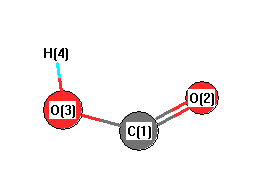 More geometry information
Calculated Bond Angles
| atom1 |
atom2 |
atom3 |
angle |
|
atom1 |
atom2 |
atom3 |
angle |
| C1 |
O2 |
H4 |
107.905 |
|
O2 |
C1 |
O3 |
130.256 |
Electronic energy levels
Charges, Dipole, Quadrupole and Polarizability
Jump to
S1C1
Energy calculated at QCISD/daug-cc-pVDZ
| | hartrees |
|---|
| Energy at 0K | -188.681928 |
| Energy at 298.15K | |
| HF Energy | -188.162128 |
| Nuclear repulsion energy | 62.364861 |
The energy at 298.15K was derived from the energy at 0K
and an integrated heat capacity that used the calculated vibrational frequencies.
Vibrational Frequencies calculated at QCISD/daug-cc-pVDZ
Geometric Data calculated at QCISD/daug-cc-pVDZ
Point Group is Cs
Cartesians (Å)
| Atom |
x (Å) |
y (Å) |
z (Å) |
|---|
| C1 |
0.000 |
0.414 |
0.000 |
| O2 |
-0.952 |
-0.554 |
0.000 |
| O3 |
1.179 |
0.257 |
0.000 |
| H4 |
-1.815 |
-0.114 |
0.000 |
Atom - Atom Distances (Å)
| |
C1 |
O2 |
O3 |
H4 |
| C1 | | 1.3576 | 1.1897 | 1.8904 |
O2 | 1.3576 | | 2.2807 | 0.9681 | O3 | 1.1897 | 2.2807 | | 3.0174 | H4 | 1.8904 | 0.9681 | 3.0174 | |
More geometry information
Calculated Bond Angles
| atom1 |
atom2 |
atom3 |
angle |
|
atom1 |
atom2 |
atom3 |
angle |
| C1 |
O2 |
H4 |
107.564 |
|
O2 |
C1 |
O3 |
126.983 |
Electronic energy levels
Charges, Dipole, Quadrupole and Polarizability
