Jump to
S1C2
Energy calculated at HF/daug-cc-pVDZ
| | hartrees |
|---|
| Energy at 0K | -498.491230 |
| Energy at 298.15K | |
| HF Energy | -498.491230 |
| Nuclear repulsion energy | 44.935264 |
The energy at 298.15K was derived from the energy at 0K
and an integrated heat capacity that used the calculated vibrational frequencies.
Vibrational Frequencies calculated at HF/daug-cc-pVDZ
| Mode Number |
Symmetry |
Frequency
(cm-1) |
Scaled Frequency
(cm-1) |
IR Intensities
(km mol-1) |
Raman Act
(Å4/u) |
Dep P |
Dep U |
|---|
| 1 |
A' |
3301 |
3010 |
11.45 |
114.76 |
0.08 |
0.14 |
| 2 |
A' |
1500 |
1368 |
18.28 |
0.92 |
0.57 |
0.72 |
| 3 |
A' |
851 |
776 |
44.75 |
11.64 |
0.15 |
0.26 |
| 4 |
A' |
465 |
424 |
44.63 |
0.59 |
0.32 |
0.48 |
| 5 |
A" |
3459 |
3154 |
0.04 |
45.30 |
0.75 |
0.86 |
| 6 |
A" |
1058 |
965 |
0.08 |
1.08 |
0.75 |
0.86 |
Unscaled Zero Point Vibrational Energy (zpe) 5317.0 cm
-1
Scaled (by 0.912) Zero Point Vibrational Energy (zpe) 4849.1 cm
-1
See section
III.C.1 List or set vibrational scaling factors
to change the scale factors used here.
See section
III.C.2
Calculate a vibrational scaling factor for a given set of molecules
to determine the least squares best scaling factor.
Geometric Data calculated at HF/daug-cc-pVDZ
Point Group is Cs
Cartesians (Å)
| Atom |
x (Å) |
y (Å) |
z (Å) |
|---|
| C1 |
-0.015 |
1.136 |
0.000 |
| Cl2 |
-0.015 |
-0.590 |
0.000 |
| H3 |
0.175 |
1.611 |
0.947 |
| H4 |
0.175 |
1.611 |
-0.947 |
Atom - Atom Distances (Å)
| |
C1 |
Cl2 |
H3 |
H4 |
| C1 | | 1.7259 | 1.0768 | 1.0768 |
Cl2 | 1.7259 | | 2.4039 | 2.4039 | H3 | 1.0768 | 2.4039 | | 1.8948 | H4 | 1.0768 | 2.4039 | 1.8948 | |
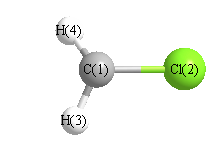 More geometry information
Calculated Bond Angles
| atom1 |
atom2 |
atom3 |
angle |
|
atom1 |
atom2 |
atom3 |
angle |
| Br2 |
C1 |
H3 |
116.195 |
|
Br2 |
C1 |
H4 |
116.195 |
| H3 |
C1 |
H4 |
123.242 |
|
Electronic energy levels
Charges, Dipole, Quadrupole and Polarizability
Charges from optimized geometry at HF/daug-cc-pVDZ
Charges (e)
| Number |
Element |
Mulliken |
CHELPG |
AIM |
ESP |
| 1 |
C |
0.276 |
|
|
|
| 2 |
Cl |
0.178 |
|
|
|
| 3 |
H |
-0.227 |
|
|
|
| 4 |
H |
-0.227 |
|
|
|
Electric dipole moments
Electric dipole components in Debye
(What's a Debye? See section
VII.A.3)
| |
x |
y |
z |
Total |
| |
0.305 |
1.547 |
0.000 |
1.577 |
| CHELPG |
|
|
|
|
| AIM |
|
|
|
|
| ESP |
|
|
|
|
Electric Quadrupole moment
Quadrupole components in D Å
| Primitive |
|---|
| | x | y | z |
|---|
| x |
-20.678 |
0.550 |
0.000 |
| y |
0.550 |
-17.312 |
0.000 |
| z |
0.000 |
0.000 |
-18.739 |
|
| Traceless |
|---|
| | x | y | z |
|---|
| x |
-2.653 |
0.550 |
0.000 |
| y |
0.550 |
2.397 |
0.000 |
| z |
0.000 |
0.000 |
0.257 |
|
| Polar |
|---|
| 3z2-r2 | 0.513 |
|---|
| x2-y2 | -3.367 |
|---|
| xy | 0.550 |
|---|
| xz | 0.000 |
|---|
| yz | 0.000 |
|---|
|
Polarizabilities
Components of the polarizability tensor.
Units are
Å
3 (Angstrom cubed)
Change units.
| |
x |
y |
z |
| x |
3.357 |
0.030 |
0.000 |
| y |
0.030 |
4.976 |
0.000 |
| z |
0.000 |
0.000 |
3.568 |
<r2> (average value of r
2) Å
2
| <r2> |
32.523 |
| (<r2>)1/2 |
5.703 |
Jump to
S1C1
Energy calculated at HF/daug-cc-pVDZ
| | hartrees |
|---|
| Energy at 0K | -498.491014 |
| Energy at 298.15K | |
| HF Energy | -498.491014 |
| Nuclear repulsion energy | 44.997383 |
The energy at 298.15K was derived from the energy at 0K
and an integrated heat capacity that used the calculated vibrational frequencies.
Vibrational Frequencies calculated at HF/daug-cc-pVDZ
| Mode Number |
Symmetry |
Frequency
(cm-1) |
Scaled Frequency
(cm-1) |
IR Intensities
(km mol-1) |
Raman Act
(Å4/u) |
Dep P |
Dep U |
|---|
| 1 |
A1 |
3314 |
3022 |
8.76 |
111.72 |
0.08 |
0.14 |
| 2 |
A1 |
1501 |
1369 |
20.05 |
|
|
|
| 3 |
A1 |
857 |
782 |
40.76 |
|
|
|
| 4 |
B1 |
338i |
309i |
61.27 |
|
|
|
| 5 |
B2 |
3481 |
3175 |
0.16 |
|
|
|
| 6 |
B2 |
1046 |
954 |
0.05 |
|
|
|
Unscaled Zero Point Vibrational Energy (zpe) 4930.6 cm
-1
Scaled (by 0.912) Zero Point Vibrational Energy (zpe) 4496.7 cm
-1
See section
III.C.1 List or set vibrational scaling factors
to change the scale factors used here.
See section
III.C.2
Calculate a vibrational scaling factor for a given set of molecules
to determine the least squares best scaling factor.
Geometric Data calculated at HF/daug-cc-pVDZ
Point Group is C2v
Cartesians (Å)
| Atom |
x (Å) |
y (Å) |
z (Å) |
|---|
| C1 |
0.000 |
0.000 |
-1.131 |
| Cl2 |
0.000 |
0.000 |
0.590 |
| H3 |
0.000 |
0.954 |
-1.626 |
| H4 |
0.000 |
-0.954 |
-1.626 |
Atom - Atom Distances (Å)
| |
C1 |
Cl2 |
H3 |
H4 |
| C1 | | 1.7213 | 1.0751 | 1.0751 |
Cl2 | 1.7213 | | 2.4131 | 2.4131 | H3 | 1.0751 | 2.4131 | | 1.9087 | H4 | 1.0751 | 2.4131 | 1.9087 | |
More geometry information
Calculated Bond Angles
| atom1 |
atom2 |
atom3 |
angle |
|
atom1 |
atom2 |
atom3 |
angle |
| Br2 |
C1 |
H3 |
117.418 |
|
Br2 |
C1 |
H4 |
117.418 |
| H3 |
C1 |
H4 |
125.165 |
|
Electronic energy levels
Charges, Dipole, Quadrupole and Polarizability
Charges from optimized geometry at HF/daug-cc-pVDZ
Charges (e)
| Number |
Element |
Mulliken |
CHELPG |
AIM |
ESP |
| 1 |
C |
0.413 |
|
|
|
| 2 |
Cl |
0.195 |
|
|
|
| 3 |
H |
-0.304 |
|
|
|
| 4 |
H |
-0.304 |
|
|
|
Electric dipole moments
Electric dipole components in Debye
(What's a Debye? See section
VII.A.3)
| |
x |
y |
z |
Total |
| |
0.000 |
0.000 |
-1.549 |
1.549 |
| CHELPG |
|
|
|
|
| AIM |
|
|
|
|
| ESP |
|
|
|
|
Electric Quadrupole moment
Quadrupole components in D Å
| Primitive |
|---|
| | x | y | z |
|---|
| x |
-20.771 |
0.000 |
0.000 |
| y |
0.000 |
-18.670 |
0.000 |
| z |
0.000 |
0.000 |
-17.218 |
|
| Traceless |
|---|
| | x | y | z |
|---|
| x |
-2.827 |
0.000 |
0.000 |
| y |
0.000 |
0.324 |
0.000 |
| z |
0.000 |
0.000 |
2.503 |
|
| Polar |
|---|
| 3z2-r2 | 5.005 |
|---|
| x2-y2 | -2.101 |
|---|
| xy | 0.000 |
|---|
| xz | 0.000 |
|---|
| yz | 0.000 |
|---|
|
Polarizabilities
Components of the polarizability tensor.
Units are
Å
3 (Angstrom cubed)
Change units.
| |
x |
y |
z |
| x |
3.362 |
0.000 |
0.000 |
| y |
0.000 |
3.563 |
0.000 |
| z |
0.000 |
0.000 |
4.951 |
<r2> (average value of r
2) Å
2
| <r2> |
32.504 |
| (<r2>)1/2 |
5.701 |
