Jump to
S1C2
Energy calculated at MP2/Def2TZVPP
| | hartrees |
|---|
| Energy at 0K | -148.522437 |
| Energy at 298.15K | -148.524729 |
| HF Energy | -147.970853 |
| Nuclear repulsion energy | 59.016311 |
The energy at 298.15K was derived from the energy at 0K
and an integrated heat capacity that used the calculated vibrational frequencies.
Vibrational Frequencies calculated at MP2/Def2TZVPP
| Mode Number |
Symmetry |
Frequency
(cm-1) |
Scaled Frequency
(cm-1) |
IR Intensities
(km mol-1) |
Raman Act
(Å4/u) |
Dep P |
Dep U |
|---|
| 1 |
A' |
3584 |
3410 |
48.98 |
|
|
|
| 2 |
A' |
2257 |
2148 |
62.48 |
|
|
|
| 3 |
A' |
1638 |
1558 |
38.19 |
|
|
|
| 4 |
A' |
1073 |
1021 |
8.93 |
|
|
|
| 5 |
A' |
659 |
627 |
207.72 |
|
|
|
| 6 |
A' |
474 |
451 |
20.37 |
|
|
|
| 7 |
A" |
3687 |
3508 |
69.48 |
|
|
|
| 8 |
A" |
1210 |
1152 |
0.01 |
|
|
|
| 9 |
A" |
404 |
385 |
0.41 |
|
|
|
Unscaled Zero Point Vibrational Energy (zpe) 7493.2 cm
-1
Scaled (by 0.9515) Zero Point Vibrational Energy (zpe) 7129.8 cm
-1
See section
III.C.1 List or set vibrational scaling factors
to change the scale factors used here.
See section
III.C.2
Calculate a vibrational scaling factor for a given set of molecules
to determine the least squares best scaling factor.
Geometric Data calculated at MP2/Def2TZVPP
Point Group is Cs
Cartesians (Å)
| Atom |
x (Å) |
y (Å) |
z (Å) |
|---|
| C1 |
0.000 |
0.219 |
0.000 |
| N2 |
-0.016 |
1.384 |
0.000 |
| N3 |
0.089 |
-1.125 |
0.000 |
| H4 |
-0.255 |
-1.566 |
0.838 |
| H5 |
-0.255 |
-1.566 |
-0.838 |
Atom - Atom Distances (Å)
| |
C1 |
N2 |
N3 |
H4 |
H5 |
| C1 | | 1.1657 | 1.3464 | 1.9877 | 1.9877 |
N2 | 1.1657 | | 2.5112 | 3.0758 | 3.0758 | N3 | 1.3464 | 2.5112 | | 1.0075 | 1.0075 | H4 | 1.9877 | 3.0758 | 1.0075 | | 1.6756 | H5 | 1.9877 | 3.0758 | 1.0075 | 1.6756 | |
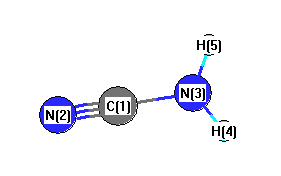 More geometry information
Calculated Bond Angles
| atom1 |
atom2 |
atom3 |
angle |
|
atom1 |
atom2 |
atom3 |
angle |
| C1 |
N3 |
H4 |
114.452 |
|
C1 |
N3 |
H5 |
114.452 |
| N2 |
C1 |
N3 |
177.002 |
|
H4 |
N3 |
H5 |
112.521 |
Electronic energy levels
Charges, Dipole, Quadrupole and Polarizability
Jump to
S1C1
Energy calculated at MP2/Def2TZVPP
| | hartrees |
|---|
| Energy at 0K | -148.520269 |
| Energy at 298.15K | |
| HF Energy | -147.969816 |
| Nuclear repulsion energy | 59.222622 |
The energy at 298.15K was derived from the energy at 0K
and an integrated heat capacity that used the calculated vibrational frequencies.
Vibrational Frequencies calculated at MP2/Def2TZVPP
| Mode Number |
Symmetry |
Frequency
(cm-1) |
Scaled Frequency
(cm-1) |
IR Intensities
(km mol-1) |
Raman Act
(Å4/u) |
Dep P |
Dep U |
|---|
| 1 |
A1 |
3670 |
3492 |
87.06 |
|
|
|
| 2 |
A1 |
2284 |
2173 |
102.40 |
|
|
|
| 3 |
A1 |
1621 |
1542 |
46.76 |
|
|
|
| 4 |
A1 |
1110 |
1056 |
15.81 |
|
|
|
| 5 |
B1 |
502 |
478 |
0.03 |
|
|
|
| 6 |
B1 |
492i |
468i |
256.34 |
|
|
|
| 7 |
B2 |
3802 |
3617 |
114.50 |
|
|
|
| 8 |
B2 |
1134 |
1079 |
2.10 |
|
|
|
| 9 |
B2 |
404 |
384 |
0.00 |
|
|
|
Unscaled Zero Point Vibrational Energy (zpe) 7016.8 cm
-1
Scaled (by 0.9515) Zero Point Vibrational Energy (zpe) 6676.5 cm
-1
See section
III.C.1 List or set vibrational scaling factors
to change the scale factors used here.
See section
III.C.2
Calculate a vibrational scaling factor for a given set of molecules
to determine the least squares best scaling factor.
Geometric Data calculated at MP2/Def2TZVPP
Point Group is C2v
Cartesians (Å)
| Atom |
x (Å) |
y (Å) |
z (Å) |
|---|
| C1 |
0.000 |
0.000 |
0.219 |
| N2 |
0.000 |
0.000 |
1.387 |
| N3 |
0.000 |
0.000 |
-1.112 |
| H4 |
0.000 |
0.863 |
-1.618 |
| H5 |
0.000 |
-0.863 |
-1.618 |
Atom - Atom Distances (Å)
| |
C1 |
N2 |
N3 |
H4 |
H5 |
| C1 | | 1.1679 | 1.3312 | 2.0293 | 2.0293 |
N2 | 1.1679 | | 2.4991 | 3.1260 | 3.1260 | N3 | 1.3312 | 2.4991 | | 1.0003 | 1.0003 | H4 | 2.0293 | 3.1260 | 1.0003 | | 1.7265 | H5 | 2.0293 | 3.1260 | 1.0003 | 1.7265 | |
More geometry information
Calculated Bond Angles
| atom1 |
atom2 |
atom3 |
angle |
|
atom1 |
atom2 |
atom3 |
angle |
| C1 |
N3 |
H4 |
120.342 |
|
C1 |
N3 |
H5 |
120.342 |
| N2 |
C1 |
N3 |
180.000 |
|
H4 |
N3 |
H5 |
119.315 |
Electronic energy levels
Charges, Dipole, Quadrupole and Polarizability
