Jump to
S1C2
Energy calculated at MP2/Def2TZVPP
| | hartrees |
|---|
| Energy at 0K | -677.919275 |
| Energy at 298.15K | -677.919952 |
| HF Energy | -677.867008 |
| Nuclear repulsion energy | 10.319478 |
The energy at 298.15K was derived from the energy at 0K
and an integrated heat capacity that used the calculated vibrational frequencies.
Vibrational Frequencies calculated at MP2/Def2TZVPP
| Mode Number |
Symmetry |
Frequency
(cm-1) |
Scaled Frequency
(cm-1) |
IR Intensities
(km mol-1) |
Raman Act
(Å4/u) |
Dep P |
Dep U |
|---|
| 1 |
Σg |
1343 |
1278 |
0.00 |
|
|
|
| 2 |
Σu |
1275 |
1213 |
887.79 |
|
|
|
| 3 |
Πu |
133 |
126 |
989.53 |
|
|
|
| 3 |
Πu |
133 |
126 |
989.53 |
|
|
|
Unscaled Zero Point Vibrational Energy (zpe) 1441.6 cm
-1
Scaled (by 0.9515) Zero Point Vibrational Energy (zpe) 1371.7 cm
-1
See section
III.C.1 List or set vibrational scaling factors
to change the scale factors used here.
See section
III.C.2
Calculate a vibrational scaling factor for a given set of molecules
to determine the least squares best scaling factor.
Geometric Data calculated at MP2/Def2TZVPP
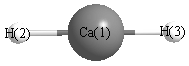
Point Group is D∞h
Cartesians (Å)
| Atom |
x (Å) |
y (Å) |
z (Å) |
|---|
| Ca1 |
0.000 |
0.000 |
0.000 |
| H2 |
0.000 |
0.000 |
1.812 |
| H3 |
0.000 |
0.000 |
-1.812 |
Atom - Atom Distances (Å)
| |
Ca1 |
H2 |
H3 |
| Ca1 | | 1.8123 | 1.8123 |
H2 | 1.8123 | | 3.6245 | H3 | 1.8123 | 3.6245 | |
 More geometry information
Calculated Bond Angles
| atom1 |
atom2 |
atom3 |
angle |
|
atom1 |
atom2 |
atom3 |
angle |
| H2 |
Ca1 |
H3 |
180.000 |
|
Electronic energy levels
Charges, Dipole, Quadrupole and Polarizability
Jump to
S1C1
Energy calculated at MP2/Def2TZVPP
| | hartrees |
|---|
| Energy at 0K | -677.919275 |
| Energy at 298.15K | -677.920177 |
| HF Energy | -677.867008 |
| Nuclear repulsion energy | 10.319360 |
The energy at 298.15K was derived from the energy at 0K
and an integrated heat capacity that used the calculated vibrational frequencies.
Geometric Data calculated at MP2/Def2TZVPP
Point Group is C2v
Cartesians (Å)
| Atom |
x (Å) |
y (Å) |
z (Å) |
|---|
| Ca1 |
0.000 |
0.000 |
0.065 |
| H2 |
0.000 |
1.917 |
-0.647 |
| H3 |
0.000 |
-1.917 |
-0.647 |
Atom - Atom Distances (Å)
| |
Ca1 |
H2 |
H3 |
| Ca1 | | 2.0445 | 2.0445 |
H2 | 2.0445 | | 3.8331 | H3 | 2.0445 | 3.8331 | |
More geometry information
Calculated Bond Angles
| atom1 |
atom2 |
atom3 |
angle |
|
atom1 |
atom2 |
atom3 |
angle |
| H2 |
Ca1 |
H3 |
139.238 |
|
Electronic energy levels
Charges, Dipole, Quadrupole and Polarizability
