Jump to
S1C2
Vibrational Frequencies calculated at QCISD/Def2TZVPP
Geometric Data calculated at QCISD/Def2TZVPP
Electronic energy levels
Charges, Dipole, Quadrupole and Polarizability
Jump to
S1C1
Energy calculated at QCISD/Def2TZVPP
| | hartrees |
|---|
| Energy at 0K | -1071.790935 |
| Energy at 298.15K | |
| HF Energy | -1070.821773 |
| Nuclear repulsion energy | 267.006423 |
The energy at 298.15K was derived from the energy at 0K
and an integrated heat capacity that used the calculated vibrational frequencies.
Vibrational Frequencies calculated at QCISD/Def2TZVPP
| Mode Number |
Symmetry |
Frequency
(cm-1) |
Scaled Frequency
(cm-1) |
IR Intensities
(km mol-1) |
Raman Act
(Å4/u) |
Dep P |
Dep U |
|---|
| 1 |
A |
3145 |
3145 |
4.88 |
|
|
|
| 2 |
A |
3003 |
3003 |
45.82 |
|
|
|
| 3 |
A |
1839 |
1839 |
123.87 |
|
|
|
| 4 |
A |
1418 |
1418 |
12.67 |
|
|
|
| 5 |
A |
1293 |
1293 |
9.71 |
|
|
|
| 6 |
A |
1244 |
1244 |
13.19 |
|
|
|
| 7 |
A |
1053 |
1053 |
13.47 |
|
|
|
| 8 |
A |
958 |
958 |
6.57 |
|
|
|
| 9 |
A |
847 |
847 |
66.44 |
|
|
|
| 10 |
A |
662 |
662 |
31.34 |
|
|
|
| 11 |
A |
629 |
629 |
27.98 |
|
|
|
| 12 |
A |
349 |
349 |
1.16 |
|
|
|
| 13 |
A |
278 |
278 |
3.41 |
|
|
|
| 14 |
A |
222 |
222 |
3.03 |
|
|
|
| 15 |
A |
85 |
85 |
10.57 |
|
|
|
Unscaled Zero Point Vibrational Energy (zpe) 8512.8 cm
-1
Scaled (by 1) Zero Point Vibrational Energy (zpe) 8512.8 cm
-1
See section
III.C.1 List or set vibrational scaling factors
to change the scale factors used here.
See section
III.C.2
Calculate a vibrational scaling factor for a given set of molecules
to determine the least squares best scaling factor.
Geometric Data calculated at QCISD/Def2TZVPP
Point Group is C1
Cartesians (Å)
| Atom |
x (Å) |
y (Å) |
z (Å) |
|---|
| C1 |
0.100 |
-0.023 |
0.520 |
| C2 |
-0.718 |
-1.274 |
0.196 |
| H3 |
0.226 |
0.057 |
1.596 |
| Cl4 |
1.723 |
-0.270 |
-0.169 |
| Cl5 |
-0.660 |
1.449 |
-0.058 |
| O6 |
-1.799 |
-1.265 |
-0.317 |
| H7 |
-0.205 |
-2.203 |
0.491 |
Atom - Atom Distances (Å)
| |
C1 |
C2 |
H3 |
Cl4 |
Cl5 |
O6 |
H7 |
| C1 | | 1.5292 | 1.0861 | 1.7805 | 1.7537 | 2.4189 | 2.2016 |
C2 | 1.5292 | | 2.1492 | 2.6643 | 2.7349 | 1.1971 | 1.1014 | H3 | 1.0861 | 2.1492 | | 2.3368 | 2.3358 | 3.0832 | 2.5514 | Cl4 | 1.7805 | 2.6643 | 2.3368 | | 2.9401 | 3.6635 | 2.8091 | Cl5 | 1.7537 | 2.7349 | 2.3358 | 2.9401 | | 2.9550 | 3.7205 | O6 | 2.4189 | 1.1971 | 3.0832 | 3.6635 | 2.9550 | | 2.0183 | H7 | 2.2016 | 1.1014 | 2.5514 | 2.8091 | 3.7205 | 2.0183 | |
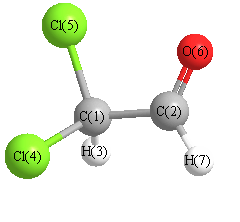 More geometry information
Calculated Bond Angles
| atom1 |
atom2 |
atom3 |
angle |
|
atom1 |
atom2 |
atom3 |
angle |
| C1 |
C2 |
O6 |
124.614 |
|
C1 |
C2 |
H7 |
112.620 |
| C2 |
C1 |
H3 |
109.358 |
|
C2 |
C1 |
Cl4 |
106.975 |
| C2 |
C1 |
Cl5 |
112.654 |
|
H3 |
C1 |
Cl4 |
106.693 |
| H3 |
C1 |
Cl5 |
108.380 |
|
Cl4 |
C1 |
Cl5 |
112.585 |
| O6 |
C2 |
H7 |
122.765 |
|
Electronic energy levels
Charges, Dipole, Quadrupole and Polarizability
