Jump to
S1C2
S2C1
S2C2
Energy calculated at MP2/6-31+G**
| | hartrees |
|---|
| Energy at 0K | -1816.889715 |
| Energy at 298.15K | -1816.891087 |
| Nuclear repulsion energy | 66.767829 |
The energy at 298.15K was derived from the energy at 0K
and an integrated heat capacity that used the calculated vibrational frequencies.
Vibrational Frequencies calculated at MP2/6-31+G**
| Mode Number |
Symmetry |
Frequency
(cm-1) |
Scaled Frequency
(cm-1) |
IR Intensities
(km mol-1) |
Raman Act
(Å4/u) |
Dep P |
Dep U |
|---|
| 1 |
A1 |
3196 |
3006 |
25.61 |
|
|
|
| 2 |
A1 |
1394 |
1312 |
17.83 |
|
|
|
| 3 |
A1 |
548 |
516 |
28.54 |
|
|
|
| 4 |
B1 |
622 |
585 |
82.89 |
|
|
|
| 5 |
B2 |
3312 |
3115 |
4.60 |
|
|
|
| 6 |
B2 |
570 |
536 |
1.72 |
|
|
|
Unscaled Zero Point Vibrational Energy (zpe) 4821.0 cm
-1
Scaled (by 0.9406) Zero Point Vibrational Energy (zpe) 4534.7 cm
-1
See section
III.C.1 List or set vibrational scaling factors
to change the scale factors used here.
See section
III.C.2
Calculate a vibrational scaling factor for a given set of molecules
to determine the least squares best scaling factor.
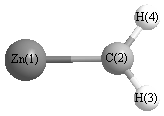
Geometric Data calculated at MP2/6-31+G**
Point Group is C2v
Cartesians (Å)
| Atom |
x (Å) |
y (Å) |
z (Å) |
|---|
| Zn1 |
0.000 |
0.000 |
0.441 |
| C2 |
0.000 |
0.000 |
-1.508 |
| H3 |
0.000 |
0.911 |
-2.098 |
| H4 |
0.000 |
-0.911 |
-2.098 |
Atom - Atom Distances (Å)
| |
Zn1 |
C2 |
H3 |
H4 |
| Zn1 | | 1.9496 | 2.6979 | 2.6979 |
C2 | 1.9496 | | 1.0852 | 1.0852 | H3 | 2.6979 | 1.0852 | | 1.8217 | H4 | 2.6979 | 1.0852 | 1.8217 | |
 More geometry information
Calculated Bond Angles
| atom1 |
atom2 |
atom3 |
angle |
|
atom1 |
atom2 |
atom3 |
angle |
| Zn1 |
C2 |
H3 |
122.928 |
|
Zn1 |
C2 |
H4 |
122.928 |
| H3 |
C2 |
H4 |
114.144 |
|
Electronic energy levels
Charges, Dipole, Quadrupole and Polarizability
Jump to
S1C1
S2C1
S2C2
Energy calculated at MP2/6-31+G**
| | hartrees |
|---|
| Energy at 0K | -1816.889715 |
| Energy at 298.15K | -1816.891087 |
| Nuclear repulsion energy | 66.767829 |
The energy at 298.15K was derived from the energy at 0K
and an integrated heat capacity that used the calculated vibrational frequencies.
Vibrational Frequencies calculated at MP2/6-31+G**
Geometric Data calculated at MP2/6-31+G**
Point Group is C2v
Electronic energy levels
Charges, Dipole, Quadrupole and Polarizability
Jump to
S1C1
S1C2
S2C2
Energy calculated at MP2/6-31+G**
| | hartrees |
|---|
| Energy at 0K | -1816.854577 |
| Energy at 298.15K | -1816.856252 |
| Nuclear repulsion energy | 71.213689 |
The energy at 298.15K was derived from the energy at 0K
and an integrated heat capacity that used the calculated vibrational frequencies.
Vibrational Frequencies calculated at MP2/6-31+G**
| Mode Number |
Symmetry |
Frequency
(cm-1) |
Scaled Frequency
(cm-1) |
IR Intensities
(km mol-1) |
Raman Act
(Å4/u) |
Dep P |
Dep U |
|---|
| 1 |
A1 |
3241 |
3048 |
10.44 |
|
|
|
| 2 |
A1 |
1240 |
1166 |
52.35 |
|
|
|
| 3 |
A1 |
685 |
644 |
10.81 |
|
|
|
| 4 |
B1 |
12154 |
11432 |
0.00 |
|
|
|
| 5 |
B2 |
3432 |
3228 |
22.16 |
|
|
|
| 6 |
B2 |
663 |
624 |
56.28 |
|
|
|
Unscaled Zero Point Vibrational Energy (zpe) 10706.9 cm
-1
Scaled (by 0.9406) Zero Point Vibrational Energy (zpe) 10070.9 cm
-1
See section
III.C.1 List or set vibrational scaling factors
to change the scale factors used here.
See section
III.C.2
Calculate a vibrational scaling factor for a given set of molecules
to determine the least squares best scaling factor.
Geometric Data calculated at MP2/6-31+G**
Point Group is C2v
Cartesians (Å)
| Atom |
x (Å) |
y (Å) |
z (Å) |
|---|
| Zn1 |
0.000 |
0.000 |
0.408 |
| C2 |
0.000 |
0.000 |
-1.416 |
| H3 |
0.000 |
0.978 |
-1.869 |
| H4 |
0.000 |
-0.978 |
-1.869 |
Atom - Atom Distances (Å)
| |
Zn1 |
C2 |
H3 |
H4 |
| Zn1 | | 1.8235 | 2.4778 | 2.4778 |
C2 | 1.8235 | | 1.0778 | 1.0778 | H3 | 2.4778 | 1.0778 | | 1.9557 | H4 | 2.4778 | 1.0778 | 1.9557 | |
More geometry information
Electronic energy levels
Charges, Dipole, Quadrupole and Polarizability
Jump to
S1C1
S1C2
S2C1
Energy calculated at MP2/6-31+G**
| | hartrees |
|---|
| Energy at 0K | -1816.876044 |
| Energy at 298.15K | -1816.877569 |
| Nuclear repulsion energy | 69.559217 |
The energy at 298.15K was derived from the energy at 0K
and an integrated heat capacity that used the calculated vibrational frequencies.
Vibrational Frequencies calculated at MP2/6-31+G**
| Mode Number |
Symmetry |
Frequency
(cm-1) |
Scaled Frequency
(cm-1) |
IR Intensities
(km mol-1) |
Raman Act
(Å4/u) |
Dep P |
Dep U |
|---|
| 1 |
A' |
2995 |
2817 |
39.77 |
|
|
|
| 2 |
A' |
1381 |
1299 |
25.21 |
|
|
|
| 3 |
A' |
777 |
731 |
214.81 |
|
|
|
| 4 |
A' |
553 |
520 |
3.90 |
|
|
|
| 5 |
A" |
3096 |
2912 |
23.37 |
|
|
|
| 6 |
A" |
721 |
679 |
26.70 |
|
|
|
Unscaled Zero Point Vibrational Energy (zpe) 4761.9 cm
-1
Scaled (by 0.9406) Zero Point Vibrational Energy (zpe) 4479.0 cm
-1
See section
III.C.1 List or set vibrational scaling factors
to change the scale factors used here.
See section
III.C.2
Calculate a vibrational scaling factor for a given set of molecules
to determine the least squares best scaling factor.
Geometric Data calculated at MP2/6-31+G**
Point Group is Cs
Cartesians (Å)
| Atom |
x (Å) |
y (Å) |
z (Å) |
|---|
| Zn1 |
-0.032 |
-0.412 |
0.000 |
| C2 |
-0.032 |
1.482 |
0.000 |
| H3 |
0.574 |
1.731 |
0.891 |
| H4 |
0.574 |
1.731 |
-0.891 |
Atom - Atom Distances (Å)
| |
Zn1 |
C2 |
H3 |
H4 |
| Zn1 | | 1.8943 | 2.3988 | 2.3988 |
C2 | 1.8943 | | 1.1057 | 1.1057 | H3 | 2.3988 | 1.1057 | | 1.7817 | H4 | 2.3988 | 1.1057 | 1.7817 | |
More geometry information
Electronic energy levels
Charges, Dipole, Quadrupole and Polarizability
