Jump to
S1C2
S2C1
S2C2
Energy calculated at TPSSh/6-31+G**
| | hartrees |
|---|
| Energy at 0K | -1818.323884 |
| Energy at 298.15K | -1818.325196 |
| HF Energy | -1818.323884 |
| Nuclear repulsion energy | 66.055461 |
The energy at 298.15K was derived from the energy at 0K
and an integrated heat capacity that used the calculated vibrational frequencies.
Vibrational Frequencies calculated at TPSSh/6-31+G**
| Mode Number |
Symmetry |
Frequency
(cm-1) |
Scaled Frequency
(cm-1) |
IR Intensities
(km mol-1) |
Raman Act
(Å4/u) |
Dep P |
Dep U |
|---|
| 1 |
A1 |
3091 |
2975 |
40.04 |
|
|
|
| 2 |
A1 |
1337 |
1287 |
32.23 |
|
|
|
| 3 |
A1 |
504 |
485 |
20.83 |
|
|
|
| 4 |
B1 |
619 |
596 |
76.71 |
|
|
|
| 5 |
B2 |
3205 |
3084 |
7.74 |
|
|
|
| 6 |
B2 |
534 |
514 |
1.86 |
|
|
|
Unscaled Zero Point Vibrational Energy (zpe) 4644.8 cm
-1
Scaled (by 0.9625) Zero Point Vibrational Energy (zpe) 4470.6 cm
-1
See section
III.C.1 List or set vibrational scaling factors
to change the scale factors used here.
See section
III.C.2
Calculate a vibrational scaling factor for a given set of molecules
to determine the least squares best scaling factor.
Geometric Data calculated at TPSSh/6-31+G**
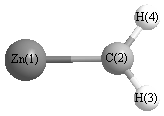
Point Group is C2v
Cartesians (Å)
| Atom |
x (Å) |
y (Å) |
z (Å) |
|---|
| Zn1 |
0.000 |
0.000 |
0.447 |
| C2 |
0.000 |
0.000 |
-1.527 |
| H3 |
0.000 |
0.919 |
-2.119 |
| H4 |
0.000 |
-0.919 |
-2.119 |
Atom - Atom Distances (Å)
| |
Zn1 |
C2 |
H3 |
H4 |
| Zn1 | | 1.9740 | 2.7254 | 2.7254 |
C2 | 1.9740 | | 1.0927 | 1.0927 | H3 | 2.7254 | 1.0927 | | 1.8370 | H4 | 2.7254 | 1.0927 | 1.8370 | |
 More geometry information
Calculated Bond Angles
| atom1 |
atom2 |
atom3 |
angle |
|
atom1 |
atom2 |
atom3 |
angle |
| Zn1 |
C2 |
H3 |
122.801 |
|
Zn1 |
C2 |
H4 |
122.801 |
| H3 |
C2 |
H4 |
114.399 |
|
Electronic energy levels
Charges, Dipole, Quadrupole and Polarizability
Charges from optimized geometry at TPSSh/6-31+G**
Charges (e)
| Number |
Element |
Mulliken |
CHELPG |
AIM |
ESP |
| 1 |
Zn |
0.099 |
|
|
|
| 2 |
C |
-0.405 |
|
|
|
| 3 |
H |
0.153 |
|
|
|
| 4 |
H |
0.153 |
|
|
|
Electric dipole moments
Electric dipole components in Debye
(What's a Debye? See section
VII.A.3)
| |
x |
y |
z |
Total |
| |
0.000 |
0.000 |
-0.206 |
0.206 |
| CHELPG |
|
|
|
|
| AIM |
|
|
|
|
| ESP |
|
|
|
|
Electric Quadrupole moment
Quadrupole components in D Å
Polarizabilities
Components of the polarizability tensor.
Units are
Å
3 (Angstrom cubed)
Change units.
| |
x |
y |
z |
| x |
6.456 |
0.000 |
0.000 |
| y |
0.000 |
6.915 |
0.000 |
| z |
0.000 |
0.000 |
9.373 |
<r2> (average value of r
2) Å
2
| <r2> |
44.535 |
| (<r2>)1/2 |
6.673 |
Jump to
S1C1
S2C1
S2C2
Energy calculated at TPSSh/6-31+G**
| | hartrees |
|---|
| Energy at 0K | -1818.323884 |
| Energy at 298.15K | -1818.325196 |
| HF Energy | -1818.323884 |
| Nuclear repulsion energy | 66.055461 |
The energy at 298.15K was derived from the energy at 0K
and an integrated heat capacity that used the calculated vibrational frequencies.
Vibrational Frequencies calculated at TPSSh/6-31+G**
Geometric Data calculated at TPSSh/6-31+G**
Point Group is C2v
Electronic energy levels
Charges, Dipole, Quadrupole and Polarizability
Jump to
S1C1
S1C2
S2C2
Energy calculated at TPSSh/6-31+G**
| | hartrees |
|---|
| Energy at 0K | -1818.281892 |
| Energy at 298.15K | |
| HF Energy | -1818.281892 |
| Nuclear repulsion energy | 71.116051 |
The energy at 298.15K was derived from the energy at 0K
and an integrated heat capacity that used the calculated vibrational frequencies.
Vibrational Frequencies calculated at TPSSh/6-31+G**
| Mode Number |
Symmetry |
Frequency
(cm-1) |
Scaled Frequency
(cm-1) |
IR Intensities
(km mol-1) |
Raman Act
(Å4/u) |
Dep P |
Dep U |
|---|
| 1 |
A1 |
3173 |
3054 |
1.36 |
|
|
|
| 2 |
A1 |
1162 |
1119 |
110.00 |
|
|
|
| 3 |
A1 |
660 |
635 |
4.28 |
|
|
|
| 4 |
B1 |
2693i |
2592i |
27929.33 |
|
|
|
| 5 |
B2 |
3367 |
3241 |
18.31 |
|
|
|
| 6 |
B2 |
667 |
642 |
57.84 |
|
|
|
Unscaled Zero Point Vibrational Energy (zpe) 3167.8 cm
-1
Scaled (by 0.9625) Zero Point Vibrational Energy (zpe) 3049.0 cm
-1
See section
III.C.1 List or set vibrational scaling factors
to change the scale factors used here.
See section
III.C.2
Calculate a vibrational scaling factor for a given set of molecules
to determine the least squares best scaling factor.
Geometric Data calculated at TPSSh/6-31+G**
Point Group is C2v
Cartesians (Å)
| Atom |
x (Å) |
y (Å) |
z (Å) |
|---|
| Zn1 |
0.000 |
0.000 |
0.418 |
| C2 |
0.000 |
0.000 |
-1.433 |
| H3 |
0.000 |
0.946 |
-1.967 |
| H4 |
0.000 |
-0.946 |
-1.967 |
Atom - Atom Distances (Å)
| |
Zn1 |
C2 |
H3 |
H4 |
| Zn1 | | 1.8512 | 2.5654 | 2.5654 |
C2 | 1.8512 | | 1.0858 | 1.0858 | H3 | 2.5654 | 1.0858 | | 1.8915 | H4 | 2.5654 | 1.0858 | 1.8915 | |
More geometry information
Electronic energy levels
Charges, Dipole, Quadrupole and Polarizability
Charges from optimized geometry at TPSSh/6-31+G**
Charges (e)
| Number |
Element |
Mulliken |
CHELPG |
AIM |
ESP |
| 1 |
Zn |
0.242 |
|
|
|
| 2 |
C |
-0.587 |
|
|
|
| 3 |
H |
0.172 |
|
|
|
| 4 |
H |
0.172 |
|
|
|
Electric dipole moments
Electric dipole components in Debye
(What's a Debye? See section
VII.A.3)
| |
x |
y |
z |
Total |
| |
0.000 |
0.000 |
3.791 |
3.791 |
| CHELPG |
|
|
|
|
| AIM |
|
|
|
|
| ESP |
|
|
|
|
Electric Quadrupole moment
Quadrupole components in D Å
Polarizabilities
Components of the polarizability tensor.
Units are
Å
3 (Angstrom cubed)
Change units.
| |
x |
y |
z |
| x |
25.593 |
0.000 |
0.000 |
| y |
0.000 |
4.746 |
0.000 |
| z |
0.000 |
0.000 |
10.656 |
<r2> (average value of r
2) Å
2
| <r2> |
39.918 |
| (<r2>)1/2 |
6.318 |
Jump to
S1C1
S1C2
S2C1
Energy calculated at TPSSh/6-31+G**
| | hartrees |
|---|
| Energy at 0K | -1818.309312 |
| Energy at 298.15K | -1818.310775 |
| HF Energy | -1818.309312 |
| Nuclear repulsion energy | 68.244855 |
The energy at 298.15K was derived from the energy at 0K
and an integrated heat capacity that used the calculated vibrational frequencies.
Vibrational Frequencies calculated at TPSSh/6-31+G**
| Mode Number |
Symmetry |
Frequency
(cm-1) |
Scaled Frequency
(cm-1) |
IR Intensities
(km mol-1) |
Raman Act
(Å4/u) |
Dep P |
Dep U |
|---|
| 1 |
A' |
2928 |
2818 |
37.36 |
|
|
|
| 2 |
A' |
1380 |
1328 |
7.10 |
|
|
|
| 3 |
A' |
757 |
728 |
301.38 |
|
|
|
| 4 |
A' |
492 |
473 |
12.30 |
|
|
|
| 5 |
A" |
3002 |
2890 |
26.99 |
|
|
|
| 6 |
A" |
698 |
672 |
32.68 |
|
|
|
Unscaled Zero Point Vibrational Energy (zpe) 4628.2 cm
-1
Scaled (by 0.9625) Zero Point Vibrational Energy (zpe) 4454.7 cm
-1
See section
III.C.1 List or set vibrational scaling factors
to change the scale factors used here.
See section
III.C.2
Calculate a vibrational scaling factor for a given set of molecules
to determine the least squares best scaling factor.
Geometric Data calculated at TPSSh/6-31+G**
Point Group is Cs
Cartesians (Å)
| Atom |
x (Å) |
y (Å) |
z (Å) |
|---|
| Zn1 |
-0.034 |
-0.424 |
0.000 |
| C2 |
-0.034 |
1.532 |
0.000 |
| H3 |
0.606 |
1.770 |
0.880 |
| H4 |
0.606 |
1.770 |
-0.880 |
Atom - Atom Distances (Å)
| |
Zn1 |
C2 |
H3 |
H4 |
| Zn1 | | 1.9568 | 2.4493 | 2.4493 |
C2 | 1.9568 | | 1.1138 | 1.1138 | H3 | 2.4493 | 1.1138 | | 1.7606 | H4 | 2.4493 | 1.1138 | 1.7606 | |
More geometry information
Electronic energy levels
Charges, Dipole, Quadrupole and Polarizability
Charges from optimized geometry at TPSSh/6-31+G**
Charges (e)
| Number |
Element |
Mulliken |
CHELPG |
AIM |
ESP |
| 1 |
Zn |
0.150 |
|
|
|
| 2 |
C |
-0.441 |
|
|
|
| 3 |
H |
0.146 |
|
|
|
| 4 |
H |
0.146 |
|
|
|
Electric dipole moments
Electric dipole components in Debye
(What's a Debye? See section
VII.A.3)
| |
x |
y |
z |
Total |
| |
0.272 |
-2.484 |
0.000 |
2.499 |
| CHELPG |
|
|
|
|
| AIM |
|
|
|
|
| ESP |
|
|
|
|
Electric Quadrupole moment
Quadrupole components in D Å
Polarizabilities
Components of the polarizability tensor.
Units are
Å
3 (Angstrom cubed)
Change units.
| |
x |
y |
z |
| x |
6.711 |
-0.807 |
0.000 |
| y |
-0.807 |
14.017 |
0.000 |
| z |
0.000 |
0.000 |
6.093 |
<r2> (average value of r
2) Å
2
| <r2> |
41.700 |
| (<r2>)1/2 |
6.458 |
