Jump to
S2C1
Energy calculated at BLYP/6-31+G**
| | hartrees |
|---|
| Energy at 0K | -151.246381 |
| Energy at 298.15K | -151.244539 |
| HF Energy | -151.246381 |
| Nuclear repulsion energy | 45.115140 |
The energy at 298.15K was derived from the energy at 0K
and an integrated heat capacity that used the calculated vibrational frequencies.
Geometric Data calculated at BLYP/6-31+G**
Point Group is C∞v
Cartesians (Å)
| Atom |
x (Å) |
y (Å) |
z (Å) |
|---|
| C1 |
0.000 |
0.000 |
-1.439 |
| C2 |
0.000 |
0.000 |
-0.062 |
| O3 |
0.000 |
0.000 |
1.126 |
Atom - Atom Distances (Å)
| |
C1 |
C2 |
O3 |
| C1 | | 1.3767 | 2.5650 |
C2 | 1.3767 | | 1.1883 | O3 | 2.5650 | 1.1883 | |
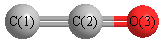 More geometry information
Calculated Bond Angles
| atom1 |
atom2 |
atom3 |
angle |
|
atom1 |
atom2 |
atom3 |
angle |
| C1 |
C2 |
O3 |
180.000 |
|
Electronic energy levels
Charges, Dipole, Quadrupole and Polarizability
Charges from optimized geometry at BLYP/6-31+G**
Charges (e)
| Number |
Element |
Mulliken |
CHELPG |
AIM |
ESP |
| 1 |
C |
-0.252 |
|
|
|
| 2 |
C |
0.542 |
|
|
|
| 3 |
O |
-0.290 |
|
|
|
Electric dipole moments
Electric dipole components in Debye
(What's a Debye? See section
VII.A.3)
| |
x |
y |
z |
Total |
| |
0.000 |
0.000 |
1.240 |
1.240 |
| CHELPG |
|
|
|
|
| AIM |
|
|
|
|
| ESP |
|
|
|
|
Electric Quadrupole moment
Quadrupole components in D Å
| Primitive |
|---|
| | x | y | z |
|---|
| x |
-16.152 |
0.000 |
0.000 |
| y |
0.000 |
-16.152 |
0.000 |
| z |
0.000 |
0.000 |
-22.702 |
|
| Traceless |
|---|
| | x | y | z |
|---|
| x |
3.275 |
0.000 |
0.000 |
| y |
0.000 |
3.275 |
0.000 |
| z |
0.000 |
0.000 |
-6.550 |
|
| Polar |
|---|
| 3z2-r2 | -13.100 |
|---|
| x2-y2 | 0.000 |
|---|
| xy | 0.000 |
|---|
| xz | 0.000 |
|---|
| yz | 0.000 |
|---|
|
Polarizabilities
Components of the polarizability tensor.
Units are
Å
3 (Angstrom cubed)
Change units.
| |
x |
y |
z |
| x |
2.680 |
0.000 |
0.000 |
| y |
0.000 |
2.680 |
0.000 |
| z |
0.000 |
0.000 |
6.170 |
<r2> (average value of r
2) Å
2
| <r2> |
34.043 |
| (<r2>)1/2 |
5.835 |
Jump to
S1C1
Energy calculated at BLYP/6-31+G**
| | hartrees |
|---|
| Energy at 0K | -151.208622 |
| Energy at 298.15K | -151.206822 |
| HF Energy | -151.208622 |
| Nuclear repulsion energy | 44.994899 |
The energy at 298.15K was derived from the energy at 0K
and an integrated heat capacity that used the calculated vibrational frequencies.
Geometric Data calculated at BLYP/6-31+G**
Point Group is C∞v
Cartesians (Å)
| Atom |
x (Å) |
y (Å) |
z (Å) |
|---|
| C1 |
0.000 |
0.000 |
-1.441 |
| C2 |
0.000 |
0.000 |
-0.065 |
| O3 |
0.000 |
0.000 |
1.129 |
Atom - Atom Distances (Å)
| |
C1 |
C2 |
O3 |
| C1 | | 1.3765 | 2.5705 |
C2 | 1.3765 | | 1.1940 | O3 | 2.5705 | 1.1940 | |
More geometry information
Calculated Bond Angles
| atom1 |
atom2 |
atom3 |
angle |
|
atom1 |
atom2 |
atom3 |
angle |
| C1 |
C2 |
O3 |
180.000 |
|
Electronic energy levels
Charges, Dipole, Quadrupole and Polarizability
Charges from optimized geometry at BLYP/6-31+G**
Charges (e)
| Number |
Element |
Mulliken |
CHELPG |
AIM |
ESP |
| 1 |
C |
-0.219 |
|
|
|
| 2 |
C |
0.509 |
|
|
|
| 3 |
O |
-0.289 |
|
|
|
Electric dipole moments
Electric dipole components in Debye
(What's a Debye? See section
VII.A.3)
| |
x |
y |
z |
Total |
| |
0.000 |
0.000 |
1.071 |
1.071 |
| CHELPG |
|
|
|
|
| AIM |
|
|
|
|
| ESP |
|
|
|
|
Electric Quadrupole moment
Quadrupole components in D Å
| Primitive |
|---|
| | x | y | z |
|---|
| x |
-18.093 |
0.000 |
0.000 |
| y |
0.000 |
-14.514 |
0.000 |
| z |
0.000 |
0.000 |
-22.521 |
|
| Traceless |
|---|
| | x | y | z |
|---|
| x |
0.424 |
0.000 |
0.000 |
| y |
0.000 |
5.793 |
0.000 |
| z |
0.000 |
0.000 |
-6.218 |
|
| Polar |
|---|
| 3z2-r2 | -12.435 |
|---|
| x2-y2 | -3.580 |
|---|
| xy | 0.000 |
|---|
| xz | 0.000 |
|---|
| yz | 0.000 |
|---|
|
Polarizabilities
Components of the polarizability tensor.
Units are
Å
3 (Angstrom cubed)
Change units.
| |
x |
y |
z |
| x |
2.680 |
0.000 |
0.000 |
| y |
0.000 |
2.680 |
0.000 |
| z |
0.000 |
0.000 |
6.170 |
<r2> (average value of r
2) Å
2
| <r2> |
34.167 |
| (<r2>)1/2 |
5.845 |
