Jump to
S1C2
Energy calculated at B2PLYP=FULLultrafine/6-31+G**
| | hartrees |
|---|
| Energy at 0K | -166.389090 |
| Energy at 298.15K | |
| HF Energy | -166.248109 |
| Nuclear repulsion energy | 48.865135 |
The energy at 298.15K was derived from the energy at 0K
and an integrated heat capacity that used the calculated vibrational frequencies.
Vibrational Frequencies calculated at B2PLYP=FULLultrafine/6-31+G**
| Mode Number |
Symmetry |
Frequency
(cm-1) |
Scaled Frequency
(cm-1) |
IR Intensities
(km mol-1) |
Raman Act
(Å4/u) |
Dep P |
Dep U |
|---|
| 1 |
A1 |
4057 |
4057 |
56.84 |
|
|
|
| 2 |
A1 |
742 |
742 |
3.58 |
|
|
|
| 3 |
A1 |
502 |
502 |
276.72 |
|
|
|
| 4 |
A1 |
293 |
293 |
1.43 |
|
|
|
| 5 |
A2 |
197i |
197i |
0.00 |
|
|
|
| 6 |
B1 |
391 |
391 |
81.47 |
|
|
|
| 7 |
B2 |
4055 |
4055 |
220.45 |
|
|
|
| 8 |
B2 |
1536 |
1536 |
466.22 |
|
|
|
| 9 |
B2 |
342 |
342 |
266.78 |
|
|
|
Unscaled Zero Point Vibrational Energy (zpe) 5859.7 cm
-1
Scaled (by 1) Zero Point Vibrational Energy (zpe) 5859.7 cm
-1
See section
III.C.1 List or set vibrational scaling factors
to change the scale factors used here.
See section
III.C.2
Calculate a vibrational scaling factor for a given set of molecules
to determine the least squares best scaling factor.
Geometric Data calculated at B2PLYP=FULLultrafine/6-31+G**
Point Group is C2v
Cartesians (Å)
| Atom |
x (Å) |
y (Å) |
z (Å) |
|---|
| Be1 |
0.000 |
0.000 |
-0.002 |
| O2 |
0.000 |
1.425 |
0.069 |
| O3 |
0.000 |
-1.425 |
0.069 |
| H4 |
0.000 |
2.155 |
-0.544 |
| H5 |
0.000 |
-2.155 |
-0.544 |
Atom - Atom Distances (Å)
| |
Be1 |
O2 |
O3 |
H4 |
H5 |
| Be1 | | 1.4268 | 1.4268 | 2.2219 | 2.2219 |
O2 | 1.4268 | | 2.8500 | 0.9529 | 3.6318 | O3 | 1.4268 | 2.8500 | | 3.6318 | 0.9529 | H4 | 2.2219 | 0.9529 | 3.6318 | | 4.3094 | H5 | 2.2219 | 3.6318 | 0.9529 | 4.3094 | |
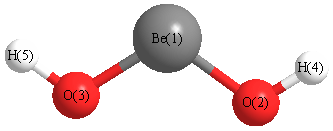 More geometry information
Calculated Bond Angles
| atom1 |
atom2 |
atom3 |
angle |
|
atom1 |
atom2 |
atom3 |
angle |
| Be1 |
O2 |
H4 |
137.142 |
|
Be1 |
O3 |
H5 |
137.142 |
| O2 |
Be1 |
O3 |
174.340 |
|
Electronic energy levels
Charges, Dipole, Quadrupole and Polarizability
Jump to
S1C1
Energy calculated at B2PLYP=FULLultrafine/6-31+G**
| | hartrees |
|---|
| Energy at 0K | -166.389766 |
| Energy at 298.15K | |
| HF Energy | -166.248708 |
| Nuclear repulsion energy | 48.819602 |
The energy at 298.15K was derived from the energy at 0K
and an integrated heat capacity that used the calculated vibrational frequencies.
Vibrational Frequencies calculated at B2PLYP=FULLultrafine/6-31+G**
| Mode Number |
Symmetry |
Frequency
(cm-1) |
Scaled Frequency
(cm-1) |
IR Intensities
(km mol-1) |
Raman Act
(Å4/u) |
Dep P |
Dep U |
|---|
| 1 |
A |
4038 |
4038 |
23.97 |
|
|
|
| 2 |
A |
736 |
736 |
0.86 |
|
|
|
| 3 |
A |
489 |
489 |
147.14 |
|
|
|
| 4 |
A |
332 |
332 |
15.57 |
|
|
|
| 5 |
A |
179 |
179 |
207.52 |
|
|
|
| 6 |
B |
4037 |
4037 |
231.75 |
|
|
|
| 7 |
B |
1531 |
1531 |
455.29 |
|
|
|
| 8 |
B |
498 |
498 |
361.43 |
|
|
|
| 9 |
B |
310 |
310 |
123.31 |
|
|
|
Unscaled Zero Point Vibrational Energy (zpe) 6074.5 cm
-1
Scaled (by 1) Zero Point Vibrational Energy (zpe) 6074.5 cm
-1
See section
III.C.1 List or set vibrational scaling factors
to change the scale factors used here.
See section
III.C.2
Calculate a vibrational scaling factor for a given set of molecules
to determine the least squares best scaling factor.
Geometric Data calculated at B2PLYP=FULLultrafine/6-31+G**
Point Group is C2
Cartesians (Å)
| Atom |
x (Å) |
y (Å) |
z (Å) |
|---|
| Be1 |
0.000 |
0.000 |
-0.005 |
| O2 |
0.000 |
1.429 |
-0.044 |
| O3 |
0.000 |
-1.429 |
-0.044 |
| H4 |
0.539 |
2.104 |
0.361 |
| H5 |
-0.539 |
-2.104 |
0.361 |
Atom - Atom Distances (Å)
| |
Be1 |
O2 |
O3 |
H4 |
H5 |
| Be1 | | 1.4293 | 1.4293 | 2.2023 | 2.2023 |
O2 | 1.4293 | | 2.8575 | 0.9541 | 3.5963 | O3 | 1.4293 | 2.8575 | | 3.5963 | 0.9541 | H4 | 2.2023 | 0.9541 | 3.5963 | | 4.3436 | H5 | 2.2023 | 3.5963 | 0.9541 | 4.3436 | |
More geometry information
Calculated Bond Angles
| atom1 |
atom2 |
atom3 |
angle |
|
atom1 |
atom2 |
atom3 |
angle |
| Be1 |
O2 |
H4 |
134.071 |
|
Be1 |
O3 |
H5 |
134.071 |
| O2 |
Be1 |
O3 |
176.861 |
|
Electronic energy levels
Charges, Dipole, Quadrupole and Polarizability
