Jump to
S1C2
S1C3
Energy calculated at B2PLYP=FULL/6-31+G**
| | hartrees |
|---|
| Energy at 0K | -1592.091468 |
| Energy at 298.15K | |
| HF Energy | -1591.912602 |
| Nuclear repulsion energy | 345.985841 |
The energy at 298.15K was derived from the energy at 0K
and an integrated heat capacity that used the calculated vibrational frequencies.
Vibrational Frequencies calculated at B2PLYP=FULL/6-31+G**
| Mode Number |
Symmetry |
Frequency
(cm-1) |
Scaled Frequency
(cm-1) |
IR Intensities
(km mol-1) |
Raman Act
(Å4/u) |
Dep P |
Dep U |
|---|
| 1 |
A1 |
493 |
469 |
0.00 |
51.15 |
0.07 |
0.13 |
| 2 |
A1 |
200 |
190 |
0.00 |
0.91 |
0.61 |
0.76 |
| 3 |
B1 |
429 |
408 |
0.00 |
37.45 |
0.75 |
0.86 |
| 4 |
B2 |
315 |
299 |
0.08 |
8.20 |
0.75 |
0.86 |
| 5 |
E |
407 |
387 |
0.07 |
5.99 |
0.75 |
0.86 |
| 5 |
E |
407 |
387 |
0.07 |
5.99 |
0.75 |
0.86 |
Unscaled Zero Point Vibrational Energy (zpe) 1125.2 cm
-1
Scaled (by 0.951) Zero Point Vibrational Energy (zpe) 1070.1 cm
-1
See section
III.C.1 List or set vibrational scaling factors
to change the scale factors used here.
See section
III.C.2
Calculate a vibrational scaling factor for a given set of molecules
to determine the least squares best scaling factor.
Geometric Data calculated at B2PLYP=FULL/6-31+G**
Point Group is D2d
Cartesians (Å)
| Atom |
x (Å) |
y (Å) |
z (Å) |
|---|
| S1 |
0.000 |
1.450 |
0.317 |
| S2 |
0.000 |
-1.450 |
0.317 |
| S3 |
-1.450 |
0.000 |
-0.317 |
| S4 |
1.450 |
0.000 |
-0.317 |
Atom - Atom Distances (Å)
| |
S1 |
S2 |
S3 |
S4 |
| S1 | | 2.8994 | 2.1457 | 2.1457 |
S2 | 2.8994 | | 2.1457 | 2.1457 | S3 | 2.1457 | 2.1457 | | 2.8994 | S4 | 2.1457 | 2.1457 | 2.8994 | |
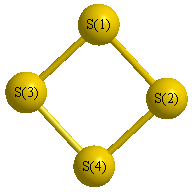 More geometry information
Calculated Bond Angles
| atom1 |
atom2 |
atom3 |
angle |
|
atom1 |
atom2 |
atom3 |
angle |
| S1 |
S2 |
S4 |
47.497 |
|
S1 |
S3 |
S4 |
47.497 |
| S2 |
S1 |
S3 |
47.497 |
|
S2 |
S4 |
S3 |
47.497 |
Electronic energy levels
Charges, Dipole, Quadrupole and Polarizability
Jump to
S1C1
S1C3
Energy calculated at B2PLYP=FULL/6-31+G**
| | hartrees |
|---|
| Energy at 0K | -1592.136711 |
| Energy at 298.15K | |
| HF Energy | -1591.905276 |
| Nuclear repulsion energy | 323.288941 |
The energy at 298.15K was derived from the energy at 0K
and an integrated heat capacity that used the calculated vibrational frequencies.
Vibrational Frequencies calculated at B2PLYP=FULL/6-31+G**
| Mode Number |
Symmetry |
Frequency
(cm-1) |
Scaled Frequency
(cm-1) |
IR Intensities
(km mol-1) |
Raman Act
(Å4/u) |
Dep P |
Dep U |
|---|
| 1 |
A1 |
676 |
643 |
0.00 |
46.06 |
0.13 |
0.22 |
| 2 |
A1 |
217 |
206 |
0.00 |
40.74 |
0.45 |
0.62 |
| 3 |
A1 |
108 |
103 |
7.91 |
0.00 |
0.25 |
0.39 |
| 4 |
A2 |
210 |
200 |
0.00 |
0.00 |
0.75 |
0.86 |
| 5 |
B2 |
664 |
632 |
42.70 |
0.00 |
0.75 |
0.86 |
| 6 |
B2 |
293 |
278 |
0.00 |
14.31 |
0.75 |
0.86 |
Unscaled Zero Point Vibrational Energy (zpe) 1083.5 cm
-1
Scaled (by 0.951) Zero Point Vibrational Energy (zpe) 1030.4 cm
-1
See section
III.C.1 List or set vibrational scaling factors
to change the scale factors used here.
See section
III.C.2
Calculate a vibrational scaling factor for a given set of molecules
to determine the least squares best scaling factor.
Geometric Data calculated at B2PLYP=FULL/6-31+G**
Point Group is C2v
Cartesians (Å)
| Atom |
x (Å) |
y (Å) |
z (Å) |
|---|
| S1 |
0.000 |
1.343 |
0.964 |
| S2 |
0.000 |
-1.343 |
0.964 |
| S3 |
0.000 |
1.343 |
-0.964 |
| S4 |
0.000 |
-1.343 |
-0.964 |
Atom - Atom Distances (Å)
| |
S1 |
S2 |
S3 |
S4 |
| S1 | | 2.6865 | 1.9283 | 3.3069 |
S2 | 2.6865 | | 3.3069 | 1.9283 | S3 | 1.9283 | 3.3069 | | 2.6865 | S4 | 3.3069 | 1.9283 | 2.6865 | |
More geometry information
Calculated Bond Angles
| atom1 |
atom2 |
atom3 |
angle |
|
atom1 |
atom2 |
atom3 |
angle |
| S1 |
S2 |
S4 |
90.001 |
|
S1 |
S3 |
S4 |
89.999 |
| S2 |
S1 |
S3 |
90.001 |
|
S2 |
S4 |
S3 |
89.999 |
Electronic energy levels
Charges, Dipole, Quadrupole and Polarizability
Jump to
S1C1
S1C2
Energy calculated at B2PLYP=FULL/6-31+G**
| | hartrees |
|---|
| Energy at 0K | -1592.136711 |
| Energy at 298.15K | |
| HF Energy | -1591.905300 |
| Nuclear repulsion energy | 323.322339 |
The energy at 298.15K was derived from the energy at 0K
and an integrated heat capacity that used the calculated vibrational frequencies.
Vibrational Frequencies calculated at B2PLYP=FULL/6-31+G**
| Mode Number |
Symmetry |
Frequency
(cm-1) |
Scaled Frequency
(cm-1) |
IR Intensities
(km mol-1) |
Raman Act
(Å4/u) |
Dep P |
Dep U |
|---|
| 1 |
Ag |
676 |
643 |
0.00 |
46.05 |
0.13 |
0.22 |
| 2 |
Ag |
217 |
206 |
0.00 |
40.32 |
0.45 |
0.62 |
| 3 |
Au |
210 |
200 |
0.00 |
0.00 |
0.00 |
0.00 |
| 4 |
B1u |
665 |
632 |
42.81 |
0.00 |
0.00 |
0.00 |
| 5 |
B2u |
108 |
102 |
7.92 |
0.00 |
0.00 |
0.00 |
| 6 |
B3g |
293 |
278 |
0.00 |
14.30 |
0.75 |
0.86 |
Unscaled Zero Point Vibrational Energy (zpe) 1083.8 cm
-1
Scaled (by 0.951) Zero Point Vibrational Energy (zpe) 1030.7 cm
-1
See section
III.C.1 List or set vibrational scaling factors
to change the scale factors used here.
See section
III.C.2
Calculate a vibrational scaling factor for a given set of molecules
to determine the least squares best scaling factor.
Geometric Data calculated at B2PLYP=FULL/6-31+G**
Point Group is D2h
Cartesians (Å)
| Atom |
x (Å) |
y (Å) |
z (Å) |
|---|
| S1 |
0.000 |
0.964 |
1.343 |
| S2 |
0.000 |
0.964 |
-1.343 |
| S3 |
0.000 |
-0.964 |
1.343 |
| S4 |
0.000 |
-0.964 |
-1.343 |
Atom - Atom Distances (Å)
| |
S1 |
S2 |
S3 |
S4 |
| S1 | | 2.6861 | 1.9282 | 3.3065 |
S2 | 2.6861 | | 3.3065 | 1.9282 | S3 | 1.9282 | 3.3065 | | 2.6861 | S4 | 3.3065 | 1.9282 | 2.6861 | |
More geometry information
Calculated Bond Angles
| atom1 |
atom2 |
atom3 |
angle |
|
atom1 |
atom2 |
atom3 |
angle |
| S1 |
S2 |
S4 |
90.000 |
|
S1 |
S3 |
S4 |
90.000 |
| S2 |
S1 |
S3 |
90.000 |
|
S2 |
S4 |
S3 |
90.000 |
Electronic energy levels
Charges, Dipole, Quadrupole and Polarizability
