Jump to
S1C2
Energy calculated at BLYP/6-31+G**
| | hartrees |
|---|
| Energy at 0K | -114.400792 |
| Energy at 298.15K | -114.402190 |
| HF Energy | -114.400792 |
| Nuclear repulsion energy | 30.238811 |
The energy at 298.15K was derived from the energy at 0K
and an integrated heat capacity that used the calculated vibrational frequencies.
Vibrational Frequencies calculated at BLYP/6-31+G**
| Mode Number |
Symmetry |
Frequency
(cm-1) |
Scaled Frequency
(cm-1) |
IR Intensities
(km mol-1) |
Raman Act
(Å4/u) |
Dep P |
Dep U |
|---|
| 1 |
A' |
3556 |
3537 |
66.58 |
|
|
|
| 2 |
A' |
2751 |
2736 |
158.81 |
|
|
|
| 3 |
A' |
1469 |
1461 |
32.79 |
|
|
|
| 4 |
A' |
1245 |
1238 |
55.21 |
|
|
|
| 5 |
A' |
1170 |
1164 |
145.14 |
|
|
|
| 6 |
A" |
1073 |
1068 |
126.85 |
|
|
|
Unscaled Zero Point Vibrational Energy (zpe) 5632.0 cm
-1
Scaled (by 0.9947) Zero Point Vibrational Energy (zpe) 5602.2 cm
-1
See section
III.C.1 List or set vibrational scaling factors
to change the scale factors used here.
See section
III.C.2
Calculate a vibrational scaling factor for a given set of molecules
to determine the least squares best scaling factor.
Geometric Data calculated at BLYP/6-31+G**
Point Group is Cs
Cartesians (Å)
| Atom |
x (Å) |
y (Å) |
z (Å) |
|---|
| C1 |
0.011 |
0.757 |
0.000 |
| O2 |
0.011 |
-0.578 |
0.000 |
| H3 |
-1.096 |
0.975 |
0.000 |
| H4 |
0.943 |
-0.891 |
0.000 |
Atom - Atom Distances (Å)
| |
C1 |
O2 |
H3 |
H4 |
| C1 | | 1.3347 | 1.1280 | 1.8930 |
O2 | 1.3347 | | 1.9067 | 0.9835 | H3 | 1.1280 | 1.9067 | | 2.7637 | H4 | 1.8930 | 0.9835 | 2.7637 | |
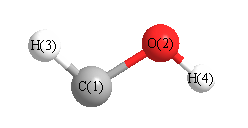 More geometry information
Calculated Bond Angles
| atom1 |
atom2 |
atom3 |
angle |
|
atom1 |
atom2 |
atom3 |
angle |
| C1 |
O2 |
H4 |
108.541 |
|
O2 |
C1 |
H3 |
101.143 |
Electronic energy levels
Charges, Dipole, Quadrupole and Polarizability
Charges from optimized geometry at BLYP/6-31+G**
Charges (e)
| Number |
Element |
Mulliken |
CHELPG |
AIM |
ESP |
| 1 |
C |
-0.124 |
|
|
|
| 2 |
O |
-0.368 |
|
|
|
| 3 |
H |
0.102 |
|
|
|
| 4 |
H |
0.390 |
|
|
|
Electric dipole moments
Electric dipole components in Debye
(What's a Debye? See section
VII.A.3)
| |
x |
y |
z |
Total |
| |
0.180 |
-1.715 |
0.000 |
1.725 |
| CHELPG |
|
|
|
|
| AIM |
|
|
|
|
| ESP |
|
|
|
|
Electric Quadrupole moment
Quadrupole components in D Å
| Primitive |
|---|
| | x | y | z |
|---|
| x |
-11.617 |
-4.024 |
0.000 |
| y |
-4.024 |
-14.483 |
0.000 |
| z |
0.000 |
0.000 |
-12.573 |
|
| Traceless |
|---|
| | x | y | z |
|---|
| x |
1.911 |
-4.024 |
0.000 |
| y |
-4.024 |
-2.388 |
0.000 |
| z |
0.000 |
0.000 |
0.477 |
|
| Polar |
|---|
| 3z2-r2 | 0.954 |
|---|
| x2-y2 | 2.866 |
|---|
| xy | -4.024 |
|---|
| xz | 0.000 |
|---|
| yz | 0.000 |
|---|
|
Polarizabilities
Components of the polarizability tensor.
Units are
Å
3 (Angstrom cubed)
Change units.
| |
x |
y |
z |
| x |
3.028 |
-0.310 |
0.000 |
| y |
-0.310 |
3.399 |
0.000 |
| z |
0.000 |
0.000 |
2.140 |
<r2> (average value of r
2) Å
2
| <r2> |
17.996 |
| (<r2>)1/2 |
4.242 |
Jump to
S1C1
Energy calculated at BLYP/6-31+G**
| | hartrees |
|---|
| Energy at 0K | -114.391856 |
| Energy at 298.15K | -114.393235 |
| HF Energy | -114.391856 |
| Nuclear repulsion energy | 30.168490 |
The energy at 298.15K was derived from the energy at 0K
and an integrated heat capacity that used the calculated vibrational frequencies.
Vibrational Frequencies calculated at BLYP/6-31+G**
| Mode Number |
Symmetry |
Frequency
(cm-1) |
Scaled Frequency
(cm-1) |
IR Intensities
(km mol-1) |
Raman Act
(Å4/u) |
Dep P |
Dep U |
|---|
| 1 |
A' |
3267 |
3250 |
68.38 |
|
|
|
| 2 |
A' |
2645 |
2631 |
243.82 |
|
|
|
| 3 |
A' |
1422 |
1415 |
64.76 |
|
|
|
| 4 |
A' |
1252 |
1246 |
47.57 |
|
|
|
| 5 |
A' |
1138 |
1132 |
24.11 |
|
|
|
| 6 |
A" |
985 |
980 |
32.27 |
|
|
|
Unscaled Zero Point Vibrational Energy (zpe) 5354.4 cm
-1
Scaled (by 0.9947) Zero Point Vibrational Energy (zpe) 5326.0 cm
-1
See section
III.C.1 List or set vibrational scaling factors
to change the scale factors used here.
See section
III.C.2
Calculate a vibrational scaling factor for a given set of molecules
to determine the least squares best scaling factor.
Geometric Data calculated at BLYP/6-31+G**
Point Group is Cs
Cartesians (Å)
| Atom |
x (Å) |
y (Å) |
z (Å) |
|---|
| C1 |
0.123 |
0.755 |
0.000 |
| O2 |
0.123 |
-0.572 |
0.000 |
| H3 |
-0.964 |
1.080 |
0.000 |
| H4 |
-0.762 |
-1.030 |
0.000 |
Atom - Atom Distances (Å)
| |
C1 |
O2 |
H3 |
H4 |
| C1 | | 1.3272 | 1.1346 | 1.9922 |
O2 | 1.3272 | | 1.9778 | 0.9965 | H3 | 1.1346 | 1.9778 | | 2.1194 | H4 | 1.9922 | 0.9965 | 2.1194 | |
More geometry information
Calculated Bond Angles
| atom1 |
atom2 |
atom3 |
angle |
|
atom1 |
atom2 |
atom3 |
angle |
| C1 |
O2 |
H4 |
117.326 |
|
O2 |
C1 |
H3 |
106.650 |
Electronic energy levels
Charges, Dipole, Quadrupole and Polarizability
Charges from optimized geometry at BLYP/6-31+G**
Charges (e)
| Number |
Element |
Mulliken |
CHELPG |
AIM |
ESP |
| 1 |
C |
-0.122 |
|
|
|
| 2 |
O |
-0.278 |
|
|
|
| 3 |
H |
0.068 |
|
|
|
| 4 |
H |
0.332 |
|
|
|
Electric dipole moments
Electric dipole components in Debye
(What's a Debye? See section
VII.A.3)
| |
x |
y |
z |
Total |
| |
-3.193 |
-1.719 |
0.000 |
3.626 |
| CHELPG |
|
|
|
|
| AIM |
|
|
|
|
| ESP |
|
|
|
|
Electric Quadrupole moment
Quadrupole components in D Å
| Primitive |
|---|
| | x | y | z |
|---|
| x |
-13.021 |
-0.181 |
0.000 |
| y |
-0.181 |
-13.713 |
0.000 |
| z |
0.000 |
0.000 |
-12.446 |
|
| Traceless |
|---|
| | x | y | z |
|---|
| x |
0.059 |
-0.181 |
0.000 |
| y |
-0.181 |
-0.980 |
0.000 |
| z |
0.000 |
0.000 |
0.921 |
|
| Polar |
|---|
| 3z2-r2 | 1.842 |
|---|
| x2-y2 | 0.692 |
|---|
| xy | -0.181 |
|---|
| xz | 0.000 |
|---|
| yz | 0.000 |
|---|
|
Polarizabilities
Components of the polarizability tensor.
Units are
Å
3 (Angstrom cubed)
Change units.
| |
x |
y |
z |
| x |
3.030 |
0.202 |
0.000 |
| y |
0.202 |
3.936 |
0.000 |
| z |
0.000 |
0.000 |
2.108 |
<r2> (average value of r
2) Å
2
| <r2> |
18.146 |
| (<r2>)1/2 |
4.260 |
