Jump to
S1C2
Energy calculated at TPSSh/6-31+G**
| | hartrees |
|---|
| Energy at 0K | -114.425377 |
| Energy at 298.15K | -114.426789 |
| HF Energy | -114.425377 |
| Nuclear repulsion energy | 30.520800 |
The energy at 298.15K was derived from the energy at 0K
and an integrated heat capacity that used the calculated vibrational frequencies.
Vibrational Frequencies calculated at TPSSh/6-31+G**
| Mode Number |
Symmetry |
Frequency
(cm-1) |
Scaled Frequency
(cm-1) |
IR Intensities
(km mol-1) |
Raman Act
(Å4/u) |
Dep P |
Dep U |
|---|
| 1 |
A' |
3690 |
3552 |
73.99 |
|
|
|
| 2 |
A' |
2866 |
2759 |
152.56 |
|
|
|
| 3 |
A' |
1512 |
1455 |
34.39 |
|
|
|
| 4 |
A' |
1308 |
1259 |
91.34 |
|
|
|
| 5 |
A' |
1205 |
1160 |
129.73 |
|
|
|
| 6 |
A" |
1102 |
1061 |
131.90 |
|
|
|
Unscaled Zero Point Vibrational Energy (zpe) 5841.5 cm
-1
Scaled (by 0.9625) Zero Point Vibrational Energy (zpe) 5622.4 cm
-1
See section
III.C.1 List or set vibrational scaling factors
to change the scale factors used here.
See section
III.C.2
Calculate a vibrational scaling factor for a given set of molecules
to determine the least squares best scaling factor.
Geometric Data calculated at TPSSh/6-31+G**
Point Group is Cs
Cartesians (Å)
| Atom |
x (Å) |
y (Å) |
z (Å) |
|---|
| C1 |
-0.004 |
0.730 |
0.000 |
| O2 |
-0.004 |
-0.580 |
0.000 |
| H3 |
0.970 |
1.129 |
0.000 |
| H4 |
-0.918 |
-0.872 |
0.000 |
Atom - Atom Distances (Å)
| |
C1 |
O2 |
H3 |
H4 |
| C1 | | 1.3101 | 1.0525 | 1.8445 |
O2 | 1.3101 | | 1.9671 | 0.9598 | H3 | 1.0525 | 1.9671 | | 2.7513 | H4 | 1.8445 | 0.9598 | 2.7513 | |
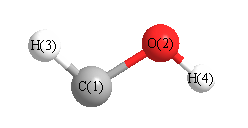 More geometry information
Calculated Bond Angles
| atom1 |
atom2 |
atom3 |
angle |
|
atom1 |
atom2 |
atom3 |
angle |
| C1 |
O2 |
H4 |
107.700 |
|
O2 |
C1 |
H3 |
112.279 |
Electronic energy levels
Charges, Dipole, Quadrupole and Polarizability
Charges from optimized geometry at TPSSh/6-31+G**
Charges (e)
| Number |
Element |
Mulliken |
CHELPG |
AIM |
ESP |
| 1 |
C |
-0.130 |
|
|
|
| 2 |
O |
-0.374 |
|
|
|
| 3 |
H |
0.105 |
|
|
|
| 4 |
H |
0.399 |
|
|
|
Electric dipole moments
Electric dipole components in Debye
(What's a Debye? See section
VII.A.3)
| |
x |
y |
z |
Total |
| |
0.172 |
-1.682 |
0.000 |
1.691 |
| CHELPG |
|
|
|
|
| AIM |
|
|
|
|
| ESP |
|
|
|
|
Electric Quadrupole moment
Quadrupole components in D Å
Polarizabilities
Components of the polarizability tensor.
Units are
Å
3 (Angstrom cubed)
Change units.
| |
x |
y |
z |
| x |
2.842 |
-0.337 |
0.000 |
| y |
-0.337 |
3.171 |
0.000 |
| z |
0.000 |
0.000 |
1.992 |
<r2> (average value of r
2) Å
2
| <r2> |
17.646 |
| (<r2>)1/2 |
4.201 |
Jump to
S1C1
Energy calculated at TPSSh/6-31+G**
| | hartrees |
|---|
| Energy at 0K | -114.415893 |
| Energy at 298.15K | -114.417289 |
| HF Energy | -114.415893 |
| Nuclear repulsion energy | 30.437830 |
The energy at 298.15K was derived from the energy at 0K
and an integrated heat capacity that used the calculated vibrational frequencies.
Vibrational Frequencies calculated at TPSSh/6-31+G**
| Mode Number |
Symmetry |
Frequency
(cm-1) |
Scaled Frequency
(cm-1) |
IR Intensities
(km mol-1) |
Raman Act
(Å4/u) |
Dep P |
Dep U |
|---|
| 1 |
A' |
3487 |
3356 |
22.52 |
|
|
|
| 2 |
A' |
2753 |
2650 |
241.09 |
|
|
|
| 3 |
A' |
1468 |
1413 |
63.76 |
|
|
|
| 4 |
A' |
1311 |
1261 |
77.77 |
|
|
|
| 5 |
A' |
1194 |
1149 |
29.21 |
|
|
|
| 6 |
A" |
1015 |
977 |
36.02 |
|
|
|
Unscaled Zero Point Vibrational Energy (zpe) 5613.7 cm
-1
Scaled (by 0.9625) Zero Point Vibrational Energy (zpe) 5403.2 cm
-1
See section
III.C.1 List or set vibrational scaling factors
to change the scale factors used here.
See section
III.C.2
Calculate a vibrational scaling factor for a given set of molecules
to determine the least squares best scaling factor.
Geometric Data calculated at TPSSh/6-31+G**
Point Group is Cs
Cartesians (Å)
| Atom |
x (Å) |
y (Å) |
z (Å) |
|---|
| C1 |
0.116 |
0.738 |
0.000 |
| O2 |
0.116 |
-0.575 |
0.000 |
| H3 |
-0.859 |
1.152 |
0.000 |
| H4 |
-0.769 |
-0.977 |
0.000 |
Atom - Atom Distances (Å)
| |
C1 |
O2 |
H3 |
H4 |
| C1 | | 1.3125 | 1.0598 | 1.9297 |
O2 | 1.3125 | | 1.9835 | 0.9720 | H3 | 1.0598 | 1.9835 | | 2.1315 | H4 | 1.9297 | 0.9720 | 2.1315 | |
More geometry information
Calculated Bond Angles
| atom1 |
atom2 |
atom3 |
angle |
|
atom1 |
atom2 |
atom3 |
angle |
| C1 |
O2 |
H4 |
114.457 |
|
O2 |
C1 |
H3 |
113.030 |
Electronic energy levels
Charges, Dipole, Quadrupole and Polarizability
Charges from optimized geometry at TPSSh/6-31+G**
Charges (e)
| Number |
Element |
Mulliken |
CHELPG |
AIM |
ESP |
| 1 |
C |
-0.119 |
|
|
|
| 2 |
O |
-0.297 |
|
|
|
| 3 |
H |
0.068 |
|
|
|
| 4 |
H |
0.348 |
|
|
|
Electric dipole moments
Electric dipole components in Debye
(What's a Debye? See section
VII.A.3)
| |
x |
y |
z |
Total |
| |
-3.232 |
-1.725 |
0.000 |
3.664 |
| CHELPG |
|
|
|
|
| AIM |
|
|
|
|
| ESP |
|
|
|
|
Electric Quadrupole moment
Quadrupole components in D Å
Polarizabilities
Components of the polarizability tensor.
Units are
Å
3 (Angstrom cubed)
Change units.
| |
x |
y |
z |
| x |
2.828 |
0.095 |
0.000 |
| y |
0.095 |
3.543 |
0.000 |
| z |
0.000 |
0.000 |
1.961 |
<r2> (average value of r
2) Å
2
| <r2> |
17.803 |
| (<r2>)1/2 |
4.219 |
