return to home page Computational Chemistry Comparison and Benchmark DataBase Release 22 (May 2022) Standard Reference Database 101 National Institute of Standards and Technology
You are here: Calculated > Energy > Optimized > Energy

All results from a given calculation for C2H (Ethynyl radical)

using model chemistry: TPSSh/6-31+G**

19 10 17 12 22

States and conformations

State Conformation minimum conformation conformer description state description
1 1 yes C*V 2Σ
Energy calculated at TPSSh/6-31+G**
 hartrees
Energy at 0K-76.616931
Energy at 298.15K 
HF Energy-76.616931
Nuclear repulsion energy20.053099
The energy at 298.15K was derived from the energy at 0K and an integrated heat capacity that used the calculated vibrational frequencies.
Vibrational Frequencies calculated at TPSSh/6-31+G**
Mode Number Symmetry Frequency
(cm-1)
Scaled Frequency
(cm-1)
IR Intensities
(km mol-1)
Raman Act
(Å4/u)
Dep P Dep U
1 Σ 3475 3345 56.15      
2 Σ 2070 1993 4.86      
3 Π 258i 249i 12.28      
4 Π 258i 249i 12.28      

Unscaled Zero Point Vibrational Energy (zpe) 2514.4 cm-1
Scaled (by 0.9625) Zero Point Vibrational Energy (zpe) 2420.1 cm-1
See section III.C.1 List or set vibrational scaling factors to change the scale factors used here.
See section III.C.2 Calculate a vibrational scaling factor for a given set of molecules to determine the least squares best scaling factor.
Rotational Constants (cm-1) from geometry optimized at TPSSh/6-31+G**
B
1.45818

See section I.F.4 to change rotational constant units
Geometric Data calculated at TPSSh/6-31+G**

Point Group is C∞v

Cartesians (Å)
Atom x (Å) y (Å) z (Å)
C1 0.000 0.000 -0.478
C2 0.000 0.000 0.736
H3 0.000 0.000 -1.547

Atom - Atom Distances (Å)
  C1 C2 H3
C11.21421.0686
C21.21422.2828
H31.06862.2828

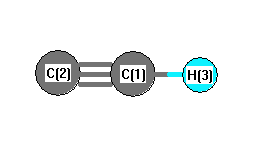
picture of Ethynyl radical state 1 conformation 1
More geometry information
Calculated Bond Angles
atom1 atom2 atom3 angle atom1 atom2 atom3 angle
C2 C1 H3 180.000
Electronic energy levels
Charges, Dipole, Quadrupole and Polarizability