return to home page Computational Chemistry Comparison and Benchmark DataBase Release 22 (May 2022) Standard Reference Database 101 National Institute of Standards and Technology
You are here: Calculated > Energy > Optimized > Energy

All results from a given calculation for C4H4N (pyrrolide radical)

using model chemistry: MP2/6-31+G**

19 10 17 12 22

States and conformations

State Conformation minimum conformation conformer description state description
1 1 yes C2V 2A2
Energy calculated at MP2/6-31+G**
 hartrees
Energy at 0K-208.872222
Energy at 298.15K-208.876911
HF Energy-208.210791
Nuclear repulsion energy151.297227
The energy at 298.15K was derived from the energy at 0K and an integrated heat capacity that used the calculated vibrational frequencies.
Vibrational Frequencies calculated at MP2/6-31+G**
Mode Number Symmetry Frequency
(cm-1)
Scaled Frequency
(cm-1)
IR Intensities
(km mol-1)
Raman Act
(Å4/u)
Dep P Dep U
1 A1 3341 3142 0.54      
2 A1 3307 3110 0.05      
3 A1 1605 1510 23.39      
4 A1 1474 1386 30.58      
5 A1 1272 1196 16.33      
6 A1 1126 1059 43.80      
7 A1 1094 1029 2.83      
8 A1 896 843 9.17      
9 A2 879 827 0.00      
10 A2 818 770 0.00      
11 A2 479 451 0.00      
12 B1 876 824 1.51      
13 B1 700 659 78.56      
14 B1 561 527 30.71      
15 B2 22412 21080 0.00      
16 B2 3319 3122 66.11      
17 B2 3299 3103 64.84      
18 B2 1347 1267 104.18      
19 B2 1324 1245 49.90      
20 B2 1046 984 1.36      
21 B2 896 843 8.17      

Unscaled Zero Point Vibrational Energy (zpe) 26034.6 cm-1
Scaled (by 0.9406) Zero Point Vibrational Energy (zpe) 24488.1 cm-1
See section III.C.1 List or set vibrational scaling factors to change the scale factors used here.
See section III.C.2 Calculate a vibrational scaling factor for a given set of molecules to determine the least squares best scaling factor.
Rotational Constants (cm-1) from geometry optimized at MP2/6-31+G**
ABC
0.33364 0.29659 0.15701

See section I.F.4 to change rotational constant units
Geometric Data calculated at MP2/6-31+G**

Point Group is C2v

Cartesians (Å)
Atom x (Å) y (Å) z (Å)
N1 0.000 0.000 1.243
C2 0.000 1.057 0.421
C3 0.000 -1.057 0.421
C4 0.000 0.689 -0.978
C5 0.000 -0.689 -0.978
H6 0.000 2.063 0.817
H7 0.000 -2.063 0.817
H8 0.000 1.360 -1.822
H9 0.000 -1.360 -1.822

Atom - Atom Distances (Å)
  N1 C2 C3 C4 C5 H6 H7 H8 H9
N11.33971.33972.32582.32582.10702.10703.35333.3533
C21.33972.11501.44702.23741.08093.14582.26303.2976
C31.33972.11502.23741.44703.14581.08093.29762.2630
C42.32581.44702.23741.37712.26103.28551.07822.2155
C52.32582.23741.44701.37713.28552.26102.21551.0782
H62.10701.08093.14582.26103.28554.12662.73064.3222
H72.10703.14581.08093.28552.26104.12664.32222.7306
H83.35332.26303.29761.07822.21552.73064.32222.7203
H93.35333.29762.26302.21551.07824.32222.73062.7203

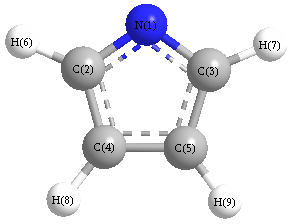
picture of pyrrolide radical state 1 conformation 1
More geometry information
Calculated Bond Angles
atom1 atom2 atom3 angle atom1 atom2 atom3 angle
N1 C2 C4 113.102 N1 C2 H6 120.645
N1 C3 C5 113.102 N1 C3 H7 120.645
C2 N1 C3 104.251 C2 C4 C5 104.773
C2 C4 H8 126.701 C3 C5 C4 104.773
C3 C5 H9 126.701 C4 C2 H6 126.254
C4 C5 H9 128.526 C5 C3 H7 126.254
C5 C4 H8 128.526
Electronic energy levels
Charges, Dipole, Quadrupole and Polarizability