return to home page Computational Chemistry Comparison and Benchmark DataBase Release 22 (May 2022) Standard Reference Database 101 National Institute of Standards and Technology
You are here: Calculated > Energy > Optimized > Energy

All results from a given calculation for C4H4N (pyrrolide radical)

using model chemistry: QCISD/6-31+G**

19 10 17 12 22

States and conformations

State Conformation minimum conformation conformer description state description
1 1 yes C2V 2A2
Energy calculated at QCISD/6-31+G**
 hartrees
Energy at 0K-208.913851
Energy at 298.15K-208.918405
HF Energy-208.211280
Nuclear repulsion energy150.477108
The energy at 298.15K was derived from the energy at 0K and an integrated heat capacity that used the calculated vibrational frequencies.
Vibrational Frequencies calculated at QCISD/6-31+G**
Mode Number Symmetry Frequency
(cm-1)
Scaled Frequency
(cm-1)
IR Intensities
(km mol-1)
Raman Act
(Å4/u)
Dep P Dep U
1 A1 3326 3145 1.80      
2 A1 3291 3111 1.59      
3 A1 1603 1516 0.99      
4 A1 1490 1408 22.33      
5 A1 1217 1150 3.02      
6 A1 1117 1056 31.46      
7 A1 1066 1008 0.81      
8 A1 886 838 7.70      
9 A2 858 811 0.00      
10 A2 790 747 0.00      
11 A2 473 447 0.00      
12 B1 793 749 0.04      
13 B1 705 666 85.06      
14 B1 543 514 19.12      
15 B2 3308 3127 2.11      
16 B2 3286 3107 8.63      
17 B2 1485 1404 0.77      
18 B2 1330 1257 1.26      
19 B2 1109 1048 58.98      
20 B2 1041 984 2.56      
21 B2 774 732 1.66      

Unscaled Zero Point Vibrational Energy (zpe) 15244.7 cm-1
Scaled (by 0.9454) Zero Point Vibrational Energy (zpe) 14412.3 cm-1
See section III.C.1 List or set vibrational scaling factors to change the scale factors used here.
See section III.C.2 Calculate a vibrational scaling factor for a given set of molecules to determine the least squares best scaling factor.
Rotational Constants (cm-1) from geometry optimized at QCISD/6-31+G**
ABC
0.33101 0.29219 0.15520

See section I.F.4 to change rotational constant units
Geometric Data calculated at QCISD/6-31+G**

Point Group is C2v

Cartesians (Å)
Atom x (Å) y (Å) z (Å)
N1 0.000 0.000 1.251
C2 0.000 1.069 0.425
C3 0.000 -1.069 0.425
C4 0.000 0.682 -0.987
C5 0.000 -0.682 -0.987
H6 0.000 2.075 0.820
H7 0.000 -2.075 0.820
H8 0.000 1.354 -1.830
H9 0.000 -1.354 -1.830

Atom - Atom Distances (Å)
  N1 C2 C3 C4 C5 H6 H7 H8 H9
N11.35071.35072.33992.33992.11922.11923.36613.3661
C21.35072.13711.46432.24891.08073.16802.27373.3101
C31.35072.13712.24891.46433.16801.08073.31012.2737
C42.33991.46432.24891.36332.28133.29571.07862.2034
C52.33992.24891.46431.36333.29572.28132.20341.0786
H62.11921.08073.16802.28133.29574.14962.74634.3334
H72.11923.16801.08073.29572.28134.14964.33342.7463
H83.36612.27373.31011.07862.20342.74634.33342.7078
H93.36613.31012.27372.20341.07864.33342.74632.7078

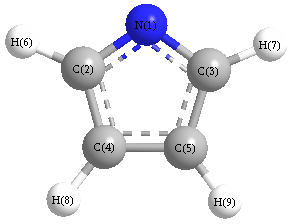
picture of pyrrolide radical state 1 conformation 1
More geometry information
Calculated Bond Angles
atom1 atom2 atom3 angle atom1 atom2 atom3 angle
N1 C2 C4 112.386 N1 C2 H6 120.894
N1 C3 C5 112.386 N1 C3 H7 120.894
C2 N1 C3 104.585 C2 C4 C5 105.321
C2 C4 H8 126.123 C3 C5 C4 105.321
C3 C5 H9 126.123 C4 C2 H6 126.720
C4 C5 H9 128.556 C5 C3 H7 126.720
C5 C4 H8 128.556
Electronic energy levels
Charges, Dipole, Quadrupole and Polarizability