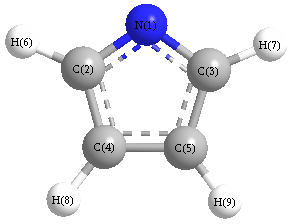
Vibrational Frequencies calculated at TPSSh/6-31+G**
| Mode Number |
Symmetry |
Frequency
(cm-1) |
Scaled Frequency
(cm-1) |
IR Intensities
(km mol-1) |
Raman Act
(Å4/u) |
Dep P |
Dep U |
|---|
| 1 |
A1 |
3269 |
3146 |
3.06 |
|
|
|
| 2 |
A1 |
3223 |
3103 |
2.19 |
|
|
|
| 3 |
A1 |
1566 |
1507 |
2.75 |
|
|
|
| 4 |
A1 |
1447 |
1393 |
24.97 |
|
|
|
| 5 |
A1 |
1201 |
1156 |
4.37 |
|
|
|
| 6 |
A1 |
1097 |
1056 |
40.27 |
|
|
|
| 7 |
A1 |
1051 |
1011 |
0.37 |
|
|
|
| 8 |
A1 |
866 |
834 |
8.78 |
|
|
|
| 9 |
A2 |
900 |
866 |
0.00 |
|
|
|
| 10 |
A2 |
817 |
787 |
0.00 |
|
|
|
| 11 |
A2 |
481 |
463 |
0.00 |
|
|
|
| 12 |
B1 |
830 |
799 |
0.50 |
|
|
|
| 13 |
B1 |
711 |
685 |
77.52 |
|
|
|
| 14 |
B1 |
532 |
512 |
20.79 |
|
|
|
| 15 |
B2 |
3248 |
3127 |
9.33 |
|
|
|
| 16 |
B2 |
3220 |
3099 |
18.79 |
|
|
|
| 17 |
B2 |
1363 |
1312 |
47.64 |
|
|
|
| 18 |
B2 |
1301 |
1252 |
0.00 |
|
|
|
| 19 |
B2 |
1080 |
1040 |
6.67 |
|
|
|
| 20 |
B2 |
939 |
904 |
0.02 |
|
|
|
| 21 |
B2 |
677 |
652 |
5.47 |
|
|
|
Unscaled Zero Point Vibrational Energy (zpe) 14910.2 cm
-1
Scaled (by 0.9625) Zero Point Vibrational Energy (zpe) 14351.1 cm
-1
See section
III.C.1 List or set vibrational scaling factors
to change the scale factors used here.
See section
III.C.2
Calculate a vibrational scaling factor for a given set of molecules
to determine the least squares best scaling factor.
Charges, Dipole, Quadrupole and Polarizability
Charges from optimized geometry at TPSSh/6-31+G**
Charges (e)
| Number |
Element |
Mulliken |
CHELPG |
AIM |
ESP |
| 1 |
N |
-0.173 |
|
|
|
| 2 |
C |
-0.169 |
|
|
|
| 3 |
C |
-0.169 |
|
|
|
| 4 |
C |
-0.065 |
|
|
|
| 5 |
C |
-0.065 |
|
|
|
| 6 |
H |
0.159 |
|
|
|
| 7 |
H |
0.159 |
|
|
|
| 8 |
H |
0.162 |
|
|
|
| 9 |
H |
0.162 |
|
|
|
Electric dipole moments
Electric dipole components in Debye
(What's a Debye? See section
VII.A.3)
| |
x |
y |
z |
Total |
| |
0.000 |
0.000 |
-2.400 |
2.400 |
| CHELPG |
|
|
|
|
| AIM |
|
|
|
|
| ESP |
|
|
|
|
Electric Quadrupole moment
Quadrupole components in D Å
Polarizabilities
Components of the polarizability tensor.
Units are
Å
3 (Angstrom cubed)
Change units.
| |
x |
y |
z |
| x |
4.573 |
0.000 |
0.000 |
| y |
0.000 |
8.961 |
0.000 |
| z |
0.000 |
0.000 |
8.040 |
<r2> (average value of r
2) Å
2
| <r2> |
82.529 |
| (<r2>)1/2 |
9.085 |