Jump to
S1C2
Energy calculated at BLYP/6-31+G**
| | hartrees |
|---|
| Energy at 0K | -189.082981 |
| Energy at 298.15K | -189.084012 |
| HF Energy | -189.082981 |
| Nuclear repulsion energy | 62.215784 |
The energy at 298.15K was derived from the energy at 0K
and an integrated heat capacity that used the calculated vibrational frequencies.
Vibrational Frequencies calculated at BLYP/6-31+G**
| Mode Number |
Symmetry |
Frequency
(cm-1) |
Scaled Frequency
(cm-1) |
IR Intensities
(km mol-1) |
Raman Act
(Å4/u) |
Dep P |
Dep U |
|---|
| 1 |
A' |
3386 |
3368 |
5.26 |
|
|
|
| 2 |
A' |
1771 |
1762 |
314.11 |
|
|
|
| 3 |
A' |
1231 |
1224 |
1.16 |
|
|
|
| 4 |
A' |
1002 |
997 |
144.07 |
|
|
|
| 5 |
A' |
559 |
556 |
28.29 |
|
|
|
| 6 |
A" |
573 |
570 |
110.13 |
|
|
|
Unscaled Zero Point Vibrational Energy (zpe) 4261.1 cm
-1
Scaled (by 0.9947) Zero Point Vibrational Energy (zpe) 4238.5 cm
-1
See section
III.C.1 List or set vibrational scaling factors
to change the scale factors used here.
See section
III.C.2
Calculate a vibrational scaling factor for a given set of molecules
to determine the least squares best scaling factor.
Geometric Data calculated at BLYP/6-31+G**
Point Group is Cs
Cartesians (Å)
| Atom |
x (Å) |
y (Å) |
z (Å) |
|---|
| C1 |
0.000 |
0.449 |
0.000 |
| O2 |
-1.077 |
-0.356 |
0.000 |
| O3 |
1.175 |
0.182 |
0.000 |
| H4 |
-0.783 |
-1.306 |
0.000 |
Atom - Atom Distances (Å)
| |
C1 |
O2 |
O3 |
H4 |
| C1 | | 1.3449 | 1.2052 | 1.9216 |
O2 | 1.3449 | | 2.3160 | 0.9944 | O3 | 1.2052 | 2.3160 | | 2.4594 | H4 | 1.9216 | 0.9944 | 2.4594 | |
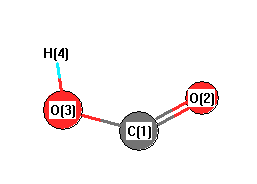 More geometry information
Calculated Bond Angles
| atom1 |
atom2 |
atom3 |
angle |
|
atom1 |
atom2 |
atom3 |
angle |
| C1 |
O2 |
H4 |
109.547 |
|
O2 |
C1 |
O3 |
130.438 |
Electronic energy levels
Charges, Dipole, Quadrupole and Polarizability
Charges from optimized geometry at BLYP/6-31+G**
Charges (e)
| Number |
Element |
Mulliken |
CHELPG |
AIM |
ESP |
| 1 |
C |
0.312 |
|
|
|
| 2 |
O |
-0.341 |
|
|
|
| 3 |
O |
-0.312 |
|
|
|
| 4 |
H |
0.341 |
|
|
|
Electric dipole moments
Electric dipole components in Debye
(What's a Debye? See section
VII.A.3)
| |
x |
y |
z |
Total |
| |
-0.940 |
-1.752 |
0.000 |
1.988 |
| CHELPG |
|
|
|
|
| AIM |
|
|
|
|
| ESP |
|
|
|
|
Electric Quadrupole moment
Quadrupole components in D Å
| Primitive |
|---|
| | x | y | z |
|---|
| x |
-20.873 |
0.820 |
0.000 |
| y |
0.820 |
-14.334 |
0.000 |
| z |
0.000 |
0.000 |
-16.776 |
|
| Traceless |
|---|
| | x | y | z |
|---|
| x |
-5.318 |
0.820 |
0.000 |
| y |
0.820 |
4.491 |
0.000 |
| z |
0.000 |
0.000 |
0.827 |
|
| Polar |
|---|
| 3z2-r2 | 1.655 |
|---|
| x2-y2 | -6.539 |
|---|
| xy | 0.820 |
|---|
| xz | 0.000 |
|---|
| yz | 0.000 |
|---|
|
Polarizabilities
Components of the polarizability tensor.
Units are
Å
3 (Angstrom cubed)
Change units.
| |
x |
y |
z |
| x |
4.178 |
0.269 |
0.000 |
| y |
0.269 |
3.440 |
0.000 |
| z |
0.000 |
0.000 |
2.220 |
<r2> (average value of r
2) Å
2
| <r2> |
35.966 |
| (<r2>)1/2 |
5.997 |
Jump to
S1C1
Energy calculated at BLYP/6-31+G**
| | hartrees |
|---|
| Energy at 0K | -189.086552 |
| Energy at 298.15K | -189.087574 |
| HF Energy | -189.086552 |
| Nuclear repulsion energy | 61.940566 |
The energy at 298.15K was derived from the energy at 0K
and an integrated heat capacity that used the calculated vibrational frequencies.
Vibrational Frequencies calculated at BLYP/6-31+G**
| Mode Number |
Symmetry |
Frequency
(cm-1) |
Scaled Frequency
(cm-1) |
IR Intensities
(km mol-1) |
Raman Act
(Å4/u) |
Dep P |
Dep U |
|---|
| 1 |
A' |
3645 |
3626 |
94.79 |
|
|
|
| 2 |
A' |
1806 |
1797 |
219.45 |
|
|
|
| 3 |
A' |
1184 |
1177 |
216.51 |
|
|
|
| 4 |
A' |
1015 |
1010 |
78.41 |
|
|
|
| 5 |
A' |
582 |
579 |
5.95 |
|
|
|
| 6 |
A" |
540 |
537 |
97.38 |
|
|
|
Unscaled Zero Point Vibrational Energy (zpe) 4386.0 cm
-1
Scaled (by 0.9947) Zero Point Vibrational Energy (zpe) 4362.7 cm
-1
See section
III.C.1 List or set vibrational scaling factors
to change the scale factors used here.
See section
III.C.2
Calculate a vibrational scaling factor for a given set of molecules
to determine the least squares best scaling factor.
Geometric Data calculated at BLYP/6-31+G**
Point Group is Cs
Cartesians (Å)
| Atom |
x (Å) |
y (Å) |
z (Å) |
|---|
| C1 |
0.000 |
0.423 |
0.000 |
| O2 |
-0.958 |
-0.551 |
0.000 |
| O3 |
1.187 |
0.248 |
0.000 |
| H4 |
-1.836 |
-0.114 |
0.000 |
Atom - Atom Distances (Å)
| |
C1 |
O2 |
O3 |
H4 |
| C1 | | 1.3653 | 1.1998 | 1.9127 |
O2 | 1.3653 | | 2.2885 | 0.9807 | O3 | 1.1998 | 2.2885 | | 3.0445 | H4 | 1.9127 | 0.9807 | 3.0445 | |
More geometry information
Calculated Bond Angles
| atom1 |
atom2 |
atom3 |
angle |
|
atom1 |
atom2 |
atom3 |
angle |
| C1 |
O2 |
H4 |
108.114 |
|
O2 |
C1 |
O3 |
126.168 |
Electronic energy levels
Charges, Dipole, Quadrupole and Polarizability
Charges from optimized geometry at BLYP/6-31+G**
Charges (e)
| Number |
Element |
Mulliken |
CHELPG |
AIM |
ESP |
| 1 |
C |
0.294 |
|
|
|
| 2 |
O |
-0.361 |
|
|
|
| 3 |
O |
-0.300 |
|
|
|
| 4 |
H |
0.368 |
|
|
|
Electric dipole moments
Electric dipole components in Debye
(What's a Debye? See section
VII.A.3)
| |
x |
y |
z |
Total |
| |
-2.981 |
0.371 |
0.000 |
3.004 |
| CHELPG |
|
|
|
|
| AIM |
|
|
|
|
| ESP |
|
|
|
|
Electric Quadrupole moment
Quadrupole components in D Å
| Primitive |
|---|
| | x | y | z |
|---|
| x |
-14.296 |
-1.020 |
0.000 |
| y |
-1.020 |
-18.584 |
0.000 |
| z |
0.000 |
0.000 |
-16.851 |
|
| Traceless |
|---|
| | x | y | z |
|---|
| x |
3.421 |
-1.020 |
0.000 |
| y |
-1.020 |
-3.011 |
0.000 |
| z |
0.000 |
0.000 |
-0.410 |
|
| Polar |
|---|
| 3z2-r2 | -0.820 |
|---|
| x2-y2 | 4.288 |
|---|
| xy | -1.020 |
|---|
| xz | 0.000 |
|---|
| yz | 0.000 |
|---|
|
Polarizabilities
Components of the polarizability tensor.
Units are
Å
3 (Angstrom cubed)
Change units.
| |
x |
y |
z |
| x |
4.650 |
0.213 |
0.000 |
| y |
0.213 |
2.945 |
0.000 |
| z |
0.000 |
0.000 |
2.283 |
<r2> (average value of r
2) Å
2
| <r2> |
36.334 |
| (<r2>)1/2 |
6.028 |
