Jump to
S1C2
S2C1
S2C2
Energy calculated at B3LYPultrafine/6-31+G**
| | hartrees |
|---|
| Energy at 0K | -131.430180 |
| Energy at 298.15K | -131.429444 |
| HF Energy | -131.430180 |
| Nuclear repulsion energy | 47.215727 |
The energy at 298.15K was derived from the energy at 0K
and an integrated heat capacity that used the calculated vibrational frequencies.
Vibrational Frequencies calculated at B3LYPultrafine/6-31+G**
| Mode Number |
Symmetry |
Frequency
(cm-1) |
Scaled Frequency
(cm-1) |
IR Intensities
(km mol-1) |
Raman Act
(Å4/u) |
Dep P |
Dep U |
|---|
| 1 |
A' |
3400 |
3273 |
45.54 |
|
|
|
| 2 |
A' |
1786 |
1720 |
28.82 |
|
|
|
| 3 |
A' |
1248 |
1201 |
5.93 |
|
|
|
| 4 |
A' |
451 |
434 |
13.86 |
|
|
|
| 5 |
A' |
363 |
350 |
41.75 |
|
|
|
| 6 |
A" |
442 |
425 |
0.93 |
|
|
|
Unscaled Zero Point Vibrational Energy (zpe) 3844.9 cm
-1
Scaled (by 0.9627) Zero Point Vibrational Energy (zpe) 3701.5 cm
-1
See section
III.C.1 List or set vibrational scaling factors
to change the scale factors used here.
See section
III.C.2
Calculate a vibrational scaling factor for a given set of molecules
to determine the least squares best scaling factor.
Geometric Data calculated at B3LYPultrafine/6-31+G**
Point Group is Cs
Cartesians (Å)
| Atom |
x (Å) |
y (Å) |
z (Å) |
|---|
| C1 |
0.084 |
-1.220 |
0.000 |
| C2 |
0.000 |
0.084 |
0.000 |
| N3 |
-0.158 |
1.281 |
0.000 |
| H4 |
0.606 |
-2.155 |
0.000 |
Atom - Atom Distances (Å)
| |
C1 |
C2 |
N3 |
H4 |
| C1 | | 1.3063 | 2.5127 | 1.0712 |
C2 | 1.3063 | | 1.2078 | 2.3193 | N3 | 2.5127 | 1.2078 | | 3.5201 | H4 | 1.0712 | 2.3193 | 3.5201 | |
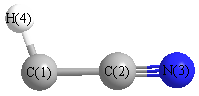 More geometry information
Calculated Bond Angles
| atom1 |
atom2 |
atom3 |
angle |
|
atom1 |
atom2 |
atom3 |
angle |
| C1 |
C2 |
N3 |
176.140 |
|
C2 |
C1 |
H4 |
154.466 |
Electronic energy levels
Charges, Dipole, Quadrupole and Polarizability
Jump to
S1C1
S2C1
S2C2
Energy calculated at B3LYPultrafine/6-31+G**
| | hartrees |
|---|
| Energy at 0K | -131.429783 |
| Energy at 298.15K | |
| HF Energy | -131.429783 |
| Nuclear repulsion energy | 47.259210 |
The energy at 298.15K was derived from the energy at 0K
and an integrated heat capacity that used the calculated vibrational frequencies.
Vibrational Frequencies calculated at B3LYPultrafine/6-31+G**
| Mode Number |
Symmetry |
Frequency
(cm-1) |
Scaled Frequency
(cm-1) |
IR Intensities
(km mol-1) |
Raman Act
(Å4/u) |
Dep P |
Dep U |
|---|
| 1 |
Σ |
3447 |
3319 |
74.33 |
|
|
|
| 2 |
Σ |
1742 |
1677 |
30.09 |
|
|
|
| 3 |
Σ |
1280 |
1233 |
3.85 |
|
|
|
| 4 |
Π |
447 |
430 |
0.41 |
|
|
|
| 4 |
Π |
447 |
430 |
0.41 |
|
|
|
| 5 |
Π |
248i |
239i |
61.21 |
|
|
|
| 5 |
Π |
248i |
239i |
61.21 |
|
|
|
Unscaled Zero Point Vibrational Energy (zpe) 3433.5 cm
-1
Scaled (by 0.9627) Zero Point Vibrational Energy (zpe) 3305.5 cm
-1
See section
III.C.1 List or set vibrational scaling factors
to change the scale factors used here.
See section
III.C.2
Calculate a vibrational scaling factor for a given set of molecules
to determine the least squares best scaling factor.
Geometric Data calculated at B3LYPultrafine/6-31+G**
Point Group is C∞v
Cartesians (Å)
| Atom |
x (Å) |
y (Å) |
z (Å) |
|---|
| C1 |
0.000 |
0.000 |
-1.212 |
| C2 |
0.000 |
0.000 |
0.080 |
| N3 |
0.000 |
0.000 |
1.295 |
| H4 |
0.000 |
0.000 |
-2.279 |
Atom - Atom Distances (Å)
| |
C1 |
C2 |
N3 |
H4 |
| C1 | | 1.2917 | 2.5070 | 1.0673 |
C2 | 1.2917 | | 1.2153 | 2.3590 | N3 | 2.5070 | 1.2153 | | 3.5743 | H4 | 1.0673 | 2.3590 | 3.5743 | |
More geometry information
Calculated Bond Angles
| atom1 |
atom2 |
atom3 |
angle |
|
atom1 |
atom2 |
atom3 |
angle |
| C1 |
C2 |
N3 |
180.000 |
|
C2 |
C1 |
H4 |
180.000 |
Electronic energy levels
Charges, Dipole, Quadrupole and Polarizability
Charges from optimized geometry at B3LYPultrafine/6-31+G**
Charges (e)
| Number |
Element |
Mulliken |
CHELPG |
AIM |
ESP |
| 1 |
C |
0.278 |
|
|
|
| 2 |
C |
-0.021 |
|
|
|
| 3 |
N |
-0.488 |
|
|
|
| 4 |
H |
0.230 |
|
|
|
Electric dipole moments
Electric dipole components in Debye
(What's a Debye? See section
VII.A.3)
| |
x |
y |
z |
Total |
| |
0.000 |
0.000 |
-3.356 |
3.356 |
| CHELPG |
|
|
|
|
| AIM |
|
|
|
|
| ESP |
|
|
|
|
Electric Quadrupole moment
Quadrupole components in D Å
| Primitive |
|---|
| | x | y | z |
|---|
| x |
-17.552 |
0.000 |
0.000 |
| y |
0.000 |
-17.552 |
0.000 |
| z |
0.000 |
0.000 |
-15.931 |
|
| Traceless |
|---|
| | x | y | z |
|---|
| x |
-0.811 |
0.000 |
0.000 |
| y |
0.000 |
-0.811 |
0.000 |
| z |
0.000 |
0.000 |
1.622 |
|
| Polar |
|---|
| 3z2-r2 | 3.244 |
|---|
| x2-y2 | 0.000 |
|---|
| xy | 0.000 |
|---|
| xz | 0.000 |
|---|
| yz | 0.000 |
|---|
|
Polarizabilities
Components of the polarizability tensor.
Units are
Å
3 (Angstrom cubed)
Change units.
| |
x |
y |
z |
| x |
2.243 |
0.000 |
0.000 |
| y |
0.000 |
2.243 |
0.000 |
| z |
0.000 |
0.000 |
7.128 |
<r2> (average value of r
2) Å
2
| <r2> |
36.411 |
| (<r2>)1/2 |
6.034 |
Jump to
S1C1
S1C2
S2C2
Energy calculated at B3LYPultrafine/6-31+G**
| | hartrees |
|---|
| Energy at 0K | -131.404948 |
| Energy at 298.15K | -131.404371 |
| HF Energy | -131.404948 |
| Nuclear repulsion energy | 46.882966 |
The energy at 298.15K was derived from the energy at 0K
and an integrated heat capacity that used the calculated vibrational frequencies.
Vibrational Frequencies calculated at B3LYPultrafine/6-31+G**
| Mode Number |
Symmetry |
Frequency
(cm-1) |
Scaled Frequency
(cm-1) |
IR Intensities
(km mol-1) |
Raman Act
(Å4/u) |
Dep P |
Dep U |
|---|
| 1 |
A' |
3076 |
2961 |
6.32 |
|
|
|
| 2 |
A' |
2096 |
2018 |
16.90 |
|
|
|
| 3 |
A' |
1088 |
1048 |
36.45 |
|
|
|
| 4 |
A' |
927 |
893 |
49.75 |
|
|
|
| 5 |
A' |
433 |
416 |
25.96 |
|
|
|
| 6 |
A" |
316 |
305 |
8.18 |
|
|
|
Unscaled Zero Point Vibrational Energy (zpe) 3968.2 cm
-1
Scaled (by 0.9627) Zero Point Vibrational Energy (zpe) 3820.2 cm
-1
See section
III.C.1 List or set vibrational scaling factors
to change the scale factors used here.
See section
III.C.2
Calculate a vibrational scaling factor for a given set of molecules
to determine the least squares best scaling factor.
Geometric Data calculated at B3LYPultrafine/6-31+G**
Point Group is Cs
Cartesians (Å)
| Atom |
x (Å) |
y (Å) |
z (Å) |
|---|
| C1 |
0.148 |
-1.277 |
0.000 |
| C2 |
0.000 |
0.092 |
0.000 |
| N3 |
-0.300 |
1.239 |
0.000 |
| H4 |
1.211 |
-1.561 |
0.000 |
Atom - Atom Distances (Å)
| |
C1 |
C2 |
N3 |
H4 |
| C1 | | 1.3774 | 2.5554 | 1.1005 |
C2 | 1.3774 | | 1.1849 | 2.0499 | N3 | 2.5554 | 1.1849 | | 3.1819 | H4 | 1.1005 | 2.0499 | 3.1819 | |
More geometry information
Electronic energy levels
Charges, Dipole, Quadrupole and Polarizability
Charges from optimized geometry at B3LYPultrafine/6-31+G**
Charges (e)
| Number |
Element |
Mulliken |
CHELPG |
AIM |
ESP |
| 1 |
C |
-0.204 |
|
|
|
| 2 |
C |
0.399 |
|
|
|
| 3 |
N |
-0.363 |
|
|
|
| 4 |
H |
0.169 |
|
|
|
Electric dipole moments
Electric dipole components in Debye
(What's a Debye? See section
VII.A.3)
| |
x |
y |
z |
Total |
| |
1.962 |
-1.326 |
0.000 |
2.368 |
| CHELPG |
|
|
|
|
| AIM |
|
|
|
|
| ESP |
|
|
|
|
Electric Quadrupole moment
Quadrupole components in D Å
| Primitive |
|---|
| | x | y | z |
|---|
| x |
-17.025 |
-2.391 |
0.000 |
| y |
-2.391 |
-21.926 |
0.000 |
| z |
0.000 |
0.000 |
-16.155 |
|
| Traceless |
|---|
| | x | y | z |
|---|
| x |
2.015 |
-2.391 |
0.000 |
| y |
-2.391 |
-5.336 |
0.000 |
| z |
0.000 |
0.000 |
3.321 |
|
| Polar |
|---|
| 3z2-r2 | 6.642 |
|---|
| x2-y2 | 4.901 |
|---|
| xy | -2.391 |
|---|
| xz | 0.000 |
|---|
| yz | 0.000 |
|---|
|
Polarizabilities
Components of the polarizability tensor.
Units are
Å
3 (Angstrom cubed)
Change units.
| |
x |
y |
z |
| x |
3.030 |
-0.814 |
0.000 |
| y |
-0.814 |
7.064 |
0.000 |
| z |
0.000 |
0.000 |
2.782 |
<r2> (average value of r
2) Å
2
| <r2> |
36.717 |
| (<r2>)1/2 |
6.059 |
Jump to
S1C1
S1C2
S2C1
Energy calculated at B3LYPultrafine/6-31+G**
| | hartrees |
|---|
| Energy at 0K | -131.404948 |
| Energy at 298.15K | -131.404371 |
| HF Energy | -131.404948 |
| Nuclear repulsion energy | 46.882966 |
The energy at 298.15K was derived from the energy at 0K
and an integrated heat capacity that used the calculated vibrational frequencies.
Vibrational Frequencies calculated at B3LYPultrafine/6-31+G**
Geometric Data calculated at B3LYPultrafine/6-31+G**
Point Group is Cs
Electronic energy levels
Charges, Dipole, Quadrupole and Polarizability
