Jump to
S1C2
Energy calculated at LSDA/6-31+G**
| | hartrees |
|---|
| Energy at 0K | -956.511205 |
| Energy at 298.15K | |
| HF Energy | -956.511205 |
| Nuclear repulsion energy | 126.419324 |
The energy at 298.15K was derived from the energy at 0K
and an integrated heat capacity that used the calculated vibrational frequencies.
Vibrational Frequencies calculated at LSDA/6-31+G**
| Mode Number |
Symmetry |
Frequency
(cm-1) |
Scaled Frequency
(cm-1) |
IR Intensities
(km mol-1) |
Raman Act
(Å4/u) |
Dep P |
Dep U |
|---|
| 1 |
A1 |
3206 |
3158 |
1.55 |
|
|
|
| 2 |
A1 |
771 |
759 |
5.62 |
|
|
|
| 3 |
A1 |
315 |
310 |
0.17 |
|
|
|
| 4 |
B1 |
206i |
203i |
68.83 |
|
|
|
| 5 |
B2 |
1211 |
1193 |
40.43 |
|
|
|
| 6 |
B2 |
946 |
932 |
168.14 |
|
|
|
Unscaled Zero Point Vibrational Energy (zpe) 3121.3 cm
-1
Scaled (by 0.985) Zero Point Vibrational Energy (zpe) 3074.5 cm
-1
See section
III.C.1 List or set vibrational scaling factors
to change the scale factors used here.
See section
III.C.2
Calculate a vibrational scaling factor for a given set of molecules
to determine the least squares best scaling factor.
Geometric Data calculated at LSDA/6-31+G**
Point Group is C2v
Cartesians (Å)
| Atom |
x (Å) |
y (Å) |
z (Å) |
|---|
| C1 |
0.000 |
0.000 |
0.663 |
| H2 |
0.000 |
0.000 |
1.752 |
| Cl3 |
0.000 |
1.468 |
-0.169 |
| Cl4 |
0.000 |
-1.468 |
-0.169 |
Atom - Atom Distances (Å)
| |
C1 |
H2 |
Cl3 |
Cl4 |
| C1 | | 1.0896 | 1.6872 | 1.6872 |
H2 | 1.0896 | | 2.4178 | 2.4178 | Cl3 | 1.6872 | 2.4178 | | 2.9364 | Cl4 | 1.6872 | 2.4178 | 2.9364 | |
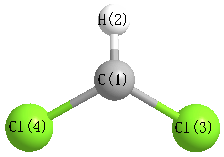 More geometry information
Calculated Bond Angles
| atom1 |
atom2 |
atom3 |
angle |
|
atom1 |
atom2 |
atom3 |
angle |
| Cl3 |
C1 |
H2 |
119.521 |
|
Cl3 |
C1 |
Cl4 |
120.957 |
| Cl4 |
C1 |
H2 |
119.521 |
|
Electronic energy levels
Charges, Dipole, Quadrupole and Polarizability
Charges from optimized geometry at LSDA/6-31+G**
Charges (e)
| Number |
Element |
Mulliken |
CHELPG |
AIM |
ESP |
| 1 |
C |
-0.446 |
|
|
|
| 2 |
H |
0.249 |
|
|
|
| 3 |
Cl |
0.098 |
|
|
|
| 4 |
Cl |
0.098 |
|
|
|
Electric dipole moments
Electric dipole components in Debye
(What's a Debye? See section
VII.A.3)
| |
x |
y |
z |
Total |
| |
0.000 |
0.000 |
0.839 |
0.839 |
| CHELPG |
|
|
|
|
| AIM |
|
|
|
|
| ESP |
|
|
|
|
Electric Quadrupole moment
Quadrupole components in D Å
| Primitive |
|---|
| | x | y | z |
|---|
| x |
-32.315 |
0.000 |
0.000 |
| y |
0.000 |
-30.967 |
0.000 |
| z |
0.000 |
0.000 |
-29.300 |
|
| Traceless |
|---|
| | x | y | z |
|---|
| x |
-2.182 |
0.000 |
0.000 |
| y |
0.000 |
-0.159 |
0.000 |
| z |
0.000 |
0.000 |
2.341 |
|
| Polar |
|---|
| 3z2-r2 | 4.682 |
|---|
| x2-y2 | -1.348 |
|---|
| xy | 0.000 |
|---|
| xz | 0.000 |
|---|
| yz | 0.000 |
|---|
|
Polarizabilities
Components of the polarizability tensor.
Units are
Å
3 (Angstrom cubed)
Change units.
| |
x |
y |
z |
| x |
3.491 |
0.000 |
0.000 |
| y |
0.000 |
7.615 |
0.000 |
| z |
0.000 |
0.000 |
4.549 |
<r2> (average value of r
2) Å
2
| <r2> |
99.237 |
| (<r2>)1/2 |
9.962 |
Jump to
S1C1
Energy calculated at LSDA/6-31+G**
| | hartrees |
|---|
| Energy at 0K | -956.511315 |
| Energy at 298.15K | -956.511922 |
| HF Energy | -956.511315 |
| Nuclear repulsion energy | 126.360554 |
The energy at 298.15K was derived from the energy at 0K
and an integrated heat capacity that used the calculated vibrational frequencies.
Vibrational Frequencies calculated at LSDA/6-31+G**
| Mode Number |
Symmetry |
Frequency
(cm-1) |
Scaled Frequency
(cm-1) |
IR Intensities
(km mol-1) |
Raman Act
(Å4/u) |
Dep P |
Dep U |
|---|
| 1 |
A' |
3188 |
3140 |
1.02 |
|
|
|
| 2 |
A' |
772 |
760 |
7.43 |
|
|
|
| 3 |
A' |
327 |
322 |
14.25 |
|
|
|
| 4 |
A' |
270 |
266 |
40.18 |
|
|
|
| 5 |
A" |
1212 |
1194 |
36.86 |
|
|
|
| 6 |
A" |
932 |
918 |
179.37 |
|
|
|
Unscaled Zero Point Vibrational Energy (zpe) 3350.4 cm
-1
Scaled (by 0.985) Zero Point Vibrational Energy (zpe) 3300.1 cm
-1
See section
III.C.1 List or set vibrational scaling factors
to change the scale factors used here.
See section
III.C.2
Calculate a vibrational scaling factor for a given set of molecules
to determine the least squares best scaling factor.
Geometric Data calculated at LSDA/6-31+G**
Point Group is Cs
Cartesians (Å)
| Atom |
x (Å) |
y (Å) |
z (Å) |
|---|
| C1 |
0.008 |
0.673 |
0.000 |
| H2 |
-0.324 |
1.712 |
0.000 |
| Cl3 |
0.008 |
-0.169 |
1.466 |
| Cl4 |
0.008 |
-0.169 |
-1.466 |
Atom - Atom Distances (Å)
| |
C1 |
H2 |
Cl3 |
Cl4 |
| C1 | | 1.0910 | 1.6911 | 1.6911 |
H2 | 1.0910 | | 2.4085 | 2.4085 | Cl3 | 1.6911 | 2.4085 | | 2.9329 | Cl4 | 1.6911 | 2.4085 | 2.9329 | |
More geometry information
Calculated Bond Angles
| atom1 |
atom2 |
atom3 |
angle |
|
atom1 |
atom2 |
atom3 |
angle |
| Cl3 |
C1 |
H2 |
118.323 |
|
Cl3 |
C1 |
Cl4 |
120.263 |
| Cl4 |
C1 |
H2 |
118.323 |
|
Electronic energy levels
Charges, Dipole, Quadrupole and Polarizability
Charges from optimized geometry at LSDA/6-31+G**
Charges (e)
| Number |
Element |
Mulliken |
CHELPG |
AIM |
ESP |
| 1 |
C |
-0.435 |
|
|
|
| 2 |
H |
0.246 |
|
|
|
| 3 |
Cl |
0.094 |
|
|
|
| 4 |
Cl |
0.094 |
|
|
|
Electric dipole moments
Electric dipole components in Debye
(What's a Debye? See section
VII.A.3)
| |
x |
y |
z |
Total |
| |
-0.389 |
0.793 |
0.000 |
0.883 |
| CHELPG |
|
|
|
|
| AIM |
|
|
|
|
| ESP |
|
|
|
|
Electric Quadrupole moment
Quadrupole components in D Å
| Primitive |
|---|
| | x | y | z |
|---|
| x |
-32.171 |
-0.757 |
0.000 |
| y |
-0.757 |
-29.524 |
0.000 |
| z |
0.000 |
0.000 |
-31.026 |
|
| Traceless |
|---|
| | x | y | z |
|---|
| x |
-1.896 |
-0.757 |
0.000 |
| y |
-0.757 |
2.074 |
0.000 |
| z |
0.000 |
0.000 |
-0.179 |
|
| Polar |
|---|
| 3z2-r2 | -0.357 |
|---|
| x2-y2 | -2.647 |
|---|
| xy | -0.757 |
|---|
| xz | 0.000 |
|---|
| yz | 0.000 |
|---|
|
Polarizabilities
Components of the polarizability tensor.
Units are
Å
3 (Angstrom cubed)
Change units.
| |
x |
y |
z |
| x |
3.523 |
-0.039 |
0.000 |
| y |
-0.039 |
4.574 |
0.000 |
| z |
0.000 |
0.000 |
7.656 |
<r2> (average value of r
2) Å
2
| <r2> |
99.150 |
| (<r2>)1/2 |
9.957 |
