Jump to
S1C2
Energy calculated at TPSSh/6-31+G**
| | hartrees |
|---|
| Energy at 0K | -959.044428 |
| Energy at 298.15K | |
| HF Energy | -959.044428 |
| Nuclear repulsion energy | 125.061986 |
The energy at 298.15K was derived from the energy at 0K
and an integrated heat capacity that used the calculated vibrational frequencies.
Vibrational Frequencies calculated at TPSSh/6-31+G**
| Mode Number |
Symmetry |
Frequency
(cm-1) |
Scaled Frequency
(cm-1) |
IR Intensities
(km mol-1) |
Raman Act
(Å4/u) |
Dep P |
Dep U |
|---|
| 1 |
A1 |
3279 |
3156 |
0.26 |
|
|
|
| 2 |
A1 |
750 |
722 |
9.44 |
|
|
|
| 3 |
A1 |
311 |
300 |
0.30 |
|
|
|
| 4 |
B1 |
377i |
363i |
58.23 |
|
|
|
| 5 |
B2 |
1251 |
1204 |
54.56 |
|
|
|
| 6 |
B2 |
917 |
883 |
174.37 |
|
|
|
Unscaled Zero Point Vibrational Energy (zpe) 3065.4 cm
-1
Scaled (by 0.9625) Zero Point Vibrational Energy (zpe) 2950.5 cm
-1
See section
III.C.1 List or set vibrational scaling factors
to change the scale factors used here.
See section
III.C.2
Calculate a vibrational scaling factor for a given set of molecules
to determine the least squares best scaling factor.
Geometric Data calculated at TPSSh/6-31+G**
Point Group is C2v
Cartesians (Å)
| Atom |
x (Å) |
y (Å) |
z (Å) |
|---|
| C1 |
0.000 |
0.000 |
0.671 |
| H2 |
0.000 |
0.000 |
1.751 |
| Cl3 |
0.000 |
1.485 |
-0.170 |
| Cl4 |
0.000 |
-1.485 |
-0.170 |
Atom - Atom Distances (Å)
| |
C1 |
H2 |
Cl3 |
Cl4 |
| C1 | | 1.0796 | 1.7072 | 1.7072 |
H2 | 1.0796 | | 2.4284 | 2.4284 | Cl3 | 1.7072 | 2.4284 | | 2.9708 | Cl4 | 1.7072 | 2.4284 | 2.9708 | |
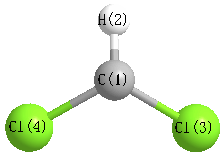 More geometry information
Calculated Bond Angles
| atom1 |
atom2 |
atom3 |
angle |
|
atom1 |
atom2 |
atom3 |
angle |
| Cl3 |
C1 |
H2 |
119.532 |
|
Cl3 |
C1 |
Cl4 |
120.937 |
| Cl4 |
C1 |
H2 |
119.532 |
|
Electronic energy levels
Charges, Dipole, Quadrupole and Polarizability
Charges from optimized geometry at TPSSh/6-31+G**
Charges (e)
| Number |
Element |
Mulliken |
CHELPG |
AIM |
ESP |
| 1 |
C |
-0.416 |
|
|
|
| 2 |
H |
0.236 |
|
|
|
| 3 |
Cl |
0.090 |
|
|
|
| 4 |
Cl |
0.090 |
|
|
|
Electric dipole moments
Electric dipole components in Debye
(What's a Debye? See section
VII.A.3)
| |
x |
y |
z |
Total |
| |
0.000 |
0.000 |
1.001 |
1.001 |
| CHELPG |
|
|
|
|
| AIM |
|
|
|
|
| ESP |
|
|
|
|
Electric Quadrupole moment
Quadrupole components in D Å
Polarizabilities
Components of the polarizability tensor.
Units are
Å
3 (Angstrom cubed)
Change units.
| |
x |
y |
z |
| x |
3.294 |
0.000 |
0.000 |
| y |
0.000 |
7.263 |
0.000 |
| z |
0.000 |
0.000 |
4.360 |
<r2> (average value of r
2) Å
2
| <r2> |
101.006 |
| (<r2>)1/2 |
10.050 |
Jump to
S1C1
Energy calculated at TPSSh/6-31+G**
| | hartrees |
|---|
| Energy at 0K | -959.045308 |
| Energy at 298.15K | -959.046099 |
| HF Energy | -959.045308 |
| Nuclear repulsion energy | 124.876876 |
The energy at 298.15K was derived from the energy at 0K
and an integrated heat capacity that used the calculated vibrational frequencies.
Vibrational Frequencies calculated at TPSSh/6-31+G**
| Mode Number |
Symmetry |
Frequency
(cm-1) |
Scaled Frequency
(cm-1) |
IR Intensities
(km mol-1) |
Raman Act
(Å4/u) |
Dep P |
Dep U |
|---|
| 1 |
A' |
3236 |
3115 |
1.26 |
|
|
|
| 2 |
A' |
756 |
727 |
15.83 |
|
|
|
| 3 |
A' |
491 |
472 |
26.82 |
|
|
|
| 4 |
A' |
304 |
293 |
0.55 |
|
|
|
| 5 |
A" |
1257 |
1210 |
45.23 |
|
|
|
| 6 |
A" |
881 |
848 |
203.00 |
|
|
|
Unscaled Zero Point Vibrational Energy (zpe) 3462.1 cm
-1
Scaled (by 0.9625) Zero Point Vibrational Energy (zpe) 3332.3 cm
-1
See section
III.C.1 List or set vibrational scaling factors
to change the scale factors used here.
See section
III.C.2
Calculate a vibrational scaling factor for a given set of molecules
to determine the least squares best scaling factor.
Geometric Data calculated at TPSSh/6-31+G**
Point Group is Cs
Cartesians (Å)
| Atom |
x (Å) |
y (Å) |
z (Å) |
|---|
| C1 |
0.012 |
0.696 |
0.000 |
| H2 |
-0.490 |
1.656 |
0.000 |
| Cl3 |
0.012 |
-0.172 |
1.482 |
| Cl4 |
0.012 |
-0.172 |
-1.482 |
Atom - Atom Distances (Å)
| |
C1 |
H2 |
Cl3 |
Cl4 |
| C1 | | 1.0828 | 1.7173 | 1.7173 |
H2 | 1.0828 | | 2.4055 | 2.4055 | Cl3 | 1.7173 | 2.4055 | | 2.9636 | Cl4 | 1.7173 | 2.4055 | 2.9636 | |
More geometry information
Calculated Bond Angles
| atom1 |
atom2 |
atom3 |
angle |
|
atom1 |
atom2 |
atom3 |
angle |
| Cl3 |
C1 |
H2 |
116.598 |
|
Cl3 |
C1 |
Cl4 |
119.281 |
| Cl4 |
C1 |
H2 |
116.598 |
|
Electronic energy levels
Charges, Dipole, Quadrupole and Polarizability
Charges from optimized geometry at TPSSh/6-31+G**
Charges (e)
| Number |
Element |
Mulliken |
CHELPG |
AIM |
ESP |
| 1 |
C |
-0.390 |
|
|
|
| 2 |
H |
0.229 |
|
|
|
| 3 |
Cl |
0.081 |
|
|
|
| 4 |
Cl |
0.081 |
|
|
|
Electric dipole moments
Electric dipole components in Debye
(What's a Debye? See section
VII.A.3)
| |
x |
y |
z |
Total |
| |
-0.535 |
0.913 |
0.000 |
1.058 |
| CHELPG |
|
|
|
|
| AIM |
|
|
|
|
| ESP |
|
|
|
|
Electric Quadrupole moment
Quadrupole components in D Å
Polarizabilities
Components of the polarizability tensor.
Units are
Å
3 (Angstrom cubed)
Change units.
| |
x |
y |
z |
| x |
3.372 |
-0.093 |
0.000 |
| y |
-0.093 |
4.404 |
0.000 |
| z |
0.000 |
0.000 |
7.369 |
<r2> (average value of r
2) Å
2
| <r2> |
100.857 |
| (<r2>)1/2 |
10.043 |
