Jump to
S1C2
Energy calculated at QCISD/6-31+G**
| | hartrees |
|---|
| Energy at 0K | -148.393932 |
| Energy at 298.15K | -148.396175 |
| Nuclear repulsion energy | 58.797123 |
The energy at 298.15K was derived from the energy at 0K
and an integrated heat capacity that used the calculated vibrational frequencies.
Vibrational Frequencies calculated at QCISD/6-31+G**
| Mode Number |
Symmetry |
Frequency
(cm-1) |
Scaled Frequency
(cm-1) |
IR Intensities
(km mol-1) |
Raman Act
(Å4/u) |
Dep P |
Dep U |
|---|
| 1 |
A' |
3630 |
3432 |
38.29 |
|
|
|
| 2 |
A' |
2338 |
2210 |
80.20 |
|
|
|
| 3 |
A' |
1687 |
1595 |
46.99 |
|
|
|
| 4 |
A' |
1080 |
1021 |
7.96 |
|
|
|
| 5 |
A' |
665 |
629 |
249.60 |
|
|
|
| 6 |
A' |
451 |
426 |
17.15 |
|
|
|
| 7 |
A" |
3739 |
3534 |
57.76 |
|
|
|
| 8 |
A" |
1231 |
1163 |
0.01 |
|
|
|
| 9 |
A" |
371 |
351 |
0.15 |
|
|
|
Unscaled Zero Point Vibrational Energy (zpe) 7595.3 cm
-1
Scaled (by 0.9454) Zero Point Vibrational Energy (zpe) 7180.6 cm
-1
See section
III.C.1 List or set vibrational scaling factors
to change the scale factors used here.
See section
III.C.2
Calculate a vibrational scaling factor for a given set of molecules
to determine the least squares best scaling factor.
Geometric Data calculated at QCISD/6-31+G**
Point Group is Cs
Cartesians (Å)
| Atom |
x (Å) |
y (Å) |
z (Å) |
|---|
| C1 |
0.000 |
0.221 |
0.000 |
| N2 |
-0.005 |
1.393 |
0.000 |
| N3 |
0.084 |
-1.136 |
0.000 |
| H4 |
-0.277 |
-1.565 |
0.840 |
| H5 |
-0.277 |
-1.565 |
-0.840 |
Atom - Atom Distances (Å)
| |
C1 |
N2 |
N3 |
H4 |
H5 |
| C1 | | 1.1718 | 1.3596 | 1.9933 | 1.9933 |
N2 | 1.1718 | | 2.5304 | 3.0871 | 3.0871 | N3 | 1.3596 | 2.5304 | | 1.0100 | 1.0100 | H4 | 1.9933 | 3.0871 | 1.0100 | | 1.6795 | H5 | 1.9933 | 3.0871 | 1.0100 | 1.6795 | |
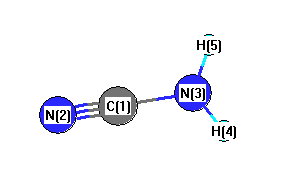 More geometry information
Calculated Bond Angles
| atom1 |
atom2 |
atom3 |
angle |
|
atom1 |
atom2 |
atom3 |
angle |
| C1 |
N3 |
H4 |
113.719 |
|
C1 |
N3 |
H5 |
113.719 |
| N2 |
C1 |
N3 |
176.694 |
|
H4 |
N3 |
H5 |
112.499 |
Electronic energy levels
Charges, Dipole, Quadrupole and Polarizability
Jump to
S1C1
Energy calculated at QCISD/6-31+G**
| | hartrees |
|---|
| Energy at 0K | -148.391873 |
| Energy at 298.15K | |
| HF Energy | -147.918162 |
| Nuclear repulsion energy | 58.994583 |
The energy at 298.15K was derived from the energy at 0K
and an integrated heat capacity that used the calculated vibrational frequencies.
Vibrational Frequencies calculated at QCISD/6-31+G**
| Mode Number |
Symmetry |
Frequency
(cm-1) |
Scaled Frequency
(cm-1) |
IR Intensities
(km mol-1) |
Raman Act
(Å4/u) |
Dep P |
Dep U |
|---|
| 1 |
A1 |
3716 |
3513 |
75.93 |
|
|
|
| 2 |
A1 |
2338 |
2210 |
123.16 |
|
|
|
| 3 |
A1 |
1669 |
1578 |
51.23 |
|
|
|
| 4 |
A1 |
1121 |
1060 |
17.11 |
|
|
|
| 5 |
B1 |
472 |
446 |
0.04 |
|
|
|
| 6 |
B1 |
500i |
473i |
321.75 |
|
|
|
| 7 |
B2 |
3847 |
3637 |
102.27 |
|
|
|
| 8 |
B2 |
1159 |
1096 |
3.16 |
|
|
|
| 9 |
B2 |
377 |
356 |
0.08 |
|
|
|
Unscaled Zero Point Vibrational Energy (zpe) 7099.2 cm
-1
Scaled (by 0.9454) Zero Point Vibrational Energy (zpe) 6711.6 cm
-1
See section
III.C.1 List or set vibrational scaling factors
to change the scale factors used here.
See section
III.C.2
Calculate a vibrational scaling factor for a given set of molecules
to determine the least squares best scaling factor.
Geometric Data calculated at QCISD/6-31+G**
Point Group is C2v
Cartesians (Å)
| Atom |
x (Å) |
y (Å) |
z (Å) |
|---|
| C1 |
0.000 |
0.000 |
0.221 |
| N2 |
0.000 |
0.000 |
1.395 |
| N3 |
0.000 |
0.000 |
-1.120 |
| H4 |
0.000 |
0.866 |
-1.626 |
| H5 |
0.000 |
-0.866 |
-1.626 |
Atom - Atom Distances (Å)
| |
C1 |
N2 |
N3 |
H4 |
H5 |
| C1 | | 1.1734 | 1.3408 | 2.0397 | 2.0397 |
N2 | 1.1734 | | 2.5142 | 3.1419 | 3.1419 | N3 | 1.3408 | 2.5142 | | 1.0028 | 1.0028 | H4 | 2.0397 | 3.1419 | 1.0028 | | 1.7316 | H5 | 2.0397 | 3.1419 | 1.0028 | 1.7316 | |
More geometry information
Calculated Bond Angles
| atom1 |
atom2 |
atom3 |
angle |
|
atom1 |
atom2 |
atom3 |
angle |
| C1 |
N3 |
H4 |
120.303 |
|
C1 |
N3 |
H5 |
120.303 |
| N2 |
C1 |
N3 |
180.000 |
|
H4 |
N3 |
H5 |
119.393 |
Electronic energy levels
Charges, Dipole, Quadrupole and Polarizability
