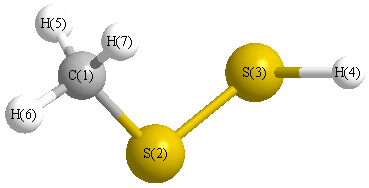
Vibrational Frequencies calculated at TPSSh/6-31+G**
| Mode Number |
Symmetry |
Frequency
(cm-1) |
Scaled Frequency
(cm-1) |
IR Intensities
(km mol-1) |
Raman Act
(Å4/u) |
Dep P |
Dep U |
|---|
| 1 |
A |
3163 |
3044 |
7.59 |
68.07 |
0.75 |
0.86 |
| 2 |
A |
3148 |
3030 |
6.94 |
99.05 |
0.73 |
0.84 |
| 3 |
A |
3055 |
2940 |
20.74 |
167.99 |
0.02 |
0.05 |
| 4 |
A |
2644 |
2545 |
16.54 |
178.12 |
0.30 |
0.46 |
| 5 |
A |
1496 |
1440 |
11.03 |
9.30 |
0.71 |
0.83 |
| 6 |
A |
1477 |
1422 |
9.36 |
13.56 |
0.75 |
0.86 |
| 7 |
A |
1369 |
1317 |
3.68 |
2.69 |
0.68 |
0.81 |
| 8 |
A |
986 |
949 |
7.77 |
3.71 |
0.31 |
0.48 |
| 9 |
A |
982 |
945 |
3.68 |
2.62 |
0.66 |
0.79 |
| 10 |
A |
882 |
848 |
11.11 |
29.83 |
0.57 |
0.72 |
| 11 |
A |
687 |
662 |
1.71 |
15.02 |
0.31 |
0.47 |
| 12 |
A |
495 |
476 |
0.98 |
14.79 |
0.21 |
0.35 |
| 13 |
A |
334 |
321 |
20.19 |
1.60 |
0.75 |
0.86 |
| 14 |
A |
232 |
223 |
0.25 |
5.50 |
0.54 |
0.70 |
| 15 |
A |
172 |
165 |
0.77 |
0.09 |
0.75 |
0.86 |
Unscaled Zero Point Vibrational Energy (zpe) 10559.6 cm
-1
Scaled (by 0.9625) Zero Point Vibrational Energy (zpe) 10163.6 cm
-1
See section
III.C.1 List or set vibrational scaling factors
to change the scale factors used here.
See section
III.C.2
Calculate a vibrational scaling factor for a given set of molecules
to determine the least squares best scaling factor.
Charges, Dipole, Quadrupole and Polarizability
Charges from optimized geometry at TPSSh/6-31+G**
Charges (e)
| Number |
Element |
Mulliken |
CHELPG |
AIM |
ESP |
| 1 |
C |
-0.576 |
|
|
|
| 2 |
S |
0.008 |
|
|
|
| 3 |
S |
-0.099 |
|
|
|
| 4 |
H |
0.082 |
|
|
|
| 5 |
H |
0.202 |
|
|
|
| 6 |
H |
0.190 |
|
|
|
| 7 |
H |
0.193 |
|
|
|
Electric dipole moments
Electric dipole components in Debye
(What's a Debye? See section
VII.A.3)
| |
x |
y |
z |
Total |
| |
-1.105 |
1.373 |
0.994 |
2.024 |
| CHELPG |
|
|
|
|
| AIM |
|
|
|
|
| ESP |
|
|
|
|
Electric Quadrupole moment
Quadrupole components in D Å
Polarizabilities
Components of the polarizability tensor.
Units are
Å
3 (Angstrom cubed)
Change units.
| |
x |
y |
z |
| x |
9.610 |
0.238 |
0.205 |
| y |
0.238 |
6.680 |
0.089 |
| z |
0.205 |
0.089 |
5.846 |
<r2> (average value of r
2) Å
2
| <r2> |
103.896 |
| (<r2>)1/2 |
10.193 |