Jump to
S1C2
Energy calculated at TPSSh/6-31+G**
| | hartrees |
|---|
| Energy at 0K | -189.771961 |
| Energy at 298.15K | -189.774665 |
| HF Energy | -189.771961 |
| Nuclear repulsion energy | 69.790925 |
The energy at 298.15K was derived from the energy at 0K
and an integrated heat capacity that used the calculated vibrational frequencies.
Vibrational Frequencies calculated at TPSSh/6-31+G**
| Mode Number |
Symmetry |
Frequency
(cm-1) |
Scaled Frequency
(cm-1) |
IR Intensities
(km mol-1) |
Raman Act
(Å4/u) |
Dep P |
Dep U |
|---|
| 1 |
A' |
3705 |
3566 |
52.36 |
76.70 |
0.21 |
0.35 |
| 2 |
A' |
3100 |
2984 |
41.40 |
125.83 |
0.29 |
0.45 |
| 3 |
A' |
1807 |
1739 |
381.83 |
10.89 |
0.16 |
0.27 |
| 4 |
A' |
1406 |
1353 |
2.00 |
7.09 |
0.65 |
0.79 |
| 5 |
A' |
1287 |
1239 |
16.98 |
1.88 |
0.30 |
0.46 |
| 6 |
A' |
1122 |
1080 |
254.26 |
2.67 |
0.22 |
0.36 |
| 7 |
A' |
611 |
588 |
45.93 |
3.82 |
0.51 |
0.67 |
| 8 |
A" |
1044 |
1004 |
4.35 |
1.89 |
0.75 |
0.86 |
| 9 |
A" |
690 |
664 |
154.89 |
0.53 |
0.75 |
0.86 |
Unscaled Zero Point Vibrational Energy (zpe) 7385.2 cm
-1
Scaled (by 0.9625) Zero Point Vibrational Energy (zpe) 7108.2 cm
-1
See section
III.C.1 List or set vibrational scaling factors
to change the scale factors used here.
See section
III.C.2
Calculate a vibrational scaling factor for a given set of molecules
to determine the least squares best scaling factor.
Geometric Data calculated at TPSSh/6-31+G**
Point Group is Cs
Cartesians (Å)
| Atom |
x (Å) |
y (Å) |
z (Å) |
|---|
| C1 |
0.000 |
0.425 |
0.000 |
| O2 |
-1.037 |
-0.440 |
0.000 |
| O3 |
1.168 |
0.108 |
0.000 |
| H4 |
-0.378 |
1.454 |
0.000 |
| H5 |
-0.666 |
-1.343 |
0.000 |
Atom - Atom Distances (Å)
| |
C1 |
O2 |
O3 |
H4 |
H5 |
| C1 | | 1.3505 | 1.2101 | 1.0968 | 1.8885 |
O2 | 1.3505 | | 2.2724 | 2.0054 | 0.9760 | O3 | 1.2101 | 2.2724 | | 2.0502 | 2.3381 | H4 | 1.0968 | 2.0054 | 2.0502 | | 2.8113 | H5 | 1.8885 | 0.9760 | 2.3381 | 2.8113 | |
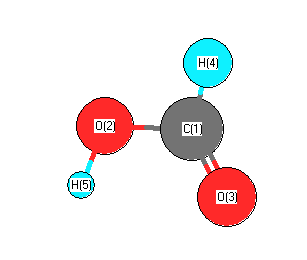 More geometry information
Calculated Bond Angles
| atom1 |
atom2 |
atom3 |
angle |
|
atom1 |
atom2 |
atom3 |
angle |
| C1 |
O2 |
H5 |
107.440 |
|
O2 |
C1 |
O3 |
125.015 |
| O2 |
C1 |
H4 |
109.623 |
|
O3 |
C1 |
H4 |
125.362 |
Electronic energy levels
Charges, Dipole, Quadrupole and Polarizability
Charges from optimized geometry at TPSSh/6-31+G**
Charges (e)
| Number |
Element |
Mulliken |
CHELPG |
AIM |
ESP |
| 1 |
C |
0.292 |
|
|
|
| 2 |
O |
-0.387 |
|
|
|
| 3 |
O |
-0.416 |
|
|
|
| 4 |
H |
0.149 |
|
|
|
| 5 |
H |
0.363 |
|
|
|
Electric dipole moments
Electric dipole components in Debye
(What's a Debye? See section
VII.A.3)
| |
x |
y |
z |
Total |
| |
-1.484 |
-0.312 |
0.000 |
1.517 |
| CHELPG |
|
|
|
|
| AIM |
|
|
|
|
| ESP |
|
|
|
|
Electric Quadrupole moment
Quadrupole components in D Å
Polarizabilities
Components of the polarizability tensor.
Units are
Å
3 (Angstrom cubed)
Change units.
| |
x |
y |
z |
| x |
3.951 |
0.086 |
0.000 |
| y |
0.086 |
3.220 |
0.000 |
| z |
0.000 |
0.000 |
1.925 |
<r2> (average value of r
2) Å
2
| <r2> |
37.681 |
| (<r2>)1/2 |
6.139 |
Jump to
S1C1
Energy calculated at TPSSh/6-31+G**
| | hartrees |
|---|
| Energy at 0K | -189.764335 |
| Energy at 298.15K | |
| HF Energy | -189.764335 |
| Nuclear repulsion energy | 69.598606 |
The energy at 298.15K was derived from the energy at 0K
and an integrated heat capacity that used the calculated vibrational frequencies.
Vibrational Frequencies calculated at TPSSh/6-31+G**
| Mode Number |
Symmetry |
Frequency
(cm-1) |
Scaled Frequency
(cm-1) |
IR Intensities
(km mol-1) |
Raman Act
(Å4/u) |
Dep P |
Dep U |
|---|
| 1 |
A' |
3755 |
3614 |
45.64 |
118.33 |
0.24 |
0.38 |
| 2 |
A' |
3001 |
2888 |
84.97 |
123.21 |
0.29 |
0.45 |
| 3 |
A' |
1853 |
1783 |
309.89 |
16.51 |
0.20 |
0.34 |
| 4 |
A' |
1424 |
1370 |
0.59 |
4.89 |
0.67 |
0.80 |
| 5 |
A' |
1261 |
1214 |
325.18 |
2.73 |
0.72 |
0.84 |
| 6 |
A' |
1105 |
1063 |
39.86 |
9.27 |
0.43 |
0.60 |
| 7 |
A' |
643 |
619 |
9.51 |
0.88 |
0.69 |
0.82 |
| 8 |
A" |
1024 |
986 |
0.06 |
2.29 |
0.75 |
0.86 |
| 9 |
A" |
539 |
519 |
100.56 |
0.75 |
0.75 |
0.86 |
Unscaled Zero Point Vibrational Energy (zpe) 7301.6 cm
-1
Scaled (by 0.9625) Zero Point Vibrational Energy (zpe) 7027.8 cm
-1
See section
III.C.1 List or set vibrational scaling factors
to change the scale factors used here.
See section
III.C.2
Calculate a vibrational scaling factor for a given set of molecules
to determine the least squares best scaling factor.
Geometric Data calculated at TPSSh/6-31+G**
Point Group is Cs
Cartesians (Å)
| Atom |
x (Å) |
y (Å) |
z (Å) |
|---|
| C1 |
0.000 |
0.389 |
0.000 |
| O2 |
-0.903 |
-0.623 |
0.000 |
| O3 |
1.186 |
0.190 |
0.000 |
| H4 |
-0.457 |
1.394 |
0.000 |
| H5 |
-1.806 |
-0.263 |
0.000 |
Atom - Atom Distances (Å)
| |
C1 |
O2 |
O3 |
H4 |
H5 |
| C1 | | 1.3569 | 1.2030 | 1.1039 | 1.9198 |
O2 | 1.3569 | | 2.2422 | 2.0660 | 0.9715 | O3 | 1.2030 | 2.2422 | | 2.0376 | 3.0260 | H4 | 1.1039 | 2.0660 | 2.0376 | | 2.1363 | H5 | 1.9198 | 0.9715 | 3.0260 | 2.1363 | |
More geometry information
Calculated Bond Angles
| atom1 |
atom2 |
atom3 |
angle |
|
atom1 |
atom2 |
atom3 |
angle |
| C1 |
O2 |
H5 |
109.973 |
|
O2 |
C1 |
O3 |
122.187 |
| O2 |
C1 |
H4 |
113.791 |
|
O3 |
C1 |
H4 |
124.022 |
Electronic energy levels
Charges, Dipole, Quadrupole and Polarizability
Charges from optimized geometry at TPSSh/6-31+G**
Charges (e)
| Number |
Element |
Mulliken |
CHELPG |
AIM |
ESP |
| 1 |
C |
0.284 |
|
|
|
| 2 |
O |
-0.370 |
|
|
|
| 3 |
O |
-0.388 |
|
|
|
| 4 |
H |
0.127 |
|
|
|
| 5 |
H |
0.347 |
|
|
|
Electric dipole moments
Electric dipole components in Debye
(What's a Debye? See section
VII.A.3)
| |
x |
y |
z |
Total |
| |
-3.740 |
1.715 |
0.000 |
4.115 |
| CHELPG |
|
|
|
|
| AIM |
|
|
|
|
| ESP |
|
|
|
|
Electric Quadrupole moment
Quadrupole components in D Å
Polarizabilities
Components of the polarizability tensor.
Units are
Å
3 (Angstrom cubed)
Change units.
| |
x |
y |
z |
| x |
4.427 |
0.128 |
0.000 |
| y |
0.128 |
2.976 |
0.000 |
| z |
0.000 |
0.000 |
1.931 |
<r2> (average value of r
2) Å
2
| <r2> |
38.137 |
| (<r2>)1/2 |
6.176 |
