Jump to
S1C2
Energy calculated at QCISD/6-31+G**
| | hartrees |
|---|
| Energy at 0K | -1071.462220 |
| Energy at 298.15K | -1071.464778 |
| HF Energy | -1070.708108 |
| Nuclear repulsion energy | 263.018856 |
The energy at 298.15K was derived from the energy at 0K
and an integrated heat capacity that used the calculated vibrational frequencies.
Vibrational Frequencies calculated at QCISD/6-31+G**
| Mode Number |
Symmetry |
Frequency
(cm-1) |
Scaled Frequency
(cm-1) |
IR Intensities
(km mol-1) |
Raman Act
(Å4/u) |
Dep P |
Dep U |
|---|
| 1 |
A' |
3229 |
3053 |
0.83 |
|
|
|
| 2 |
A' |
3075 |
2907 |
34.66 |
|
|
|
| 3 |
A' |
1816 |
1717 |
142.84 |
|
|
|
| 4 |
A' |
1435 |
1357 |
2.33 |
|
|
|
| 5 |
A' |
1266 |
1197 |
11.41 |
|
|
|
| 6 |
A' |
1107 |
1047 |
20.52 |
|
|
|
| 7 |
A' |
815 |
770 |
20.75 |
|
|
|
| 8 |
A' |
447 |
423 |
4.48 |
|
|
|
| 9 |
A' |
337 |
318 |
24.26 |
|
|
|
| 10 |
A' |
264 |
249 |
1.92 |
|
|
|
| 11 |
A" |
1307 |
1236 |
29.14 |
|
|
|
| 12 |
A" |
1036 |
980 |
24.07 |
|
|
|
| 13 |
A" |
781 |
739 |
97.26 |
|
|
|
| 14 |
A" |
288 |
272 |
2.82 |
|
|
|
| 15 |
A" |
74 |
70 |
10.33 |
|
|
|
Unscaled Zero Point Vibrational Energy (zpe) 8638.6 cm
-1
Scaled (by 0.9454) Zero Point Vibrational Energy (zpe) 8166.9 cm
-1
See section
III.C.1 List or set vibrational scaling factors
to change the scale factors used here.
See section
III.C.2
Calculate a vibrational scaling factor for a given set of molecules
to determine the least squares best scaling factor.
Geometric Data calculated at QCISD/6-31+G**
Point Group is Cs
Cartesians (Å)
| Atom |
x (Å) |
y (Å) |
z (Å) |
|---|
| C1 |
0.382 |
-0.021 |
0.000 |
| C2 |
-0.173 |
1.397 |
0.000 |
| H3 |
1.467 |
0.005 |
0.000 |
| Cl4 |
-0.173 |
-0.844 |
1.475 |
| Cl5 |
-0.173 |
-0.844 |
-1.475 |
| O6 |
0.552 |
2.372 |
0.000 |
| H7 |
-1.271 |
1.467 |
0.000 |
Atom - Atom Distances (Å)
| |
C1 |
C2 |
H3 |
Cl4 |
Cl5 |
O6 |
H7 |
| C1 | | 1.5232 | 1.0852 | 1.7775 | 1.7775 | 2.3992 | 2.2237 |
C2 | 1.5232 | | 2.1510 | 2.6832 | 2.6832 | 1.2144 | 1.1002 | H3 | 1.0852 | 2.1510 | | 2.3628 | 2.3628 | 2.5377 | 3.1032 | Cl4 | 1.7775 | 2.6832 | 2.3628 | | 2.9497 | 3.6115 | 2.9531 | Cl5 | 1.7775 | 2.6832 | 2.3628 | 2.9497 | | 3.6115 | 2.9531 | O6 | 2.3992 | 1.2144 | 2.5377 | 3.6115 | 3.6115 | | 2.0350 | H7 | 2.2237 | 1.1002 | 3.1032 | 2.9531 | 2.9531 | 2.0350 | |
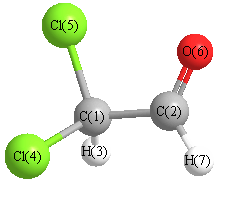 More geometry information
Calculated Bond Angles
| atom1 |
atom2 |
atom3 |
angle |
|
atom1 |
atom2 |
atom3 |
angle |
| C1 |
C2 |
O6 |
122.021 |
|
C1 |
C2 |
H7 |
114.961 |
| C2 |
C1 |
H3 |
109.971 |
|
C2 |
C1 |
Cl4 |
108.519 |
| C2 |
C1 |
Cl5 |
108.519 |
|
H3 |
C1 |
Cl4 |
108.839 |
| H3 |
C1 |
Cl5 |
108.839 |
|
Cl4 |
C1 |
Cl5 |
112.142 |
| O6 |
C2 |
H7 |
123.018 |
|
Electronic energy levels
Charges, Dipole, Quadrupole and Polarizability
Jump to
S1C1
Energy calculated at QCISD/6-31+G**
| | hartrees |
|---|
| Energy at 0K | -1071.459354 |
| Energy at 298.15K | |
| HF Energy | -1070.704597 |
| Nuclear repulsion energy | 265.552661 |
The energy at 298.15K was derived from the energy at 0K
and an integrated heat capacity that used the calculated vibrational frequencies.
Vibrational Frequencies calculated at QCISD/6-31+G**
| Mode Number |
Symmetry |
Frequency
(cm-1) |
Scaled Frequency
(cm-1) |
IR Intensities
(km mol-1) |
Raman Act
(Å4/u) |
Dep P |
Dep U |
|---|
| 1 |
A |
3173 |
3000 |
4.94 |
|
|
|
| 2 |
A |
3061 |
2894 |
44.07 |
|
|
|
| 3 |
A |
1824 |
1725 |
120.52 |
|
|
|
| 4 |
A |
1435 |
1357 |
12.91 |
|
|
|
| 5 |
A |
1312 |
1240 |
16.05 |
|
|
|
| 6 |
A |
1284 |
1214 |
11.97 |
|
|
|
| 7 |
A |
1063 |
1005 |
12.25 |
|
|
|
| 8 |
A |
967 |
915 |
6.18 |
|
|
|
| 9 |
A |
856 |
810 |
72.39 |
|
|
|
| 10 |
A |
669 |
633 |
31.65 |
|
|
|
| 11 |
A |
618 |
584 |
26.07 |
|
|
|
| 12 |
A |
360 |
340 |
0.78 |
|
|
|
| 13 |
A |
284 |
268 |
3.21 |
|
|
|
| 14 |
A |
226 |
214 |
3.53 |
|
|
|
| 15 |
A |
76 |
72 |
12.79 |
|
|
|
Unscaled Zero Point Vibrational Energy (zpe) 8603.8 cm
-1
Scaled (by 0.9454) Zero Point Vibrational Energy (zpe) 8134.0 cm
-1
See section
III.C.1 List or set vibrational scaling factors
to change the scale factors used here.
See section
III.C.2
Calculate a vibrational scaling factor for a given set of molecules
to determine the least squares best scaling factor.
Geometric Data calculated at QCISD/6-31+G**
Point Group is C1
Cartesians (Å)
| Atom |
x (Å) |
y (Å) |
z (Å) |
|---|
| C1 |
0.101 |
-0.037 |
0.504 |
| C2 |
-0.744 |
-1.268 |
0.160 |
| H3 |
0.206 |
0.020 |
1.587 |
| Cl4 |
1.738 |
-0.298 |
-0.159 |
| Cl5 |
-0.629 |
1.464 |
-0.058 |
| O6 |
-1.870 |
-1.224 |
-0.284 |
| H7 |
-0.233 |
-2.218 |
0.382 |
Atom - Atom Distances (Å)
| |
C1 |
C2 |
H3 |
Cl4 |
Cl5 |
O6 |
H7 |
| C1 | | 1.5317 | 1.0893 | 1.7856 | 1.7612 | 2.4316 | 2.2093 |
C2 | 1.5317 | | 2.1437 | 2.6834 | 2.7432 | 1.2115 | 1.1009 | H3 | 1.0893 | 2.1437 | | 2.3445 | 2.3422 | 3.0587 | 2.5790 | Cl4 | 1.7856 | 2.6834 | 2.3445 | | 2.9527 | 3.7268 | 2.8039 | Cl5 | 1.7612 | 2.7432 | 2.3422 | 2.9527 | | 2.9692 | 3.7291 | O6 | 2.4316 | 1.2115 | 3.0587 | 3.7268 | 2.9692 | | 2.0277 | H7 | 2.2093 | 1.1009 | 2.5790 | 2.8039 | 3.7291 | 2.0277 | |
More geometry information
Calculated Bond Angles
| atom1 |
atom2 |
atom3 |
angle |
|
atom1 |
atom2 |
atom3 |
angle |
| C1 |
C2 |
O6 |
124.433 |
|
C1 |
C2 |
H7 |
113.093 |
| C2 |
C1 |
H3 |
108.574 |
|
C2 |
C1 |
Cl4 |
107.737 |
| C2 |
C1 |
Cl5 |
112.644 |
|
H3 |
C1 |
Cl4 |
106.760 |
| H3 |
C1 |
Cl5 |
108.186 |
|
Cl4 |
C1 |
Cl5 |
112.710 |
| O6 |
C2 |
H7 |
122.457 |
|
Electronic energy levels
Charges, Dipole, Quadrupole and Polarizability
