Jump to
S1C2
Vibrational Frequencies calculated at TPSSh/6-31+G**
Geometric Data calculated at TPSSh/6-31+G**
Electronic energy levels
Charges, Dipole, Quadrupole and Polarizability
Jump to
S1C1
Energy calculated at TPSSh/6-31+G**
| | hartrees |
|---|
| Energy at 0K | -115.975248 |
| Energy at 298.15K | -115.976846 |
| HF Energy | -115.975248 |
| Nuclear repulsion energy | 57.822008 |
The energy at 298.15K was derived from the energy at 0K
and an integrated heat capacity that used the calculated vibrational frequencies.
Vibrational Frequencies calculated at TPSSh/6-31+G**
| Mode Number |
Symmetry |
Frequency
(cm-1) |
Scaled Frequency
(cm-1) |
IR Intensities
(km mol-1) |
Raman Act
(Å4/u) |
Dep P |
Dep U |
|---|
| 1 |
A' |
3306 |
3182 |
0.00 |
|
|
|
| 2 |
A' |
3069 |
2953 |
60.55 |
|
|
|
| 3 |
A' |
1664 |
1601 |
0.75 |
|
|
|
| 4 |
A' |
1246 |
1199 |
9.77 |
|
|
|
| 5 |
A' |
993 |
956 |
17.31 |
|
|
|
| 6 |
A' |
928 |
893 |
6.34 |
|
|
|
| 7 |
A' |
607 |
584 |
82.11 |
|
|
|
| 8 |
A" |
3261 |
3138 |
0.79 |
|
|
|
| 9 |
A" |
1039 |
1000 |
25.61 |
|
|
|
| 10 |
A" |
981 |
944 |
5.49 |
|
|
|
| 11 |
A" |
867 |
834 |
0.30 |
|
|
|
| 12 |
A" |
714 |
688 |
41.32 |
|
|
|
Unscaled Zero Point Vibrational Energy (zpe) 9336.6 cm
-1
Scaled (by 0.9625) Zero Point Vibrational Energy (zpe) 8986.4 cm
-1
See section
III.C.1 List or set vibrational scaling factors
to change the scale factors used here.
See section
III.C.2
Calculate a vibrational scaling factor for a given set of molecules
to determine the least squares best scaling factor.
Geometric Data calculated at TPSSh/6-31+G**
Point Group is Cs
Cartesians (Å)
| Atom |
x (Å) |
y (Å) |
z (Å) |
|---|
| C1 |
-0.036 |
0.889 |
0.000 |
| H2 |
0.738 |
1.661 |
0.000 |
| C3 |
-0.036 |
-0.419 |
0.660 |
| C4 |
-0.036 |
-0.419 |
-0.660 |
| H5 |
-0.043 |
-0.983 |
1.580 |
| H6 |
-0.043 |
-0.983 |
-1.580 |
Atom - Atom Distances (Å)
| |
C1 |
H2 |
C3 |
C4 |
H5 |
H6 |
| C1 | | 1.0935 | 1.4648 | 1.4648 | 2.4495 | 2.4495 |
H2 | 1.0935 | | 2.3156 | 2.3156 | 3.1778 | 3.1778 | C3 | 1.4648 | 2.3156 | | 1.3193 | 1.0795 | 2.3097 | C4 | 1.4648 | 2.3156 | 1.3193 | | 2.3097 | 1.0795 | H5 | 2.4495 | 3.1778 | 1.0795 | 2.3097 | | 3.1603 | H6 | 2.4495 | 3.1778 | 2.3097 | 1.0795 | 3.1603 | |
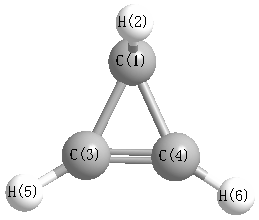 More geometry information
Calculated Bond Angles
| atom1 |
atom2 |
atom3 |
angle |
|
atom1 |
atom2 |
atom3 |
angle |
| C1 |
C3 |
C4 |
63.234 |
|
C1 |
C3 |
H5 |
148.253 |
| C1 |
C4 |
C3 |
63.234 |
|
C1 |
C4 |
H6 |
148.253 |
| H2 |
C1 |
C3 |
129.102 |
|
H2 |
C1 |
C4 |
129.102 |
| C3 |
C1 |
C4 |
53.532 |
|
C3 |
C4 |
H6 |
148.509 |
| C4 |
C3 |
H5 |
148.509 |
|
Electronic energy levels
Charges, Dipole, Quadrupole and Polarizability
Charges from optimized geometry at TPSSh/6-31+G**
Charges (e)
| Number |
Element |
Mulliken |
CHELPG |
AIM |
ESP |
| 1 |
C |
-0.262 |
|
|
|
| 2 |
H |
0.138 |
|
|
|
| 3 |
C |
-0.102 |
|
|
|
| 4 |
C |
-0.102 |
|
|
|
| 5 |
H |
0.164 |
|
|
|
| 6 |
H |
0.164 |
|
|
|
Electric dipole moments
Electric dipole components in Debye
(What's a Debye? See section
VII.A.3)
| |
x |
y |
z |
Total |
| |
0.722 |
-1.355 |
0.000 |
1.535 |
| CHELPG |
|
|
|
|
| AIM |
|
|
|
|
| ESP |
|
|
|
|
Electric Quadrupole moment
Quadrupole components in D Å
Polarizabilities
Components of the polarizability tensor.
Units are
Å
3 (Angstrom cubed)
Change units.
| |
x |
y |
z |
| x |
3.422 |
-0.010 |
0.000 |
| y |
-0.010 |
5.564 |
0.000 |
| z |
0.000 |
0.000 |
5.222 |
<r2> (average value of r
2) Å
2
| <r2> |
33.558 |
| (<r2>)1/2 |
5.793 |
