Jump to
S1C2
Energy calculated at QCISD(T)/cc-pVTZ-PP
| | hartrees |
|---|
| Energy at 0K | -909.981210 |
| Energy at 298.15K | |
| HF Energy | -909.113050 |
| Nuclear repulsion energy | 279.435325 |
The energy at 298.15K was derived from the energy at 0K
and an integrated heat capacity that used the calculated vibrational frequencies.
Vibrational Frequencies calculated at QCISD(T)/cc-pVTZ-PP
| Mode Number |
Symmetry |
Frequency
(cm-1) |
Scaled Frequency
(cm-1) |
IR Intensities
(km mol-1) |
Raman Act
(Å4/u) |
Dep P |
Dep U |
|---|
| 1 |
Ag |
3111 |
3111 |
|
|
|
|
| 2 |
Ag |
1488 |
1488 |
|
|
|
|
| 3 |
Ag |
1291 |
1291 |
|
|
|
|
| 4 |
Ag |
1079 |
1079 |
|
|
|
|
| 5 |
Ag |
691 |
691 |
|
|
|
|
| 6 |
Ag |
192 |
192 |
|
|
|
|
| 7 |
Au |
3192 |
3192 |
|
|
|
|
| 8 |
Au |
1106 |
1106 |
|
|
|
|
| 9 |
Au |
755 |
755 |
|
|
|
|
| 10 |
Au |
100 |
100 |
|
|
|
|
| 11 |
Bg |
3170 |
3170 |
|
|
|
|
| 12 |
Bg |
1291 |
1291 |
|
|
|
|
| 13 |
Bg |
951 |
951 |
|
|
|
|
| 14 |
Bu |
3118 |
3118 |
|
|
|
|
| 15 |
Bu |
1485 |
1485 |
|
|
|
|
| 16 |
Bu |
1211 |
1211 |
|
|
|
|
| 17 |
Bu |
621 |
621 |
|
|
|
|
| 18 |
Bu |
177 |
177 |
|
|
|
|
Unscaled Zero Point Vibrational Energy (zpe) 12514.5 cm
-1
Scaled (by 1) Zero Point Vibrational Energy (zpe) 12514.5 cm
-1
See section
III.C.1 List or set vibrational scaling factors
to change the scale factors used here.
See section
III.C.2
Calculate a vibrational scaling factor for a given set of molecules
to determine the least squares best scaling factor.
Geometric Data calculated at QCISD(T)/cc-pVTZ-PP
Point Group is C2h
Cartesians (Å)
| Atom |
x (Å) |
y (Å) |
z (Å) |
|---|
| C1 |
0.493 |
0.572 |
0.000 |
| C2 |
-0.493 |
-0.572 |
0.000 |
| Br3 |
-0.493 |
2.255 |
0.000 |
| Br4 |
0.493 |
-2.255 |
0.000 |
| H5 |
1.116 |
0.572 |
0.891 |
| H6 |
1.116 |
0.572 |
-0.891 |
| H7 |
-1.116 |
-0.572 |
0.891 |
| H8 |
-1.116 |
-0.572 |
-0.891 |
Atom - Atom Distances (Å)
| |
C1 |
C2 |
Br3 |
Br4 |
H5 |
H6 |
H7 |
H8 |
| C1 | | 1.5106 | 1.9507 | 2.8263 | 1.0863 | 1.0863 | 2.1658 | 2.1658 |
C2 | 1.5106 | | 2.8263 | 1.9507 | 2.1658 | 2.1658 | 1.0863 | 1.0863 | Br3 | 1.9507 | 2.8263 | | 4.6158 | 2.4925 | 2.4925 | 3.0283 | 3.0283 | Br4 | 2.8263 | 1.9507 | 4.6158 | | 3.0283 | 3.0283 | 2.4925 | 2.4925 | H5 | 1.0863 | 2.1658 | 2.4925 | 3.0283 | | 1.7810 | 2.5075 | 3.0757 | H6 | 1.0863 | 2.1658 | 2.4925 | 3.0283 | 1.7810 | | 3.0757 | 2.5075 | H7 | 2.1658 | 1.0863 | 3.0283 | 2.4925 | 2.5075 | 3.0757 | | 1.7810 | H8 | 2.1658 | 1.0863 | 3.0283 | 2.4925 | 3.0757 | 2.5075 | 1.7810 | |
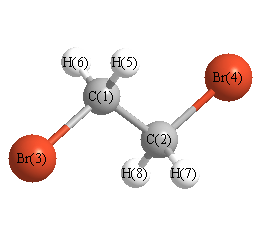 More geometry information
Calculated Bond Angles
| atom1 |
atom2 |
atom3 |
angle |
|
atom1 |
atom2 |
atom3 |
angle |
| C1 |
C2 |
Br4 |
108.818 |
|
C1 |
C2 |
H7 |
111.988 |
| C1 |
C2 |
H8 |
111.988 |
|
C2 |
C1 |
Br3 |
108.818 |
| C2 |
C1 |
H5 |
111.988 |
|
C2 |
C1 |
H6 |
111.988 |
| Br3 |
C1 |
H5 |
106.826 |
|
Br3 |
C1 |
H6 |
106.826 |
| Br4 |
C2 |
H7 |
106.826 |
|
Br4 |
C2 |
H8 |
106.826 |
| H5 |
C1 |
H6 |
110.119 |
|
H7 |
C2 |
H8 |
110.119 |
Electronic energy levels
Charges, Dipole, Quadrupole and Polarizability
Jump to
S1C1
Energy calculated at QCISD(T)/cc-pVTZ-PP
| | hartrees |
|---|
| Energy at 0K | -909.978187 |
| Energy at 298.15K | |
| HF Energy | -909.108813 |
| Nuclear repulsion energy | 296.819828 |
The energy at 298.15K was derived from the energy at 0K
and an integrated heat capacity that used the calculated vibrational frequencies.
Vibrational Frequencies calculated at QCISD(T)/cc-pVTZ-PP
| Mode Number |
Symmetry |
Frequency
(cm-1) |
Scaled Frequency
(cm-1) |
IR Intensities
(km mol-1) |
Raman Act
(Å4/u) |
Dep P |
Dep U |
|---|
| 1 |
A |
3153 |
3153 |
|
|
|
|
| 2 |
A |
3095 |
3095 |
|
|
|
|
| 3 |
A |
1470 |
1470 |
|
|
|
|
| 4 |
A |
1314 |
1314 |
|
|
|
|
| 5 |
A |
1194 |
1194 |
|
|
|
|
| 6 |
A |
1044 |
1044 |
|
|
|
|
| 7 |
A |
915 |
915 |
|
|
|
|
| 8 |
A |
575 |
575 |
|
|
|
|
| 9 |
A |
229 |
229 |
|
|
|
|
| 10 |
A |
81 |
81 |
|
|
|
|
| 11 |
B |
3166 |
3166 |
|
|
|
|
| 12 |
B |
3087 |
3087 |
|
|
|
|
| 13 |
B |
1466 |
1466 |
|
|
|
|
| 14 |
B |
1284 |
1284 |
|
|
|
|
| 15 |
B |
1124 |
1124 |
|
|
|
|
| 16 |
B |
854 |
854 |
|
|
|
|
| 17 |
B |
608 |
608 |
|
|
|
|
| 18 |
B |
357 |
357 |
|
|
|
|
Unscaled Zero Point Vibrational Energy (zpe) 12507.7 cm
-1
Scaled (by 1) Zero Point Vibrational Energy (zpe) 12507.7 cm
-1
See section
III.C.1 List or set vibrational scaling factors
to change the scale factors used here.
See section
III.C.2
Calculate a vibrational scaling factor for a given set of molecules
to determine the least squares best scaling factor.
Geometric Data calculated at QCISD(T)/cc-pVTZ-PP
Point Group is C2
Cartesians (Å)
| Atom |
x (Å) |
y (Å) |
z (Å) |
|---|
| C1 |
0.312 |
0.689 |
1.183 |
| C2 |
-0.312 |
-0.689 |
1.183 |
| Br3 |
-0.312 |
1.783 |
-0.294 |
| Br4 |
0.312 |
-1.783 |
-0.294 |
| H5 |
0.032 |
1.220 |
2.091 |
| H6 |
1.395 |
0.640 |
1.103 |
| H7 |
-0.032 |
-1.220 |
2.091 |
| H8 |
-1.395 |
-0.640 |
1.103 |
Atom - Atom Distances (Å)
| |
C1 |
C2 |
Br3 |
Br4 |
H5 |
H6 |
H7 |
H8 |
| C1 | | 1.5123 | 1.9419 | 2.8797 | 1.0892 | 1.0870 | 2.1420 | 2.1650 |
C2 | 1.5123 | | 2.8797 | 1.9419 | 2.1420 | 2.1650 | 1.0892 | 1.0870 | Br3 | 1.9419 | 2.8797 | | 3.6212 | 2.4752 | 2.4849 | 3.8460 | 2.9992 | Br4 | 2.8797 | 1.9419 | 3.6212 | | 3.8460 | 2.9992 | 2.4752 | 2.4849 | H5 | 1.0892 | 2.1420 | 2.4752 | 3.8460 | | 1.7813 | 2.4414 | 2.5448 | H6 | 1.0870 | 2.1650 | 2.4849 | 2.9992 | 1.7813 | | 2.5448 | 3.0700 | H7 | 2.1420 | 1.0892 | 3.8460 | 2.4752 | 2.4414 | 2.5448 | | 1.7813 | H8 | 2.1650 | 1.0870 | 2.9992 | 2.4849 | 2.5448 | 3.0700 | 1.7813 | |
More geometry information
Calculated Bond Angles
| atom1 |
atom2 |
atom3 |
angle |
|
atom1 |
atom2 |
atom3 |
angle |
| C1 |
C2 |
Br4 |
112.366 |
|
C1 |
C2 |
H7 |
109.772 |
| C1 |
C2 |
H8 |
111.755 |
|
C2 |
C1 |
Br3 |
112.366 |
| C2 |
C1 |
H5 |
109.772 |
|
C2 |
C1 |
H6 |
111.755 |
| Br3 |
C1 |
H5 |
106.051 |
|
Br3 |
C1 |
H6 |
106.833 |
| Br4 |
C2 |
H7 |
106.051 |
|
Br4 |
C2 |
H8 |
106.833 |
| H5 |
C1 |
H6 |
109.868 |
|
H7 |
C2 |
H8 |
109.868 |
Electronic energy levels
Charges, Dipole, Quadrupole and Polarizability
