return to home page Computational Chemistry Comparison and Benchmark DataBase Release 22 (May 2022) Standard Reference Database 101 National Institute of Standards and Technology
You are here: Calculated > Energy > Optimized > Energy

All results from a given calculation for C6H4Cl2 (1,4-dichlorobenzene)

using model chemistry: QCISD(T)/cc-pVDZ

19 10 17 12 22

States and conformations

State Conformation minimum conformation conformer description state description
1 1 yes D2H 1AG
Energy calculated at QCISD(T)/cc-pVDZ
 hartrees
Energy at 0K-1149.703998
Energy at 298.15K-1149.708022
HF Energy-1148.557223
Nuclear repulsion energy444.492596
The energy at 298.15K was derived from the energy at 0K and an integrated heat capacity that used the calculated vibrational frequencies.
Vibrational Frequencies calculated at QCISD(T)/cc-pVDZ
Mode Number Symmetry Frequency
(cm-1)
Scaled Frequency
(cm-1)
IR Intensities
(km mol-1)
Raman Act
(Å4/u)
Dep P Dep U
1 Ag 3226 3075        
2 Ag 1630 1553        
3 Ag 1177 1122        
4 Ag 1117 1065        
5 Ag 748 713        
6 Ag 327 312        
7 Au 935 891        
8 Au 402 384        
9 B1g 817 779        
10 B1u 3210 3059        
11 B1u 1501 1431        
12 B1u 1111 1059        
13 B1u 1009 961        
14 B1u 550 524        
15 B2g 902 860        
16 B2g 600 572        
17 B2g 291 277        
18 B2u 3225 3074        
19 B2u 1411 1345        
20 B2u 1305 1243        
21 B2u 1104 1053        
22 B2u 217 206        
23 B3g 3211 3060        
24 B3g 1614 1538        
25 B3g 1291 1231        
26 B3g 627 598        
27 B3g 345 329        
28 B3u 804 766        
29 B3u 472 450        
30 B3u 101 97        

Unscaled Zero Point Vibrational Energy (zpe) 17639.9 cm-1
Scaled (by 0.9531) Zero Point Vibrational Energy (zpe) 16812.6 cm-1
See section III.C.1 List or set vibrational scaling factors to change the scale factors used here.
See section III.C.2 Calculate a vibrational scaling factor for a given set of molecules to determine the least squares best scaling factor.
Rotational Constants (cm-1) from geometry optimized at QCISD(T)/cc-pVDZ
ABC
0.18527 0.02181 0.01951

See section I.F.4 to change rotational constant units
Geometric Data calculated at QCISD(T)/cc-pVDZ

Point Group is D2h

Cartesians (Å)
Atom x (Å) y (Å) z (Å)
C1 0.000 0.000 1.400
C2 0.000 0.000 -1.400
C3 0.000 1.225 0.704
C4 0.000 -1.225 0.704
C5 0.000 -1.225 -0.704
C6 0.000 1.225 -0.704
Cl7 0.000 0.000 3.154
Cl8 0.000 0.000 -3.154
H9 0.000 2.170 1.259
H10 0.000 -2.170 1.259
H11 0.000 -2.170 -1.259
H12 0.000 2.170 -1.259

Atom - Atom Distances (Å)
  C1 C2 C3 C4 C5 C6 Cl7 Cl8 H9 H10 H11 H12
C12.79941.40841.40842.43462.43461.75474.55412.17472.17473.43173.4317
C22.79942.43462.43461.40841.40844.55411.75473.43173.43172.17472.1747
C31.40842.43462.44952.82581.40882.73904.04851.09593.43993.92162.1789
C41.40842.43462.44951.40882.82582.73904.04853.43991.09592.17893.9216
C52.43461.40842.82581.40882.44954.04852.73903.92162.17891.09593.4399
C62.43461.40841.40882.82582.44954.04852.73902.17893.92163.43991.0959
Cl71.75474.55412.73902.73904.04854.04856.30872.88152.88154.91774.9177
Cl84.55411.75474.04854.04852.73902.73906.30874.91774.91772.88152.8815
H92.17473.43171.09593.43993.92162.17892.88154.91774.34035.01752.5173
H102.17473.43173.43991.09592.17893.92162.88154.91774.34032.51735.0175
H113.43172.17473.92162.17891.09593.43994.91772.88155.01752.51734.3403
H123.43172.17472.17893.92163.43991.09594.91772.88152.51735.01754.3403

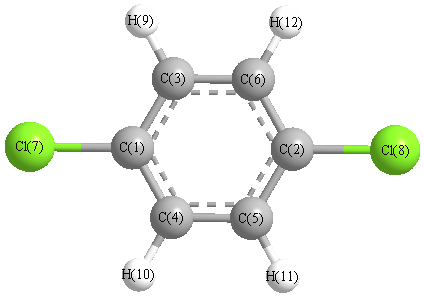
picture of 1,4-dichlorobenzene state 1 conformation 1
More geometry information
Calculated Bond Angles
atom1 atom2 atom3 angle atom1 atom2 atom3 angle
C1 C3 C6 119.583 C1 C3 H9 120.035
C1 C4 C5 119.583 C1 C4 H10 120.035
C2 C5 C4 119.583 C2 C5 H11 120.035
C2 C6 C3 119.583 C2 C6 H12 120.035
C3 C1 C4 120.834 C3 C1 Cl7 119.583
C3 C6 H12 120.382 C4 C1 Cl7 119.583
C4 C5 H11 120.382 C5 C2 C6 120.834
C5 C2 Cl8 119.583 C5 C4 H10 120.382
C6 C2 Cl8 119.583 C6 C3 H9 120.382
Electronic energy levels
Charges, Dipole, Quadrupole and Polarizability