Jump to
S1C2
Energy calculated at QCISD(T)/cc-pVDZ
| | hartrees |
|---|
| Energy at 0K | -5223.446341 |
| Energy at 298.15K | -5223.456510 |
| HF Energy | -5222.843195 |
| Nuclear repulsion energy | 414.802311 |
The energy at 298.15K was derived from the energy at 0K
and an integrated heat capacity that used the calculated vibrational frequencies.
Vibrational Frequencies calculated at QCISD(T)/cc-pVDZ
| Mode Number |
Symmetry |
Frequency
(cm-1) |
Scaled Frequency
(cm-1) |
IR Intensities
(km mol-1) |
Raman Act
(Å4/u) |
Dep P |
Dep U |
|---|
| 1 |
Ag |
3115 |
2969 |
|
|
|
|
| 2 |
Ag |
1479 |
1409 |
|
|
|
|
| 3 |
Ag |
1290 |
1230 |
|
|
|
|
| 4 |
Ag |
1080 |
1029 |
|
|
|
|
| 5 |
Ag |
688 |
655 |
|
|
|
|
| 6 |
Ag |
192 |
183 |
|
|
|
|
| 7 |
Au |
3200 |
3050 |
|
|
|
|
| 8 |
Au |
1101 |
1049 |
|
|
|
|
| 9 |
Au |
751 |
716 |
|
|
|
|
| 10 |
Au |
104 |
99 |
|
|
|
|
| 11 |
Bg |
3180 |
3031 |
|
|
|
|
| 12 |
Bg |
1280 |
1220 |
|
|
|
|
| 13 |
Bg |
947 |
903 |
|
|
|
|
| 14 |
Bu |
3119 |
2972 |
|
|
|
|
| 15 |
Bu |
1470 |
1401 |
|
|
|
|
| 16 |
Bu |
1202 |
1145 |
|
|
|
|
| 17 |
Bu |
612 |
583 |
|
|
|
|
| 18 |
Bu |
180 |
171 |
|
|
|
|
Unscaled Zero Point Vibrational Energy (zpe) 12493.6 cm
-1
Scaled (by 0.9531) Zero Point Vibrational Energy (zpe) 11907.7 cm
-1
See section
III.C.1 List or set vibrational scaling factors
to change the scale factors used here.
See section
III.C.2
Calculate a vibrational scaling factor for a given set of molecules
to determine the least squares best scaling factor.
Geometric Data calculated at QCISD(T)/cc-pVDZ
Point Group is C2h
Cartesians (Å)
| Atom |
x (Å) |
y (Å) |
z (Å) |
|---|
| C1 |
0.495 |
0.578 |
0.000 |
| C2 |
-0.495 |
-0.578 |
0.000 |
| Br3 |
-0.495 |
2.277 |
0.000 |
| Br4 |
0.495 |
-2.277 |
0.000 |
| H5 |
1.128 |
0.575 |
0.902 |
| H6 |
1.128 |
0.575 |
-0.902 |
| H7 |
-1.128 |
-0.575 |
0.902 |
| H8 |
-1.128 |
-0.575 |
-0.902 |
Atom - Atom Distances (Å)
| |
C1 |
C2 |
Br3 |
Br4 |
H5 |
H6 |
H7 |
H8 |
| C1 | | 1.5224 | 1.9664 | 2.8553 | 1.1016 | 1.1016 | 2.1855 | 2.1855 |
C2 | 1.5224 | | 2.8553 | 1.9664 | 2.1855 | 2.1855 | 1.1016 | 1.1016 | Br3 | 1.9664 | 2.8553 | | 4.6605 | 2.5190 | 2.5190 | 3.0571 | 3.0571 | Br4 | 2.8553 | 1.9664 | 4.6605 | | 3.0571 | 3.0571 | 2.5190 | 2.5190 | H5 | 1.1016 | 2.1855 | 2.5190 | 3.0571 | | 1.8034 | 2.5318 | 3.1084 | H6 | 1.1016 | 2.1855 | 2.5190 | 3.0571 | 1.8034 | | 3.1084 | 2.5318 | H7 | 2.1855 | 1.1016 | 3.0571 | 2.5190 | 2.5318 | 3.1084 | | 1.8034 | H8 | 2.1855 | 1.1016 | 3.0571 | 2.5190 | 3.1084 | 2.5318 | 1.8034 | |
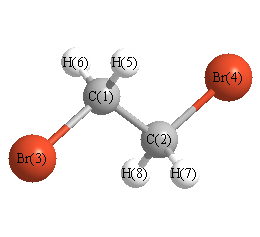 More geometry information
Calculated Bond Angles
| atom1 |
atom2 |
atom3 |
angle |
|
atom1 |
atom2 |
atom3 |
angle |
| C1 |
C2 |
Br4 |
109.192 |
|
C1 |
C2 |
H7 |
111.789 |
| C1 |
C2 |
H8 |
111.789 |
|
C2 |
C1 |
Br3 |
109.192 |
| C2 |
C1 |
H5 |
111.789 |
|
C2 |
C1 |
H6 |
111.789 |
| Br3 |
C1 |
H5 |
106.981 |
|
Br3 |
C1 |
H6 |
106.981 |
| Br4 |
C2 |
H7 |
106.981 |
|
Br4 |
C2 |
H8 |
106.981 |
| H5 |
C1 |
H6 |
109.875 |
|
H7 |
C2 |
H8 |
109.875 |
Electronic energy levels
Charges, Dipole, Quadrupole and Polarizability
Jump to
S1C1
Energy calculated at QCISD(T)/cc-pVDZ
| | hartrees |
|---|
| Energy at 0K | -5223.443086 |
| Energy at 298.15K | |
| HF Energy | -5222.839188 |
| Nuclear repulsion energy | 449.301187 |
The energy at 298.15K was derived from the energy at 0K
and an integrated heat capacity that used the calculated vibrational frequencies.
Vibrational Frequencies calculated at QCISD(T)/cc-pVDZ
| Mode Number |
Symmetry |
Frequency
(cm-1) |
Scaled Frequency
(cm-1) |
IR Intensities
(km mol-1) |
Raman Act
(Å4/u) |
Dep P |
Dep U |
|---|
| 1 |
A |
3163 |
3015 |
|
|
|
|
| 2 |
A |
3098 |
2953 |
|
|
|
|
| 3 |
A |
1459 |
1391 |
|
|
|
|
| 4 |
A |
1307 |
1246 |
|
|
|
|
| 5 |
A |
1194 |
1138 |
|
|
|
|
| 6 |
A |
1047 |
998 |
|
|
|
|
| 7 |
A |
916 |
873 |
|
|
|
|
| 8 |
A |
565 |
539 |
|
|
|
|
| 9 |
A |
230 |
220 |
|
|
|
|
| 10 |
A |
83 |
79 |
|
|
|
|
| 11 |
B |
3174 |
3025 |
|
|
|
|
| 12 |
B |
3088 |
2944 |
|
|
|
|
| 13 |
B |
1452 |
1384 |
|
|
|
|
| 14 |
B |
1277 |
1217 |
|
|
|
|
| 15 |
B |
1118 |
1065 |
|
|
|
|
| 16 |
B |
847 |
808 |
|
|
|
|
| 17 |
B |
600 |
572 |
|
|
|
|
| 18 |
B |
357 |
340 |
|
|
|
|
Unscaled Zero Point Vibrational Energy (zpe) 12488.0 cm
-1
Scaled (by 0.9531) Zero Point Vibrational Energy (zpe) 11902.3 cm
-1
See section
III.C.1 List or set vibrational scaling factors
to change the scale factors used here.
See section
III.C.2
Calculate a vibrational scaling factor for a given set of molecules
to determine the least squares best scaling factor.
Geometric Data calculated at QCISD(T)/cc-pVDZ
Point Group is C2
Cartesians (Å)
| Atom |
x (Å) |
y (Å) |
z (Å) |
|---|
| C1 |
0.310 |
0.696 |
1.192 |
| C2 |
-0.310 |
-0.696 |
1.192 |
| Br3 |
-0.310 |
1.805 |
-0.297 |
| Br4 |
0.310 |
-1.805 |
-0.297 |
| H5 |
0.018 |
1.227 |
2.115 |
| H6 |
1.410 |
0.650 |
1.123 |
| H7 |
-0.018 |
-1.227 |
2.115 |
| H8 |
-1.410 |
-0.650 |
1.123 |
Atom - Atom Distances (Å)
| |
C1 |
C2 |
Br3 |
Br4 |
H5 |
H6 |
H7 |
H8 |
| C1 | | 1.5242 | 1.9579 | 2.9110 | 1.1045 | 1.1022 | 2.1584 | 2.1852 |
C2 | 1.5242 | | 2.9110 | 1.9579 | 2.1584 | 2.1852 | 1.1045 | 1.1022 | Br3 | 1.9579 | 2.9110 | | 3.6638 | 2.5022 | 2.5122 | 3.8859 | 3.0422 | Br4 | 2.9110 | 1.9579 | 3.6638 | | 3.8859 | 3.0422 | 2.5022 | 2.5122 | H5 | 1.1045 | 2.1584 | 2.5022 | 3.8859 | | 1.8035 | 2.4545 | 2.5585 | H6 | 1.1022 | 2.1852 | 2.5122 | 3.0422 | 1.8035 | | 2.5585 | 3.1046 | H7 | 2.1584 | 1.1045 | 3.8859 | 2.5022 | 2.4545 | 2.5585 | | 1.8035 | H8 | 2.1852 | 1.1022 | 3.0422 | 2.5122 | 2.5585 | 3.1046 | 1.8035 | |
More geometry information
Calculated Bond Angles
| atom1 |
atom2 |
atom3 |
angle |
|
atom1 |
atom2 |
atom3 |
angle |
| C1 |
C2 |
Br4 |
112.848 |
|
C1 |
C2 |
H7 |
109.350 |
| C1 |
C2 |
H8 |
111.607 |
|
C2 |
C1 |
Br3 |
112.848 |
| C2 |
C1 |
H5 |
109.350 |
|
C2 |
C1 |
H6 |
111.607 |
| Br3 |
C1 |
H5 |
106.214 |
|
Br3 |
C1 |
H6 |
107.013 |
| Br4 |
C2 |
H7 |
106.214 |
|
Br4 |
C2 |
H8 |
107.013 |
| H5 |
C1 |
H6 |
109.629 |
|
H7 |
C2 |
H8 |
109.629 |
Electronic energy levels
Charges, Dipole, Quadrupole and Polarizability
