Jump to
S1C2
Energy calculated at QCISD(T)/cc-pVDZ
| | hartrees |
|---|
| Energy at 0K | -191.408302 |
| Energy at 298.15K | |
| HF Energy | -190.775292 |
| Nuclear repulsion energy | 101.918840 |
The energy at 298.15K was derived from the energy at 0K
and an integrated heat capacity that used the calculated vibrational frequencies.
Vibrational Frequencies calculated at QCISD(T)/cc-pVDZ
| Mode Number |
Symmetry |
Frequency
(cm-1) |
Scaled Frequency
(cm-1) |
IR Intensities
(km mol-1) |
Raman Act
(Å4/u) |
Dep P |
Dep U |
|---|
| 1 |
A' |
3252 |
3100 |
|
|
|
|
| 2 |
A' |
3197 |
3047 |
|
|
|
|
| 3 |
A' |
3148 |
3001 |
|
|
|
|
| 4 |
A' |
2906 |
2770 |
|
|
|
|
| 5 |
A' |
1773 |
1690 |
|
|
|
|
| 6 |
A' |
1662 |
1584 |
|
|
|
|
| 7 |
A' |
1443 |
1376 |
|
|
|
|
| 8 |
A' |
1380 |
1316 |
|
|
|
|
| 9 |
A' |
1279 |
1219 |
|
|
|
|
| 10 |
A' |
1159 |
1104 |
|
|
|
|
| 11 |
A' |
914 |
871 |
|
|
|
|
| 12 |
A' |
562 |
536 |
|
|
|
|
| 13 |
A' |
310 |
296 |
|
|
|
|
| 14 |
A" |
1014 |
967 |
|
|
|
|
| 15 |
A" |
998 |
951 |
|
|
|
|
| 16 |
A" |
948 |
904 |
|
|
|
|
| 17 |
A" |
596 |
568 |
|
|
|
|
| 18 |
A" |
162 |
154 |
|
|
|
|
Unscaled Zero Point Vibrational Energy (zpe) 13351.1 cm
-1
Scaled (by 0.9531) Zero Point Vibrational Energy (zpe) 12725.0 cm
-1
See section
III.C.1 List or set vibrational scaling factors
to change the scale factors used here.
See section
III.C.2
Calculate a vibrational scaling factor for a given set of molecules
to determine the least squares best scaling factor.
Geometric Data calculated at QCISD(T)/cc-pVDZ
Point Group is Cs
Cartesians (Å)
| Atom |
x (Å) |
y (Å) |
z (Å) |
|---|
| C1 |
-0.156 |
-0.754 |
0.000 |
| C2 |
0.000 |
0.728 |
0.000 |
| C3 |
1.233 |
1.292 |
0.000 |
| O4 |
-1.233 |
-1.330 |
0.000 |
| H5 |
0.815 |
-1.321 |
0.000 |
| H6 |
-0.922 |
1.325 |
0.000 |
| H7 |
1.376 |
2.380 |
0.000 |
| H8 |
2.137 |
0.666 |
0.000 |
Atom - Atom Distances (Å)
| |
C1 |
C2 |
C3 |
O4 |
H5 |
H6 |
H7 |
H8 |
| C1 | | 1.4905 | 2.4736 | 1.2213 | 1.1245 | 2.2161 | 3.4889 | 2.6971 |
C2 | 1.4905 | | 1.3558 | 2.3993 | 2.2052 | 1.0986 | 2.1501 | 2.1377 | C3 | 2.4736 | 1.3558 | | 3.5999 | 2.6467 | 2.1551 | 1.0970 | 1.1001 | O4 | 1.2213 | 2.3993 | 3.5999 | | 2.0482 | 2.6735 | 4.5358 | 3.9167 | H5 | 1.1245 | 2.2052 | 2.6467 | 2.0482 | | 3.1655 | 3.7434 | 2.3863 | H6 | 2.2161 | 1.0986 | 2.1551 | 2.6735 | 3.1655 | | 2.5287 | 3.1293 | H7 | 3.4889 | 2.1501 | 1.0970 | 4.5358 | 3.7434 | 2.5287 | | 1.8757 | H8 | 2.6971 | 2.1377 | 1.1001 | 3.9167 | 2.3863 | 3.1293 | 1.8757 | |
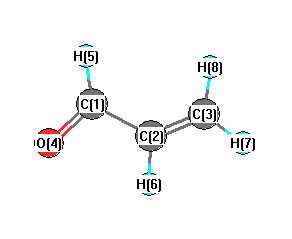 More geometry information
Calculated Bond Angles
| atom1 |
atom2 |
atom3 |
angle |
|
atom1 |
atom2 |
atom3 |
angle |
| C1 |
C2 |
C3 |
120.619 |
|
C1 |
C2 |
H6 |
116.912 |
| C2 |
C1 |
O4 |
124.150 |
|
C2 |
C1 |
H5 |
114.249 |
| C2 |
C3 |
H7 |
122.107 |
|
C2 |
C3 |
H8 |
120.663 |
| C3 |
C2 |
H6 |
122.469 |
|
O4 |
C1 |
H5 |
121.600 |
| H7 |
C3 |
H8 |
117.230 |
|
Electronic energy levels
Charges, Dipole, Quadrupole and Polarizability
Jump to
S1C1
Energy calculated at QCISD(T)/cc-pVDZ
| | hartrees |
|---|
| Energy at 0K | -191.406482 |
| Energy at 298.15K | |
| HF Energy | -190.772776 |
| Nuclear repulsion energy | 103.573301 |
The energy at 298.15K was derived from the energy at 0K
and an integrated heat capacity that used the calculated vibrational frequencies.
Vibrational Frequencies calculated at QCISD(T)/cc-pVDZ
| Mode Number |
Symmetry |
Frequency
(cm-1) |
Scaled Frequency
(cm-1) |
IR Intensities
(km mol-1) |
Raman Act
(Å4/u) |
Dep P |
Dep U |
|---|
| 1 |
A' |
3266 |
3113 |
|
|
|
|
| 2 |
A' |
3184 |
3035 |
|
|
|
|
| 3 |
A' |
3159 |
3011 |
|
|
|
|
| 4 |
A' |
2938 |
2800 |
|
|
|
|
| 5 |
A' |
1765 |
1683 |
|
|
|
|
| 6 |
A' |
1660 |
1582 |
|
|
|
|
| 7 |
A' |
1428 |
1361 |
|
|
|
|
| 8 |
A' |
1415 |
1349 |
|
|
|
|
| 9 |
A' |
1293 |
1232 |
|
|
|
|
| 10 |
A' |
1055 |
1006 |
|
|
|
|
| 11 |
A' |
935 |
891 |
|
|
|
|
| 12 |
A' |
671 |
640 |
|
|
|
|
| 13 |
A' |
288 |
275 |
|
|
|
|
| 14 |
A" |
1013 |
965 |
|
|
|
|
| 15 |
A" |
999 |
952 |
|
|
|
|
| 16 |
A" |
959 |
914 |
|
|
|
|
| 17 |
A" |
553 |
527 |
|
|
|
|
| 18 |
A" |
182 |
173 |
|
|
|
|
Unscaled Zero Point Vibrational Energy (zpe) 13381.0 cm
-1
Scaled (by 0.9531) Zero Point Vibrational Energy (zpe) 12753.4 cm
-1
See section
III.C.1 List or set vibrational scaling factors
to change the scale factors used here.
See section
III.C.2
Calculate a vibrational scaling factor for a given set of molecules
to determine the least squares best scaling factor.
Geometric Data calculated at QCISD(T)/cc-pVDZ
Point Group is Cs
Cartesians (Å)
| Atom |
x (Å) |
y (Å) |
z (Å) |
|---|
| C1 |
-0.902 |
-0.288 |
0.000 |
| C2 |
0.000 |
0.911 |
0.000 |
| C3 |
1.348 |
0.764 |
0.000 |
| O4 |
-0.501 |
-1.443 |
0.000 |
| H5 |
-2.000 |
-0.060 |
0.000 |
| H6 |
-0.473 |
1.903 |
0.000 |
| H7 |
2.024 |
1.627 |
0.000 |
| H8 |
1.785 |
-0.244 |
0.000 |
Atom - Atom Distances (Å)
| |
C1 |
C2 |
C3 |
O4 |
H5 |
H6 |
H7 |
H8 |
| C1 | | 1.5001 | 2.4836 | 1.2226 | 1.1213 | 2.2327 | 3.4975 | 2.6875 |
C2 | 1.5001 | | 1.3558 | 2.4062 | 2.2235 | 1.0994 | 2.1475 | 2.1257 | C3 | 2.4836 | 1.3558 | | 2.8788 | 3.4480 | 2.1478 | 1.0971 | 1.0982 | O4 | 1.2226 | 2.4062 | 2.8788 | | 2.0392 | 3.3460 | 3.9754 | 2.5815 | H5 | 1.1213 | 2.2235 | 3.4480 | 2.0392 | | 2.4876 | 4.3641 | 3.7896 | H6 | 2.2327 | 1.0994 | 2.1478 | 3.3460 | 2.4876 | | 2.5123 | 3.1155 | H7 | 3.4975 | 2.1475 | 1.0971 | 3.9754 | 4.3641 | 2.5123 | | 1.8863 | H8 | 2.6875 | 2.1257 | 1.0982 | 2.5815 | 3.7896 | 3.1155 | 1.8863 | |
More geometry information
Calculated Bond Angles
| atom1 |
atom2 |
atom3 |
angle |
|
atom1 |
atom2 |
atom3 |
angle |
| C1 |
C2 |
C3 |
120.753 |
|
C1 |
C2 |
H6 |
117.555 |
| C2 |
C1 |
O4 |
123.877 |
|
C2 |
C1 |
H5 |
115.266 |
| C2 |
C3 |
H7 |
121.854 |
|
C2 |
C3 |
H8 |
119.676 |
| C3 |
C2 |
H6 |
121.692 |
|
O4 |
C1 |
H5 |
120.857 |
| H7 |
C3 |
H8 |
118.471 |
|
Electronic energy levels
Charges, Dipole, Quadrupole and Polarizability
