return to home page Computational Chemistry Comparison and Benchmark DataBase Release 22 (May 2022) Standard Reference Database 101 National Institute of Standards and Technology
You are here: Calculated > Energy > Optimized > Energy

All results from a given calculation for C2H5CN (ethyl cyanide)

using model chemistry: QCISD(T)/cc-pVDZ

19 10 17 12 22

States and conformations

State Conformation minimum conformation conformer description state description
1 1 yes Cs 1A'
Energy calculated at QCISD(T)/cc-pVDZ
 hartrees
Energy at 0K-171.598798
Energy at 298.15K 
HF Energy-170.971137
Nuclear repulsion energy101.654402
The energy at 298.15K was derived from the energy at 0K and an integrated heat capacity that used the calculated vibrational frequencies.
Vibrational Frequencies calculated at QCISD(T)/cc-pVDZ
Mode Number Symmetry Frequency
(cm-1)
Scaled Frequency
(cm-1)
IR Intensities
(km mol-1)
Raman Act
(Å4/u)
Dep P Dep U
1 A' 3148 3000        
2 A' 3071 2927        
3 A' 3057 2913        
4 A' 2274 2168        
5 A' 1494 1424        
6 A' 1465 1396        
7 A' 1410 1344        
8 A' 1347 1284        
9 A' 1093 1042        
10 A' 1032 984        
11 A' 840 800        
12 A' 523 499        
13 A' 204 194        
14 A" 3153 3005        
15 A" 3118 2972        
16 A" 1486 1417        
17 A" 1283 1223        
18 A" 1107 1055        
19 A" 782 745        
20 A" 373 356        
21 A" 230 219        

Unscaled Zero Point Vibrational Energy (zpe) 16243.6 cm-1
Scaled (by 0.9531) Zero Point Vibrational Energy (zpe) 15481.8 cm-1
See section III.C.1 List or set vibrational scaling factors to change the scale factors used here.
See section III.C.2 Calculate a vibrational scaling factor for a given set of molecules to determine the least squares best scaling factor.
Rotational Constants (cm-1) from geometry optimized at QCISD(T)/cc-pVDZ
ABC
0.91108 0.15312 0.13799

See section I.F.4 to change rotational constant units
Geometric Data calculated at QCISD(T)/cc-pVDZ

Point Group is Cs

Cartesians (Å)
Atom x (Å) y (Å) z (Å)
C1 1.521 0.578 0.000
C2 0.000 0.828 0.000
C3 -0.774 -0.438 0.000
N4 -1.369 -1.455 0.000
H5 2.058 1.544 0.000
H6 1.825 0.007 0.896
H7 1.825 0.007 -0.896
H8 -0.302 1.411 0.890
H9 -0.302 1.411 -0.890

Atom - Atom Distances (Å)
  C1 C2 C3 N4 H5 H6 H7 H8 H9
C11.54152.51063.53391.10521.10511.10512.19282.1928
C21.54151.48402.66182.17912.19212.19211.10621.1062
C32.51061.48401.17793.45732.78482.78482.10612.1061
N43.53392.66181.17794.55433.62503.62503.18513.1851
H51.10522.17913.45734.55431.79471.79472.52542.5254
H61.10512.19212.78483.62501.79471.79192.54793.1116
H71.10512.19212.78483.62501.79471.79193.11162.5479
H82.19281.10622.10613.18512.52542.54793.11161.7805
H92.19281.10622.10613.18512.52543.11162.54791.7805

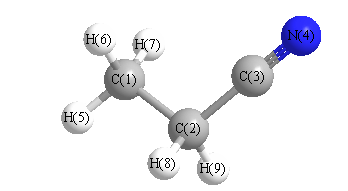
picture of ethyl cyanide state 1 conformation 1
More geometry information
Calculated Bond Angles
atom1 atom2 atom3 angle atom1 atom2 atom3 angle
C1 C2 C3 112.142 C1 C2 H8 110.758
C1 C2 H9 110.758 C2 C1 H5 109.740
C2 C1 H6 110.766 C2 C1 H7 110.766
C2 C3 N4 178.885 C3 C2 H8 107.906
C3 C2 H9 107.906 H5 C1 H6 108.580
H5 C1 H7 108.580 H6 C1 H7 108.344
H8 C2 H9 107.176
Electronic energy levels
Charges, Dipole, Quadrupole and Polarizability