return to home page Computational Chemistry Comparison and Benchmark DataBase Release 22 (May 2022) Standard Reference Database 101 National Institute of Standards and Technology
You are here: Calculated > Energy > Optimized > Energy

All results from a given calculation for C2H5CN (ethyl cyanide)

using model chemistry: CCSD(T)=FULL/cc-pVDZ

19 10 17 12 22

States and conformations

State Conformation minimum conformation conformer description state description
1 1 yes Cs 1A'
Energy calculated at CCSD(T)=FULL/cc-pVDZ
 hartrees
Energy at 0K-171.607379
Energy at 298.15K 
HF Energy-170.971514
Nuclear repulsion energy101.759500
The energy at 298.15K was derived from the energy at 0K and an integrated heat capacity that used the calculated vibrational frequencies.
Vibrational Frequencies calculated at CCSD(T)=FULL/cc-pVDZ
Mode Number Symmetry Frequency
(cm-1)
Scaled Frequency
(cm-1)
IR Intensities
(km mol-1)
Raman Act
(Å4/u)
Dep P Dep U
1 A' 3155 3039        
2 A' 3077 2964        
3 A' 3063 2951        
4 A' 2284 2200        
5 A' 1497 1441        
6 A' 1467 1413        
7 A' 1412 1361        
8 A' 1350 1300        
9 A' 1095 1055        
10 A' 1035 997        
11 A' 843 812        
12 A' 525 506        
13 A' 205 197        
14 A" 3160 3044        
15 A" 3125 3010        
16 A" 1489 1434        
17 A" 1285 1238        
18 A" 1108 1068        
19 A" 783 754        
20 A" 375 361        
21 A" 230 222        

Unscaled Zero Point Vibrational Energy (zpe) 16280.3 cm-1
Scaled (by 0.9632) Zero Point Vibrational Energy (zpe) 15681.1 cm-1
See section III.C.1 List or set vibrational scaling factors to change the scale factors used here.
See section III.C.2 Calculate a vibrational scaling factor for a given set of molecules to determine the least squares best scaling factor.
Rotational Constants (cm-1) from geometry optimized at CCSD(T)=FULL/cc-pVDZ
ABC
0.91287 0.15345 0.13828

See section I.F.4 to change rotational constant units
Geometric Data calculated at CCSD(T)=FULL/cc-pVDZ

Point Group is Cs

Cartesians (Å)
Atom x (Å) y (Å) z (Å)
C1 1.520 0.577 0.000
C2 0.000 0.827 0.000
C3 -0.774 -0.438 0.000
N4 -1.368 -1.453 0.000
H5 2.056 1.542 0.000
H6 1.823 0.007 0.895
H7 1.823 0.007 -0.895
H8 -0.301 1.409 0.889
H9 -0.301 1.409 -0.889

Atom - Atom Distances (Å)
  C1 C2 C3 N4 H5 H6 H7 H8 H9
C11.54012.50793.53021.10411.10401.10402.19092.1909
C21.54011.48222.65882.17742.19022.19021.10511.1051
C32.50791.48221.17673.45382.78212.78212.10372.1037
N43.53022.65881.17674.54973.62143.62143.18173.1817
H51.10412.17743.45384.54971.79271.79272.52342.5234
H61.10402.19022.78213.62141.79271.79002.54583.1088
H71.10402.19022.78213.62141.79271.79003.10882.5458
H82.19091.10512.10373.18172.52342.54583.10881.7785
H92.19091.10512.10373.18172.52343.10882.54581.7785

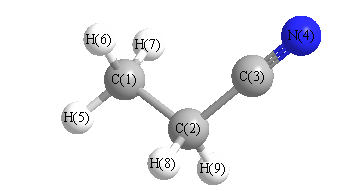
picture of ethyl cyanide state 1 conformation 1
More geometry information
Calculated Bond Angles
atom1 atom2 atom3 angle atom1 atom2 atom3 angle
C1 C2 C3 112.144 C1 C2 H8 110.765
C1 C2 H9 110.765 C2 C1 H5 109.766
C2 C1 H6 110.778 C2 C1 H7 110.778
C2 C3 N4 178.889 C3 C2 H8 107.910
C3 C2 H9 107.910 H5 C1 H6 108.562
H5 C1 H7 108.562 H6 C1 H7 108.330
H8 C2 H9 107.153
Electronic energy levels
Charges, Dipole, Quadrupole and Polarizability