return to home page Computational Chemistry Comparison and Benchmark DataBase Release 22 (May 2022) Standard Reference Database 101 National Institute of Standards and Technology
You are here: Calculated > Energy > Optimized > Energy

All results from a given calculation for C2H5CN (ethyl cyanide)

using model chemistry: QCISD(T)=FULL/cc-pVDZ

19 10 17 12 22

States and conformations

State Conformation minimum conformation conformer description state description
1 1 yes Cs 1A'
Energy calculated at QCISD(T)=FULL/cc-pVDZ
 hartrees
Energy at 0K-171.607978
Energy at 298.15K 
HF Energy-170.971399
Nuclear repulsion energy101.741435
The energy at 298.15K was derived from the energy at 0K and an integrated heat capacity that used the calculated vibrational frequencies.
Vibrational Frequencies calculated at QCISD(T)=FULL/cc-pVDZ
Mode Number Symmetry Frequency
(cm-1)
Scaled Frequency
(cm-1)
IR Intensities
(km mol-1)
Raman Act
(Å4/u)
Dep P Dep U
1 A' 3154 3025        
2 A' 3076 2950        
3 A' 3062 2937        
4 A' 2278 2185        
5 A' 1496 1435        
6 A' 1467 1407        
7 A' 1412 1354        
8 A' 1349 1294        
9 A' 1094 1050        
10 A' 1034 992        
11 A' 842 807        
12 A' 525 503        
13 A' 205 196        
14 A" 3159 3030        
15 A" 3124 2996        
16 A" 1489 1428        
17 A" 1285 1232        
18 A" 1108 1063        
19 A" 783 751        
20 A" 375 359        
21 A" 230 221        

Unscaled Zero Point Vibrational Energy (zpe) 16273.5 cm-1
Scaled (by 0.959) Zero Point Vibrational Energy (zpe) 15606.3 cm-1
See section III.C.1 List or set vibrational scaling factors to change the scale factors used here.
See section III.C.2 Calculate a vibrational scaling factor for a given set of molecules to determine the least squares best scaling factor.
Rotational Constants (cm-1) from geometry optimized at QCISD(T)=FULL/cc-pVDZ
ABC
0.91273 0.15339 0.13823

See section I.F.4 to change rotational constant units
Geometric Data calculated at QCISD(T)=FULL/cc-pVDZ

Point Group is Cs

Cartesians (Å)
Atom x (Å) y (Å) z (Å)
C1 1.520 0.578 0.000
C2 0.000 0.827 0.000
C3 -0.774 -0.438 0.000
N4 -1.368 -1.454 0.000
H5 2.056 1.543 0.000
H6 1.823 0.007 0.895
H7 1.823 0.007 -0.895
H8 -0.301 1.410 0.889
H9 -0.301 1.410 -0.889

Atom - Atom Distances (Å)
  C1 C2 C3 N4 H5 H6 H7 H8 H9
C11.54012.50813.53101.10421.10401.10402.19092.1909
C21.54011.48242.65952.17752.19032.19031.10521.1052
C32.50811.48241.17723.45412.78242.78242.10392.1039
N43.53102.65951.17724.55053.62213.62213.18243.1824
H51.10422.17753.45414.55051.79281.79282.52352.5235
H61.10402.19032.78243.62211.79281.79012.54603.1090
H71.10402.19032.78243.62211.79281.79013.10902.5460
H82.19091.10522.10393.18242.52352.54603.10901.7786
H92.19091.10522.10393.18242.52353.10902.54601.7786

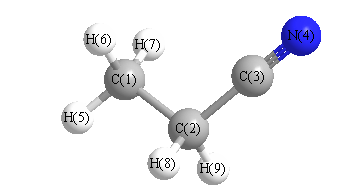
picture of ethyl cyanide state 1 conformation 1
More geometry information
Calculated Bond Angles
atom1 atom2 atom3 angle atom1 atom2 atom3 angle
C1 C2 C3 112.147 C1 C2 H8 110.763
C1 C2 H9 110.763 C2 C1 H5 109.768
C2 C1 H6 110.779 C2 C1 H7 110.779
C2 C3 N4 178.889 C3 C2 H8 107.911
C3 C2 H9 107.911 H5 C1 H6 108.561
H5 C1 H7 108.561 H6 C1 H7 108.328
H8 C2 H9 107.152
Electronic energy levels
Charges, Dipole, Quadrupole and Polarizability