Jump to
S1C2
Vibrational Frequencies calculated at QCISD(T)/cc-pVDZ
Geometric Data calculated at QCISD(T)/cc-pVDZ
Electronic energy levels
Charges, Dipole, Quadrupole and Polarizability
Jump to
S1C1
Energy calculated at QCISD(T)/cc-pVDZ
| | hartrees |
|---|
| Energy at 0K | -207.435368 |
| Energy at 298.15K | -207.438705 |
| HF Energy | -206.782421 |
| Nuclear repulsion energy | 101.109534 |
The energy at 298.15K was derived from the energy at 0K
and an integrated heat capacity that used the calculated vibrational frequencies.
Vibrational Frequencies calculated at QCISD(T)/cc-pVDZ
| Mode Number |
Symmetry |
Frequency
(cm-1) |
Scaled Frequency
(cm-1) |
IR Intensities
(km mol-1) |
Raman Act
(Å4/u) |
Dep P |
Dep U |
|---|
| 1 |
A |
3820 |
3641 |
|
|
|
|
| 2 |
A |
3135 |
2988 |
|
|
|
|
| 3 |
A |
3042 |
2899 |
|
|
|
|
| 4 |
A |
2266 |
2160 |
|
|
|
|
| 5 |
A |
1484 |
1414 |
|
|
|
|
| 6 |
A |
1432 |
1365 |
|
|
|
|
| 7 |
A |
1380 |
1315 |
|
|
|
|
| 8 |
A |
1227 |
1169 |
|
|
|
|
| 9 |
A |
1104 |
1052 |
|
|
|
|
| 10 |
A |
987 |
941 |
|
|
|
|
| 11 |
A |
891 |
850 |
|
|
|
|
| 12 |
A |
565 |
539 |
|
|
|
|
| 13 |
A |
392 |
374 |
|
|
|
|
| 14 |
A |
304 |
289 |
|
|
|
|
| 15 |
A |
205 |
195 |
|
|
|
|
Unscaled Zero Point Vibrational Energy (zpe) 11116.5 cm
-1
Scaled (by 0.9531) Zero Point Vibrational Energy (zpe) 10595.1 cm
-1
See section
III.C.1 List or set vibrational scaling factors
to change the scale factors used here.
See section
III.C.2
Calculate a vibrational scaling factor for a given set of molecules
to determine the least squares best scaling factor.
Geometric Data calculated at QCISD(T)/cc-pVDZ
Point Group is C1
Cartesians (Å)
| Atom |
x (Å) |
y (Å) |
z (Å) |
|---|
| C1 |
-0.589 |
0.592 |
0.038 |
| C2 |
0.829 |
0.119 |
-0.006 |
| O3 |
-1.517 |
-0.463 |
-0.113 |
| H4 |
-0.726 |
1.163 |
0.978 |
| H5 |
-0.750 |
1.285 |
-0.805 |
| H6 |
-1.391 |
-1.057 |
0.642 |
| N7 |
1.938 |
-0.279 |
-0.015 |
Atom - Atom Distances (Å)
| |
C1 |
C2 |
O3 |
H4 |
H5 |
H6 |
N7 |
| C1 | | 1.4956 | 1.4130 | 1.1093 | 1.1032 | 1.9303 | 2.6732 |
C2 | 1.4956 | | 2.4199 | 2.1165 | 2.1195 | 2.5945 | 1.1779 | O3 | 1.4130 | 2.4199 | | 2.1120 | 2.0311 | 0.9686 | 3.4616 | H4 | 1.1093 | 2.1165 | 2.1120 | | 1.7878 | 2.3416 | 3.1883 | H5 | 1.1032 | 2.1195 | 2.0311 | 1.7878 | | 2.8269 | 3.2083 | H6 | 1.9303 | 2.5945 | 0.9686 | 2.3416 | 2.8269 | | 3.4814 | N7 | 2.6732 | 1.1779 | 3.4616 | 3.1883 | 3.2083 | 3.4814 | |
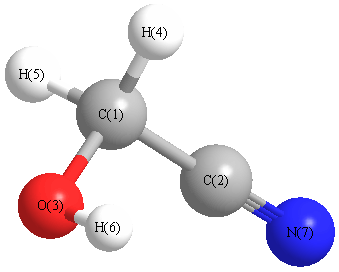 More geometry information
Calculated Bond Angles
| atom1 |
atom2 |
atom3 |
angle |
|
atom1 |
atom2 |
atom3 |
angle |
| C1 |
C2 |
N7 |
178.239 |
|
C1 |
O3 |
H6 |
106.802 |
| C2 |
C1 |
O3 |
112.573 |
|
C2 |
C1 |
H4 |
107.757 |
| C2 |
C1 |
H5 |
108.339 |
|
O3 |
C1 |
H4 |
113.167 |
| O3 |
C1 |
H5 |
107.005 |
|
H4 |
C1 |
H5 |
107.805 |
Electronic energy levels
Charges, Dipole, Quadrupole and Polarizability
