Jump to
S1C2
Energy calculated at QCISD(T)/cc-pVDZ
| | hartrees |
|---|
| Energy at 0K | -612.483490 |
| Energy at 298.15K | -612.486772 |
| HF Energy | -611.843018 |
| Nuclear repulsion energy | 141.906081 |
The energy at 298.15K was derived from the energy at 0K
and an integrated heat capacity that used the calculated vibrational frequencies.
Vibrational Frequencies calculated at QCISD(T)/cc-pVDZ
| Mode Number |
Symmetry |
Frequency
(cm-1) |
Scaled Frequency
(cm-1) |
IR Intensities
(km mol-1) |
Raman Act
(Å4/u) |
Dep P |
Dep U |
|---|
| 1 |
A |
3171 |
3022 |
|
|
|
|
| 2 |
A |
3086 |
2941 |
|
|
|
|
| 3 |
A |
2956 |
2817 |
|
|
|
|
| 4 |
A |
1795 |
1711 |
|
|
|
|
| 5 |
A |
1445 |
1378 |
|
|
|
|
| 6 |
A |
1400 |
1335 |
|
|
|
|
| 7 |
A |
1261 |
1202 |
|
|
|
|
| 8 |
A |
1177 |
1122 |
|
|
|
|
| 9 |
A |
1058 |
1008 |
|
|
|
|
| 10 |
A |
1019 |
971 |
|
|
|
|
| 11 |
A |
823 |
785 |
|
|
|
|
| 12 |
A |
708 |
675 |
|
|
|
|
| 13 |
A |
457 |
436 |
|
|
|
|
| 14 |
A |
286 |
273 |
|
|
|
|
| 15 |
A |
67 |
64 |
|
|
|
|
Unscaled Zero Point Vibrational Energy (zpe) 10354.4 cm
-1
Scaled (by 0.9531) Zero Point Vibrational Energy (zpe) 9868.8 cm
-1
See section
III.C.1 List or set vibrational scaling factors
to change the scale factors used here.
See section
III.C.2
Calculate a vibrational scaling factor for a given set of molecules
to determine the least squares best scaling factor.
Geometric Data calculated at QCISD(T)/cc-pVDZ
Point Group is C1
Cartesians (Å)
| Atom |
x (Å) |
y (Å) |
z (Å) |
|---|
| C1 |
0.015 |
0.691 |
0.143 |
| C2 |
1.169 |
-0.306 |
0.237 |
| Cl3 |
-1.544 |
-0.177 |
-0.086 |
| O4 |
2.262 |
-0.088 |
-0.249 |
| H5 |
-0.056 |
1.266 |
1.084 |
| H6 |
0.182 |
1.379 |
-0.702 |
| H7 |
0.935 |
-1.245 |
0.802 |
Atom - Atom Distances (Å)
| |
C1 |
C2 |
Cl3 |
O4 |
H5 |
H6 |
H7 |
| C1 | | 1.5284 | 1.7994 | 2.4103 | 1.1055 | 1.1019 | 2.2430 |
C2 | 1.5284 | | 2.7358 | 1.2154 | 2.1654 | 2.1665 | 1.1208 | Cl3 | 1.7994 | 2.7358 | | 3.8106 | 2.3815 | 2.4043 | 2.8418 | O4 | 2.4103 | 1.2154 | 3.8106 | | 2.9968 | 2.5848 | 2.0503 | H5 | 1.1055 | 2.1654 | 2.3815 | 2.9968 | | 1.8057 | 2.7144 | H6 | 1.1019 | 2.1665 | 2.4043 | 2.5848 | 1.8057 | | 3.1165 | H7 | 2.2430 | 1.1208 | 2.8418 | 2.0503 | 2.7144 | 3.1165 | |
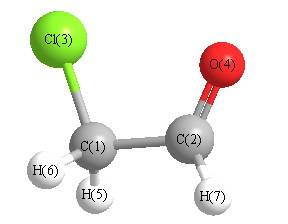 More geometry information
Calculated Bond Angles
| atom1 |
atom2 |
atom3 |
angle |
|
atom1 |
atom2 |
atom3 |
angle |
| C1 |
C2 |
O4 |
122.505 |
|
C1 |
C2 |
H7 |
114.833 |
| C2 |
C1 |
Cl3 |
110.329 |
|
C2 |
C1 |
H5 |
109.550 |
| C2 |
C1 |
H6 |
109.850 |
|
Cl3 |
C1 |
H5 |
107.733 |
| Cl3 |
C1 |
H6 |
109.576 |
|
O4 |
C2 |
H7 |
122.657 |
| H5 |
C1 |
H6 |
109.771 |
|
Electronic energy levels
Charges, Dipole, Quadrupole and Polarizability
Jump to
S1C1
Energy calculated at QCISD(T)/cc-pVDZ
| | hartrees |
|---|
| Energy at 0K | -612.482145 |
| Energy at 298.15K | -612.485583 |
| HF Energy | -611.840797 |
| Nuclear repulsion energy | 145.758528 |
The energy at 298.15K was derived from the energy at 0K
and an integrated heat capacity that used the calculated vibrational frequencies.
Vibrational Frequencies calculated at QCISD(T)/cc-pVDZ
| Mode Number |
Symmetry |
Frequency
(cm-1) |
Scaled Frequency
(cm-1) |
IR Intensities
(km mol-1) |
Raman Act
(Å4/u) |
Dep P |
Dep U |
|---|
| 1 |
A' |
3070 |
2926 |
|
|
|
|
| 2 |
A' |
2909 |
2772 |
|
|
|
|
| 3 |
A' |
1816 |
1730 |
|
|
|
|
| 4 |
A' |
1434 |
1367 |
|
|
|
|
| 5 |
A' |
1399 |
1333 |
|
|
|
|
| 6 |
A' |
1306 |
1244 |
|
|
|
|
| 7 |
A' |
955 |
911 |
|
|
|
|
| 8 |
A' |
776 |
739 |
|
|
|
|
| 9 |
A' |
634 |
604 |
|
|
|
|
| 10 |
A' |
213 |
203 |
|
|
|
|
| 11 |
A" |
3128 |
2982 |
|
|
|
|
| 12 |
A" |
1196 |
1140 |
|
|
|
|
| 13 |
A" |
1028 |
980 |
|
|
|
|
| 14 |
A" |
694 |
662 |
|
|
|
|
| 15 |
A" |
164 |
156 |
|
|
|
|
Unscaled Zero Point Vibrational Energy (zpe) 10359.8 cm
-1
Scaled (by 0.9531) Zero Point Vibrational Energy (zpe) 9873.9 cm
-1
See section
III.C.1 List or set vibrational scaling factors
to change the scale factors used here.
See section
III.C.2
Calculate a vibrational scaling factor for a given set of molecules
to determine the least squares best scaling factor.
Geometric Data calculated at QCISD(T)/cc-pVDZ
Point Group is Cs
Cartesians (Å)
| Atom |
x (Å) |
y (Å) |
z (Å) |
|---|
| C1 |
0.000 |
0.933 |
0.000 |
| C2 |
1.374 |
0.265 |
0.000 |
| Cl3 |
-1.352 |
-0.232 |
0.000 |
| O4 |
1.586 |
-0.928 |
0.000 |
| H5 |
-0.079 |
1.580 |
0.894 |
| H6 |
-0.079 |
1.580 |
-0.894 |
| H7 |
2.207 |
1.020 |
0.000 |
Atom - Atom Distances (Å)
| |
C1 |
C2 |
Cl3 |
O4 |
H5 |
H6 |
H7 |
| C1 | | 1.5270 | 1.7841 | 2.4446 | 1.1063 | 1.1063 | 2.2089 |
C2 | 1.5270 | | 2.7702 | 1.2119 | 2.1530 | 2.1530 | 1.1247 | Cl3 | 1.7841 | 2.7702 | | 3.0188 | 2.3877 | 2.3877 | 3.7727 | O4 | 2.4446 | 1.2119 | 3.0188 | | 3.1396 | 3.1396 | 2.0448 | H5 | 1.1063 | 2.1530 | 2.3877 | 3.1396 | | 1.7877 | 2.5173 | H6 | 1.1063 | 2.1530 | 2.3877 | 3.1396 | 1.7877 | | 2.5173 | H7 | 2.2089 | 1.1247 | 3.7727 | 2.0448 | 2.5173 | 2.5173 | |
More geometry information
Calculated Bond Angles
| atom1 |
atom2 |
atom3 |
angle |
|
atom1 |
atom2 |
atom3 |
angle |
| C1 |
C2 |
O4 |
125.999 |
|
C1 |
C2 |
H7 |
111.924 |
| C2 |
C1 |
Cl3 |
113.345 |
|
C2 |
C1 |
H5 |
108.639 |
| C2 |
C1 |
H6 |
108.639 |
|
Cl3 |
C1 |
H5 |
109.137 |
| Cl3 |
C1 |
H6 |
109.137 |
|
O4 |
C2 |
H7 |
122.077 |
| H5 |
C1 |
H6 |
107.799 |
|
Electronic energy levels
Charges, Dipole, Quadrupole and Polarizability
