return to home page Computational Chemistry Comparison and Benchmark DataBase Release 22 (May 2022) Standard Reference Database 101 National Institute of Standards and Technology
You are here: Calculated > Energy > Optimized > Energy

All results from a given calculation for CCO (Dicarbon monoxide)

using model chemistry: CCSD/cc-pVDZ

19 10 17 12 22

States and conformations

State Conformation minimum conformation conformer description state description
1 1 yes C*V 3Σ
2 1 yes C*V 1Π

State 1 (3Σ)

Jump to S2C1
Energy calculated at CCSD/cc-pVDZ
 hartrees
Energy at 0K-150.870029
Energy at 298.15K-150.868424
HF Energy-150.477325
Nuclear repulsion energy45.486201
The energy at 298.15K was derived from the energy at 0K and an integrated heat capacity that used the calculated vibrational frequencies.
Vibrational Frequencies calculated at CCSD/cc-pVDZ
Mode Number Symmetry Frequency
(cm-1)
Scaled Frequency
(cm-1)
IR Intensities
(km mol-1)
Raman Act
4/u)
Dep P Dep U
1 Σ 2051 1943 209.43      
2 Σ 1077 1021 6.30      
3 Π 390 370 38.28      
3 Π 390 370 38.28      

Unscaled Zero Point Vibrational Energy (zpe) 1954.6 cm-1
Scaled (by 0.9473) Zero Point Vibrational Energy (zpe) 1851.6 cm-1
See section III.C.1 List or set vibrational scaling factors to change the scale factors used here.
See section III.C.2 Calculate a vibrational scaling factor for a given set of molecules to determine the least squares best scaling factor.
Rotational Constants (cm-1) from geometry optimized at CCSD/cc-pVDZ
B
0.37719

See section I.F.4 to change rotational constant units
Geometric Data calculated at CCSD/cc-pVDZ

Point Group is C∞v

Cartesians (Å)
Atom x (Å) y (Å) z (Å)
C1 0.000 0.000 -1.437
C2 0.000 0.000 -0.050
O3 0.000 0.000 1.115

Atom - Atom Distances (Å)
  C1 C2 O3
C11.38622.5519
C21.38621.1657
O32.55191.1657

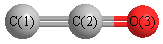
picture of Dicarbon monoxide state 1 conformation 1
More geometry information
Calculated Bond Angles
atom1 atom2 atom3 angle atom1 atom2 atom3 angle
C1 C2 O3 180.000
Electronic energy levels
Charges, Dipole, Quadrupole and Polarizability

State 2 (1Π)

Jump to S1C1
Energy calculated at CCSD/cc-pVDZ
 hartrees
Energy at 0K-150.835318
Energy at 298.15K-150.833738
HF Energy-150.416207
Nuclear repulsion energy45.295130
The energy at 298.15K was derived from the energy at 0K and an integrated heat capacity that used the calculated vibrational frequencies.
Vibrational Frequencies calculated at CCSD/cc-pVDZ
Mode Number Symmetry Frequency
(cm-1)
Scaled Frequency
(cm-1)
IR Intensities
(km mol-1)
Raman Act
4/u)
Dep P Dep U
1 Σ 2026 1919 113.01      
2 Σ 1107 1049 31.50      
3 Π 467 442 4.47      
3 Π 344 326 49.11      

Unscaled Zero Point Vibrational Energy (zpe) 1972.1 cm-1
Scaled (by 0.9473) Zero Point Vibrational Energy (zpe) 1868.2 cm-1
See section III.C.1 List or set vibrational scaling factors to change the scale factors used here.
See section III.C.2 Calculate a vibrational scaling factor for a given set of molecules to determine the least squares best scaling factor.
Rotational Constants (cm-1) from geometry optimized at CCSD/cc-pVDZ
B
0.37510

See section I.F.4 to change rotational constant units
Geometric Data calculated at CCSD/cc-pVDZ

Point Group is C∞v

Cartesians (Å)
Atom x (Å) y (Å) z (Å)
C1 0.000 0.000 -1.438
C2 0.000 0.000 -0.056
O3 0.000 0.000 1.121

Atom - Atom Distances (Å)
  C1 C2 O3
C11.38172.5587
C21.38171.1770
O32.55871.1770

picture of Dicarbon monoxide state 2 conformation 1
More geometry information
Calculated Bond Angles
atom1 atom2 atom3 angle atom1 atom2 atom3 angle
C1 C2 O3 180.000
Electronic energy levels
Charges, Dipole, Quadrupole and Polarizability