Jump to
S2C1
Energy calculated at QCISD(T)=FULL/cc-pVDZ
| | hartrees |
|---|
| Energy at 0K | -151.676382 |
| Energy at 298.15K | |
| HF Energy | -151.194408 |
| Nuclear repulsion energy | 62.208282 |
The energy at 298.15K was derived from the energy at 0K
and an integrated heat capacity that used the calculated vibrational frequencies.
Vibrational Frequencies calculated at QCISD(T)=FULL/cc-pVDZ
| Mode Number |
Symmetry |
Frequency
(cm-1) |
Scaled Frequency
(cm-1) |
IR Intensities
(km mol-1) |
Raman Act
(Å4/u) |
Dep P |
Dep U |
|---|
| 1 |
Σg |
2082 |
1996 |
0.00 |
|
|
|
| 2 |
Σg |
910 |
873 |
0.00 |
|
|
|
| 3 |
Σu |
1550 |
1486 |
0.00 |
|
|
|
| 4 |
Πg |
356 |
341 |
0.00 |
|
|
|
| 4 |
Πg |
356 |
341 |
0.00 |
|
|
|
| 5 |
Πu |
122 |
117 |
0.00 |
|
|
|
| 5 |
Πu |
122 |
117 |
0.00 |
|
|
|
Unscaled Zero Point Vibrational Energy (zpe) 2748.0 cm
-1
Scaled (by 0.959) Zero Point Vibrational Energy (zpe) 2635.4 cm
-1
See section
III.C.1 List or set vibrational scaling factors
to change the scale factors used here.
See section
III.C.2
Calculate a vibrational scaling factor for a given set of molecules
to determine the least squares best scaling factor.
Geometric Data calculated at QCISD(T)=FULL/cc-pVDZ
Point Group is D∞h
Cartesians (Å)
| Atom |
x (Å) |
y (Å) |
z (Å) |
|---|
| C1 |
0.000 |
0.000 |
0.656 |
| C2 |
0.000 |
0.000 |
-0.656 |
| C3 |
0.000 |
0.000 |
1.992 |
| C4 |
0.000 |
0.000 |
-1.992 |
Atom - Atom Distances (Å)
| |
C1 |
C2 |
C3 |
C4 |
| C1 | | 1.3119 | 1.3358 | 2.6477 |
C2 | 1.3119 | | 2.6477 | 1.3358 | C3 | 1.3358 | 2.6477 | | 3.9835 | C4 | 2.6477 | 1.3358 | 3.9835 | |
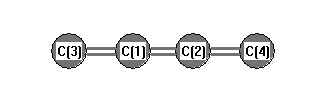 More geometry information
Calculated Bond Angles
| atom1 |
atom2 |
atom3 |
angle |
|
atom1 |
atom2 |
atom3 |
angle |
| C1 |
C2 |
C4 |
180.000 |
|
C2 |
C1 |
C3 |
180.000 |
Electronic energy levels
Charges, Dipole, Quadrupole and Polarizability
Jump to
S1C1
Energy calculated at QCISD(T)=FULL/cc-pVDZ
| | hartrees |
|---|
| Energy at 0K | -151.662102 |
| Energy at 298.15K | |
| HF Energy | -151.144235 |
| Nuclear repulsion energy | 61.937251 |
The energy at 298.15K was derived from the energy at 0K
and an integrated heat capacity that used the calculated vibrational frequencies.
Vibrational Frequencies calculated at QCISD(T)=FULL/cc-pVDZ
| Mode Number |
Symmetry |
Frequency
(cm-1) |
Scaled Frequency
(cm-1) |
IR Intensities
(km mol-1) |
Raman Act
(Å4/u) |
Dep P |
Dep U |
|---|
| 1 |
Σg |
2009 |
1926 |
0.00 |
|
|
|
| 2 |
Σg |
891 |
855 |
0.00 |
|
|
|
| 3 |
Σu |
1537 |
1474 |
0.00 |
|
|
|
| 4 |
Πg |
435 |
417 |
0.00 |
|
|
|
| 4 |
Πg |
261 |
250 |
0.00 |
|
|
|
| 5 |
Πu |
196 |
188 |
0.00 |
|
|
|
| 5 |
Πu |
130 |
125 |
0.00 |
|
|
|
Unscaled Zero Point Vibrational Energy (zpe) 2729.6 cm
-1
Scaled (by 0.959) Zero Point Vibrational Energy (zpe) 2617.7 cm
-1
See section
III.C.1 List or set vibrational scaling factors
to change the scale factors used here.
See section
III.C.2
Calculate a vibrational scaling factor for a given set of molecules
to determine the least squares best scaling factor.
Geometric Data calculated at QCISD(T)=FULL/cc-pVDZ
Point Group is D∞h
Cartesians (Å)
| Atom |
x (Å) |
y (Å) |
z (Å) |
|---|
| C1 |
0.000 |
0.000 |
0.661 |
| C2 |
0.000 |
0.000 |
-0.661 |
| C3 |
0.000 |
0.000 |
2.000 |
| C4 |
0.000 |
0.000 |
-2.000 |
Atom - Atom Distances (Å)
| |
C1 |
C2 |
C3 |
C4 |
| C1 | | 1.3212 | 1.3395 | 2.6607 |
C2 | 1.3212 | | 2.6607 | 1.3395 | C3 | 1.3395 | 2.6607 | | 4.0002 | C4 | 2.6607 | 1.3395 | 4.0002 | |
More geometry information
Electronic energy levels
Charges, Dipole, Quadrupole and Polarizability
