Jump to
S1C2
Energy calculated at B2PLYP=FULL/cc-pVDZ
| | hartrees |
|---|
| Energy at 0K | -166.378812 |
| Energy at 298.15K | |
| HF Energy | -166.239030 |
| Nuclear repulsion energy | 48.602769 |
The energy at 298.15K was derived from the energy at 0K
and an integrated heat capacity that used the calculated vibrational frequencies.
Vibrational Frequencies calculated at B2PLYP=FULL/cc-pVDZ
| Mode Number |
Symmetry |
Frequency
(cm-1) |
Scaled Frequency
(cm-1) |
IR Intensities
(km mol-1) |
Raman Act
(Å4/u) |
Dep P |
Dep U |
|---|
| 1 |
A1 |
3964 |
3799 |
68.05 |
|
|
|
| 2 |
A1 |
738 |
708 |
13.45 |
|
|
|
| 3 |
A1 |
621 |
595 |
121.67 |
|
|
|
| 4 |
A1 |
295 |
283 |
13.12 |
|
|
|
| 5 |
A2 |
211i |
202i |
0.00 |
|
|
|
| 6 |
B1 |
337 |
323 |
63.49 |
|
|
|
| 7 |
B2 |
3961 |
3797 |
139.14 |
|
|
|
| 8 |
B2 |
1536 |
1472 |
291.68 |
|
|
|
| 9 |
B2 |
500 |
480 |
290.16 |
|
|
|
Unscaled Zero Point Vibrational Energy (zpe) 5870.7 cm
-1
Scaled (by 0.9585) Zero Point Vibrational Energy (zpe) 5627.1 cm
-1
See section
III.C.1 List or set vibrational scaling factors
to change the scale factors used here.
See section
III.C.2
Calculate a vibrational scaling factor for a given set of molecules
to determine the least squares best scaling factor.
Geometric Data calculated at B2PLYP=FULL/cc-pVDZ
Point Group is C2v
Cartesians (Å)
| Atom |
x (Å) |
y (Å) |
z (Å) |
|---|
| Be1 |
0.000 |
0.000 |
0.017 |
| O2 |
0.000 |
1.439 |
0.080 |
| O3 |
0.000 |
-1.439 |
0.080 |
| H4 |
0.000 |
2.031 |
-0.674 |
| H5 |
0.000 |
-2.031 |
-0.674 |
Atom - Atom Distances (Å)
| |
Be1 |
O2 |
O3 |
H4 |
H5 |
| Be1 | | 1.4404 | 1.4404 | 2.1452 | 2.1452 |
O2 | 1.4404 | | 2.8779 | 0.9585 | 3.5510 | O3 | 1.4404 | 2.8779 | | 3.5510 | 0.9585 | H4 | 2.1452 | 0.9585 | 3.5510 | | 4.0622 | H5 | 2.1452 | 3.5510 | 0.9585 | 4.0622 | |
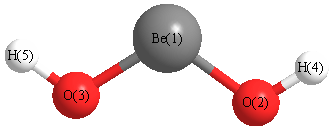 More geometry information
Calculated Bond Angles
| atom1 |
atom2 |
atom3 |
angle |
|
atom1 |
atom2 |
atom3 |
angle |
| Be1 |
O2 |
H4 |
125.625 |
|
Be1 |
O3 |
H5 |
125.625 |
| O2 |
Be1 |
O3 |
174.940 |
|
Electronic energy levels
Charges, Dipole, Quadrupole and Polarizability
Jump to
S1C1
Energy calculated at B2PLYP=FULL/cc-pVDZ
| | hartrees |
|---|
| Energy at 0K | -166.379506 |
| Energy at 298.15K | -166.381044 |
| HF Energy | -166.239506 |
| Nuclear repulsion energy | 48.571076 |
The energy at 298.15K was derived from the energy at 0K
and an integrated heat capacity that used the calculated vibrational frequencies.
Vibrational Frequencies calculated at B2PLYP=FULL/cc-pVDZ
| Mode Number |
Symmetry |
Frequency
(cm-1) |
Scaled Frequency
(cm-1) |
IR Intensities
(km mol-1) |
Raman Act
(Å4/u) |
Dep P |
Dep U |
|---|
| 1 |
A |
3942 |
3779 |
45.04 |
|
|
|
| 2 |
A |
733 |
702 |
7.48 |
|
|
|
| 3 |
A |
620 |
595 |
77.02 |
|
|
|
| 4 |
A |
299 |
286 |
13.09 |
|
|
|
| 5 |
A |
244 |
234 |
104.10 |
|
|
|
| 6 |
B |
3941 |
3777 |
147.69 |
|
|
|
| 7 |
B |
1532 |
1469 |
285.62 |
|
|
|
| 8 |
B |
592 |
567 |
309.24 |
|
|
|
| 9 |
B |
297 |
285 |
85.68 |
|
|
|
Unscaled Zero Point Vibrational Energy (zpe) 6099.8 cm
-1
Scaled (by 0.9585) Zero Point Vibrational Energy (zpe) 5846.7 cm
-1
See section
III.C.1 List or set vibrational scaling factors
to change the scale factors used here.
See section
III.C.2
Calculate a vibrational scaling factor for a given set of molecules
to determine the least squares best scaling factor.
Geometric Data calculated at B2PLYP=FULL/cc-pVDZ
Point Group is C2
Cartesians (Å)
| Atom |
x (Å) |
y (Å) |
z (Å) |
|---|
| Be1 |
0.000 |
0.000 |
-0.034 |
| O2 |
0.000 |
1.442 |
-0.061 |
| O3 |
0.000 |
-1.442 |
-0.061 |
| H4 |
0.508 |
1.978 |
0.553 |
| H5 |
-0.508 |
-1.978 |
0.553 |
Atom - Atom Distances (Å)
| |
Be1 |
O2 |
O3 |
H4 |
H5 |
| Be1 | | 1.4426 | 1.4426 | 2.1248 | 2.1248 |
O2 | 1.4426 | | 2.8846 | 0.9599 | 3.5119 | O3 | 1.4426 | 2.8846 | | 3.5119 | 0.9599 | H4 | 2.1248 | 0.9599 | 3.5119 | | 4.0843 | H5 | 2.1248 | 3.5119 | 0.9599 | 4.0843 | |
More geometry information
Calculated Bond Angles
| atom1 |
atom2 |
atom3 |
angle |
|
atom1 |
atom2 |
atom3 |
angle |
| Be1 |
O2 |
H4 |
123.096 |
|
Be1 |
O3 |
H5 |
123.096 |
| O2 |
Be1 |
O3 |
177.855 |
|
Electronic energy levels
Charges, Dipole, Quadrupole and Polarizability
