Jump to
S1C2
Energy calculated at QCISD(T)=FULL/cc-pVDZ
| | hartrees |
|---|
| Energy at 0K | -454.061733 |
| Energy at 298.15K | -454.065431 |
| HF Energy | -453.702791 |
| Nuclear repulsion energy | 56.654198 |
The energy at 298.15K was derived from the energy at 0K
and an integrated heat capacity that used the calculated vibrational frequencies.
Vibrational Frequencies calculated at QCISD(T)=FULL/cc-pVDZ
| Mode Number |
Symmetry |
Frequency
(cm-1) |
Scaled Frequency
(cm-1) |
IR Intensities
(km mol-1) |
Raman Act
(Å4/u) |
Dep P |
Dep U |
|---|
| 1 |
A' |
3478 |
3335 |
|
|
|
|
| 2 |
A' |
2698 |
2588 |
|
|
|
|
| 3 |
A' |
1626 |
1559 |
|
|
|
|
| 4 |
A' |
1043 |
1000 |
|
|
|
|
| 5 |
A' |
929 |
891 |
|
|
|
|
| 6 |
A' |
662 |
635 |
|
|
|
|
| 7 |
A" |
3573 |
3426 |
|
|
|
|
| 8 |
A" |
1142 |
1095 |
|
|
|
|
| 9 |
A" |
361 |
346 |
|
|
|
|
Unscaled Zero Point Vibrational Energy (zpe) 7755.8 cm
-1
Scaled (by 0.959) Zero Point Vibrational Energy (zpe) 7437.8 cm
-1
See section
III.C.1 List or set vibrational scaling factors
to change the scale factors used here.
See section
III.C.2
Calculate a vibrational scaling factor for a given set of molecules
to determine the least squares best scaling factor.
Geometric Data calculated at QCISD(T)=FULL/cc-pVDZ
Point Group is Cs
Cartesians (Å)
| Atom |
x (Å) |
y (Å) |
z (Å) |
|---|
| N1 |
0.010 |
1.140 |
0.000 |
| S2 |
0.010 |
-0.630 |
0.000 |
| H3 |
-1.337 |
-0.767 |
0.000 |
| H4 |
0.558 |
1.428 |
0.817 |
| H5 |
0.558 |
1.428 |
-0.817 |
Atom - Atom Distances (Å)
| |
N1 |
S2 |
H3 |
H4 |
H5 |
| N1 | | 1.7699 | 2.3346 | 1.0252 | 1.0252 |
S2 | 1.7699 | | 1.3536 | 2.2808 | 2.2808 | H3 | 2.3346 | 1.3536 | | 3.0124 | 3.0124 | H4 | 1.0252 | 2.2808 | 3.0124 | | 1.6344 | H5 | 1.0252 | 2.2808 | 3.0124 | 1.6344 | |
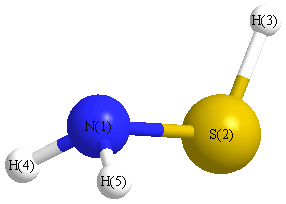 More geometry information
Calculated Bond Angles
| atom1 |
atom2 |
atom3 |
angle |
|
atom1 |
atom2 |
atom3 |
angle |
| N1 |
S2 |
H3 |
95.814 |
|
S2 |
N1 |
H4 |
106.303 |
| S2 |
N1 |
H5 |
106.303 |
|
H4 |
N1 |
H5 |
105.717 |
Electronic energy levels
Charges, Dipole, Quadrupole and Polarizability
Jump to
S1C1
Energy calculated at QCISD(T)=FULL/cc-pVDZ
| | hartrees |
|---|
| Energy at 0K | -454.060668 |
| Energy at 298.15K | -454.064472 |
| HF Energy | -453.702818 |
| Nuclear repulsion energy | 56.944136 |
The energy at 298.15K was derived from the energy at 0K
and an integrated heat capacity that used the calculated vibrational frequencies.
Vibrational Frequencies calculated at QCISD(T)=FULL/cc-pVDZ
| Mode Number |
Symmetry |
Frequency
(cm-1) |
Scaled Frequency
(cm-1) |
IR Intensities
(km mol-1) |
Raman Act
(Å4/u) |
Dep P |
Dep U |
|---|
| 1 |
A' |
3484 |
3342 |
|
|
|
|
| 2 |
A' |
2608 |
2501 |
|
|
|
|
| 3 |
A' |
1612 |
1545 |
|
|
|
|
| 4 |
A' |
1045 |
1002 |
|
|
|
|
| 5 |
A' |
893 |
856 |
|
|
|
|
| 6 |
A' |
655 |
628 |
|
|
|
|
| 7 |
A" |
3588 |
3441 |
|
|
|
|
| 8 |
A" |
1128 |
1081 |
|
|
|
|
| 9 |
A" |
493 |
473 |
|
|
|
|
Unscaled Zero Point Vibrational Energy (zpe) 7752.3 cm
-1
Scaled (by 0.959) Zero Point Vibrational Energy (zpe) 7434.4 cm
-1
See section
III.C.1 List or set vibrational scaling factors
to change the scale factors used here.
See section
III.C.2
Calculate a vibrational scaling factor for a given set of molecules
to determine the least squares best scaling factor.
Geometric Data calculated at QCISD(T)=FULL/cc-pVDZ
Point Group is Cs
Electronic energy levels
Charges, Dipole, Quadrupole and Polarizability
