Jump to
S1C2
Energy calculated at QCISD(T)/cc-pVDZ
| | hartrees |
|---|
| Energy at 0K | -116.913734 |
| Energy at 298.15K | -116.917949 |
| HF Energy | -116.478196 |
| Nuclear repulsion energy | 64.180311 |
The energy at 298.15K was derived from the energy at 0K
and an integrated heat capacity that used the calculated vibrational frequencies.
Vibrational Frequencies calculated at QCISD(T)/cc-pVDZ
| Mode Number |
Symmetry |
Frequency
(cm-1) |
Scaled Frequency
(cm-1) |
IR Intensities
(km mol-1) |
Raman Act
(Å4/u) |
Dep P |
Dep U |
|---|
| 1 |
A1 |
3265 |
3112 |
|
|
|
|
| 2 |
A1 |
3168 |
3019 |
|
|
|
|
| 3 |
A1 |
3156 |
3008 |
|
|
|
|
| 4 |
A1 |
1518 |
1447 |
|
|
|
|
| 5 |
A1 |
1265 |
1206 |
|
|
|
|
| 6 |
A1 |
1032 |
984 |
|
|
|
|
| 7 |
A1 |
421 |
401 |
|
|
|
|
| 8 |
A2 |
754 |
719 |
|
|
|
|
| 9 |
A2 |
553 |
527 |
|
|
|
|
| 10 |
B1 |
991 |
945 |
|
|
|
|
| 11 |
B1 |
761 |
725 |
|
|
|
|
| 12 |
B1 |
525 |
500 |
|
|
|
|
| 13 |
B2 |
3262 |
3109 |
|
|
|
|
| 14 |
B2 |
3153 |
3005 |
|
|
|
|
| 15 |
B2 |
1508 |
1437 |
|
|
|
|
| 16 |
B2 |
1407 |
1341 |
|
|
|
|
| 17 |
B2 |
1187 |
1131 |
|
|
|
|
| 18 |
B2 |
928 |
884 |
|
|
|
|
Unscaled Zero Point Vibrational Energy (zpe) 14426.5 cm
-1
Scaled (by 0.9531) Zero Point Vibrational Energy (zpe) 13749.9 cm
-1
See section
III.C.1 List or set vibrational scaling factors
to change the scale factors used here.
See section
III.C.2
Calculate a vibrational scaling factor for a given set of molecules
to determine the least squares best scaling factor.
Geometric Data calculated at QCISD(T)/cc-pVDZ
Point Group is C2v
Cartesians (Å)
| Atom |
x (Å) |
y (Å) |
z (Å) |
|---|
| C1 |
0.000 |
0.000 |
0.455 |
| H2 |
0.000 |
0.000 |
1.555 |
| C3 |
0.000 |
1.239 |
-0.201 |
| C4 |
0.000 |
-1.239 |
-0.201 |
| H5 |
0.000 |
2.181 |
0.360 |
| H6 |
0.000 |
-2.181 |
0.360 |
| H7 |
0.000 |
1.294 |
-1.298 |
| H8 |
0.000 |
-1.294 |
-1.298 |
Atom - Atom Distances (Å)
| |
C1 |
H2 |
C3 |
C4 |
H5 |
H6 |
H7 |
H8 |
| C1 | | 1.1007 | 1.4013 | 1.4013 | 2.1827 | 2.1827 | 2.1782 | 2.1782 |
H2 | 1.1007 | | 2.1489 | 2.1489 | 2.4870 | 2.4870 | 3.1327 | 3.1327 | C3 | 1.4013 | 2.1489 | | 2.4773 | 1.0961 | 3.4649 | 1.0985 | 2.7596 | C4 | 1.4013 | 2.1489 | 2.4773 | | 3.4649 | 1.0961 | 2.7596 | 1.0985 | H5 | 2.1827 | 2.4870 | 1.0961 | 3.4649 | | 4.3614 | 1.8798 | 3.8493 | H6 | 2.1827 | 2.4870 | 3.4649 | 1.0961 | 4.3614 | | 3.8493 | 1.8798 | H7 | 2.1782 | 3.1327 | 1.0985 | 2.7596 | 1.8798 | 3.8493 | | 2.5871 | H8 | 2.1782 | 3.1327 | 2.7596 | 1.0985 | 3.8493 | 1.8798 | 2.5871 | |
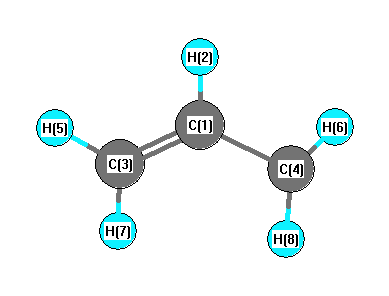 More geometry information
Calculated Bond Angles
| atom1 |
atom2 |
atom3 |
angle |
|
atom1 |
atom2 |
atom3 |
angle |
| C1 |
C3 |
H5 |
121.376 |
|
C1 |
C3 |
H7 |
120.750 |
| C1 |
C4 |
H6 |
121.376 |
|
C1 |
C4 |
H8 |
120.750 |
| H2 |
C1 |
C3 |
117.883 |
|
H2 |
C1 |
C4 |
117.883 |
| C3 |
C1 |
C4 |
124.235 |
|
H5 |
C3 |
H7 |
117.874 |
| H6 |
C4 |
H8 |
117.874 |
|
Electronic energy levels
Charges, Dipole, Quadrupole and Polarizability
Jump to
S1C1
Energy calculated at QCISD(T)/cc-pVDZ
| | hartrees |
|---|
| Energy at 0K | -116.913734 |
| Energy at 298.15K | -116.917945 |
| HF Energy | -116.478191 |
| Nuclear repulsion energy | 64.176503 |
The energy at 298.15K was derived from the energy at 0K
and an integrated heat capacity that used the calculated vibrational frequencies.
Vibrational Frequencies calculated at QCISD(T)/cc-pVDZ
| Mode Number |
Symmetry |
Frequency
(cm-1) |
Scaled Frequency
(cm-1) |
IR Intensities
(km mol-1) |
Raman Act
(Å4/u) |
Dep P |
Dep U |
|---|
| 1 |
A' |
3265 |
3111 |
|
|
|
|
| 2 |
A' |
3261 |
3108 |
|
|
|
|
| 3 |
A' |
3167 |
3018 |
|
|
|
|
| 4 |
A' |
3156 |
3008 |
|
|
|
|
| 5 |
A' |
3152 |
3004 |
|
|
|
|
| 6 |
A' |
1516 |
1445 |
|
|
|
|
| 7 |
A' |
1507 |
1437 |
|
|
|
|
| 8 |
A' |
1406 |
1340 |
|
|
|
|
| 9 |
A' |
1265 |
1206 |
|
|
|
|
| 10 |
A' |
1186 |
1130 |
|
|
|
|
| 11 |
A' |
1033 |
984 |
|
|
|
|
| 12 |
A' |
926 |
882 |
|
|
|
|
| 13 |
A' |
422 |
402 |
|
|
|
|
| 14 |
A" |
989 |
943 |
|
|
|
|
| 15 |
A" |
760 |
724 |
|
|
|
|
| 16 |
A" |
752 |
716 |
|
|
|
|
| 17 |
A" |
551 |
525 |
|
|
|
|
| 18 |
A" |
525 |
501 |
|
|
|
|
Unscaled Zero Point Vibrational Energy (zpe) 14418.6 cm
-1
Scaled (by 0.9531) Zero Point Vibrational Energy (zpe) 13742.4 cm
-1
See section
III.C.1 List or set vibrational scaling factors
to change the scale factors used here.
See section
III.C.2
Calculate a vibrational scaling factor for a given set of molecules
to determine the least squares best scaling factor.
Geometric Data calculated at QCISD(T)/cc-pVDZ
Point Group is Cs
Cartesians (Å)
| Atom |
x (Å) |
y (Å) |
z (Å) |
|---|
| C1 |
0.000 |
0.455 |
0.000 |
| H2 |
0.001 |
1.555 |
0.000 |
| C3 |
-1.239 |
-0.200 |
0.000 |
| C4 |
1.239 |
-0.201 |
0.000 |
| H5 |
-2.181 |
0.360 |
0.000 |
| H6 |
2.181 |
0.360 |
0.000 |
| H7 |
-1.294 |
-1.297 |
0.000 |
| H8 |
1.294 |
-1.298 |
0.000 |
Atom - Atom Distances (Å)
| |
C1 |
H2 |
C3 |
C4 |
H5 |
H6 |
H7 |
H8 |
| C1 | | 1.1007 | 1.4013 | 1.4014 | 2.1833 | 2.1826 | 2.1777 | 2.1783 |
H2 | 1.1007 | | 2.1492 | 2.1486 | 2.4881 | 2.4860 | 3.1326 | 3.1324 | C3 | 1.4013 | 2.1492 | | 2.4776 | 1.0964 | 3.4650 | 1.0984 | 2.7603 | C4 | 1.4014 | 2.1486 | 2.4776 | | 3.4657 | 1.0960 | 2.7595 | 1.0983 | H5 | 2.1833 | 2.4881 | 1.0964 | 3.4657 | | 4.3618 | 1.8802 | 3.8504 | H6 | 2.1826 | 2.4860 | 3.4650 | 1.0960 | 4.3618 | | 3.8491 | 1.8798 | H7 | 2.1777 | 3.1326 | 1.0984 | 2.7595 | 1.8802 | 3.8491 | | 2.5875 | H8 | 2.1783 | 3.1324 | 2.7603 | 1.0983 | 3.8504 | 1.8798 | 2.5875 | |
More geometry information
Calculated Bond Angles
| atom1 |
atom2 |
atom3 |
angle |
|
atom1 |
atom2 |
atom3 |
angle |
| C1 |
C3 |
H5 |
121.401 |
|
C1 |
C3 |
H7 |
120.717 |
| C1 |
C4 |
H6 |
121.353 |
|
C1 |
C4 |
H8 |
120.766 |
| H2 |
C1 |
C3 |
117.910 |
|
H2 |
C1 |
C4 |
117.837 |
| C3 |
C1 |
C4 |
124.253 |
|
H5 |
C3 |
H7 |
117.882 |
| H6 |
C4 |
H8 |
117.881 |
|
Electronic energy levels
Charges, Dipole, Quadrupole and Polarizability
