return to home page Computational Chemistry Comparison and Benchmark DataBase Release 22 (May 2022) Standard Reference Database 101 National Institute of Standards and Technology
You are here: Calculated > Energy > Optimized > Energy

All results from a given calculation for C3H7 (n-Propyl radical)

using model chemistry: QCISD(T)/cc-pVDZ

19 10 17 12 22

States and conformations

State Conformation minimum conformation conformer description state description
1 1 yes C1 2A"
Energy calculated at QCISD(T)/cc-pVDZ
 hartrees
Energy at 0K-118.114838
Energy at 298.15K 
HF Energy-117.640396
Nuclear repulsion energy75.188668
The energy at 298.15K was derived from the energy at 0K and an integrated heat capacity that used the calculated vibrational frequencies.
Vibrational Frequencies calculated at QCISD(T)/cc-pVDZ
Mode Number Symmetry Frequency
(cm-1)
Scaled Frequency
(cm-1)
IR Intensities
(km mol-1)
Raman Act
(Å4/u)
Dep P Dep U
1 A 3253 3100        
2 A 3144 2997        
3 A 3128 2982        
4 A 3123 2976        
5 A 3053 2910        
6 A 3040 2897        
7 A 2970 2831        
8 A 1495 1424        
9 A 1487 1417        
10 A 1465 1396        
11 A 1458 1390        
12 A 1406 1340        
13 A 1355 1292        
14 A 1267 1207        
15 A 1173 1118        
16 A 1100 1049        
17 A 1052 1002        
18 A 920 877        
19 A 889 848        
20 A 752 717        
21 A 459 437        
22 A 363 346        
23 A 262 250        
24 A 139 132        

Unscaled Zero Point Vibrational Energy (zpe) 19376.0 cm-1
Scaled (by 0.9531) Zero Point Vibrational Energy (zpe) 18467.2 cm-1
See section III.C.1 List or set vibrational scaling factors to change the scale factors used here.
See section III.C.2 Calculate a vibrational scaling factor for a given set of molecules to determine the least squares best scaling factor.
Rotational Constants (cm-1) from geometry optimized at QCISD(T)/cc-pVDZ
ABC
1.06982 0.29597 0.25652

See section I.F.4 to change rotational constant units
Geometric Data calculated at QCISD(T)/cc-pVDZ

Point Group is C1

Cartesians (Å)
Atom x (Å) y (Å) z (Å)
C1 1.307 -0.298 -0.041
C2 0.076 0.562 0.056
C3 -1.229 -0.248 -0.040
H4 -2.116 0.410 0.034
H5 -1.282 -0.792 -1.001
H6 -1.287 -0.994 0.776
H7 0.081 1.126 1.018
H8 0.100 1.337 -0.738
H9 2.280 0.138 -0.301
H10 1.297 -1.322 0.359

Atom - Atom Distances (Å)
  C1 C2 C3 H4 H5 H6 H7 H8 H9 H10
C11.50462.53633.49572.80582.80722.15692.14831.09751.0989
C21.50461.53882.19722.19062.19071.11561.10972.27192.2651
C32.53631.53881.10621.10671.10752.17312.18273.53942.7737
H43.49572.19721.10621.79221.79112.51142.52304.41633.8405
H52.80582.19061.10671.79221.78903.10162.55223.74792.9639
H62.80722.19071.10751.79111.78902.53503.10663.89412.6380
H72.15691.11562.17312.51143.10162.53501.76942.74752.8116
H82.14831.10972.18272.52302.55223.10661.76942.52533.1150
H91.09752.27193.53944.41633.74793.89412.74752.52531.8797
H101.09892.26512.77373.84052.96392.63802.81163.11501.8797

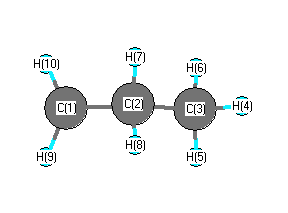
picture of n-Propyl radical state 1 conformation 1
More geometry information
Calculated Bond Angles
atom1 atom2 atom3 angle atom1 atom2 atom3 angle
C1 C2 C3 112.894 C1 C2 H7 109.924
C1 C2 H8 109.601 C2 C1 H9 120.846
C2 C1 H10 120.124 C2 C3 H4 111.290
C2 C3 H5 110.739 C2 C3 H6 110.704
C3 C2 H7 108.863 C3 C2 H8 109.943
H4 C3 H5 108.166 H4 C3 H6 108.019
H5 C3 H6 107.794 H7 C2 H8 105.338
H9 C1 H10 117.692
Electronic energy levels
Charges, Dipole, Quadrupole and Polarizability