return to home page Computational Chemistry Comparison and Benchmark DataBase Release 22 (May 2022) Standard Reference Database 101 National Institute of Standards and Technology
You are here: Calculated > Energy > Optimized > Energy

All results from a given calculation for C3H7 (n-Propyl radical)

using model chemistry: CCSD(T)=FULL/cc-pVDZ

19 10 17 12 22

States and conformations

State Conformation minimum conformation conformer description state description
1 1 yes C1 2A"
Energy calculated at CCSD(T)=FULL/cc-pVDZ
 hartrees
Energy at 0K-118.121904
Energy at 298.15K 
HF Energy-117.640556
Nuclear repulsion energy75.257736
The energy at 298.15K was derived from the energy at 0K and an integrated heat capacity that used the calculated vibrational frequencies.
Vibrational Frequencies calculated at CCSD(T)=FULL/cc-pVDZ
Mode Number Symmetry Frequency
(cm-1)
Scaled Frequency
(cm-1)
IR Intensities
(km mol-1)
Raman Act
(Å4/u)
Dep P Dep U
1 A 3259 3139        
2 A 3151 3035        
3 A 3135 3020        
4 A 3130 3015        
5 A 3059 2946        
6 A 3046 2934        
7 A 2977 2867        
8 A 1497 1442        
9 A 1489 1435        
10 A 1467 1413        
11 A 1461 1407        
12 A 1409 1357        
13 A 1358 1308        
14 A 1269 1222        
15 A 1174 1131        
16 A 1103 1062        
17 A 1053 1014        
18 A 922 888        
19 A 891 858        
20 A 753 726        
21 A 461 444        
22 A 364 351        
23 A 263 253        
24 A 139 134        

Unscaled Zero Point Vibrational Energy (zpe) 19414.5 cm-1
Scaled (by 0.9632) Zero Point Vibrational Energy (zpe) 18700.0 cm-1
See section III.C.1 List or set vibrational scaling factors to change the scale factors used here.
See section III.C.2 Calculate a vibrational scaling factor for a given set of molecules to determine the least squares best scaling factor.
Rotational Constants (cm-1) from geometry optimized at CCSD(T)=FULL/cc-pVDZ
ABC
1.07202 0.29651 0.25695

See section I.F.4 to change rotational constant units
Geometric Data calculated at CCSD(T)=FULL/cc-pVDZ

Point Group is C1

Cartesians (Å)
Atom x (Å) y (Å) z (Å)
C1 1.306 -0.298 -0.041
C2 0.076 0.561 0.055
C3 -1.228 -0.247 -0.039
H4 -2.114 0.409 0.034
H5 -1.282 -0.792 -1.000
H6 -1.286 -0.993 0.776
H7 0.081 1.126 1.017
H8 0.100 1.335 -0.738
H9 2.278 0.139 -0.298
H10 1.295 -1.322 0.356

Atom - Atom Distances (Å)
  C1 C2 C3 H4 H5 H6 H7 H8 H9 H10
C11.50322.53413.49282.80352.80492.15482.14641.09651.0979
C21.50321.53732.19542.18852.18871.11451.10862.27002.2633
C32.53411.53731.10511.10561.10642.17112.18063.53672.7705
H43.49282.19541.10511.79021.78922.50952.52094.41293.8367
H52.80352.18851.10561.79021.78723.09872.55003.74602.9593
H62.80492.18871.10641.78921.78722.53273.10373.89072.6358
H72.15481.11452.17112.50953.09872.53271.76752.74372.8107
H82.14641.10862.18062.52092.55003.10371.76752.52393.1118
H91.09652.27003.53674.41293.74603.89072.74372.52391.8779
H101.09792.26332.77053.83672.95932.63582.81073.11181.8779

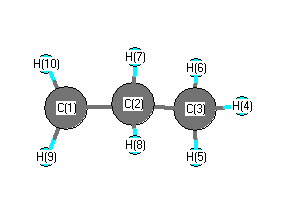
picture of n-Propyl radical state 1 conformation 1
More geometry information
Calculated Bond Angles
atom1 atom2 atom3 angle atom1 atom2 atom3 angle
C1 C2 C3 112.904 C1 C2 H7 109.914
C1 C2 H8 109.604 C2 C1 H9 120.854
C2 C1 H10 120.138 C2 C3 H4 111.314
C2 C3 H5 110.743 C2 C3 H6 110.708
C3 C2 H7 108.872 C3 C2 H8 109.947
H4 C3 H5 108.150 H4 C3 H6 108.002
H5 C3 H6 107.794 H7 C2 H8 105.320
H9 C1 H10 117.678
Electronic energy levels
Charges, Dipole, Quadrupole and Polarizability