Jump to
S2C1
Energy calculated at QCISD/cc-pVDZ
| | hartrees |
|---|
| Energy at 0K | -77.035999 |
| Energy at 298.15K | -77.035739 |
| HF Energy | -76.772255 |
| Nuclear repulsion energy | 23.469507 |
The energy at 298.15K was derived from the energy at 0K
and an integrated heat capacity that used the calculated vibrational frequencies.
Vibrational Frequencies calculated at QCISD/cc-pVDZ
| Mode Number |
Symmetry |
Frequency
(cm-1) |
Scaled Frequency
(cm-1) |
IR Intensities
(km mol-1) |
Raman Act
(Å4/u) |
Dep P |
Dep U |
|---|
| 1 |
A1 |
3159 |
3031 |
30.73 |
|
|
|
| 2 |
A1 |
1677 |
1608 |
74.23 |
|
|
|
| 3 |
A1 |
1224 |
1175 |
16.61 |
|
|
|
| 4 |
B1 |
752 |
722 |
74.27 |
|
|
|
| 5 |
B2 |
3260 |
3128 |
13.42 |
|
|
|
| 6 |
B2 |
387 |
371 |
6.64 |
|
|
|
Unscaled Zero Point Vibrational Energy (zpe) 5229.4 cm
-1
Scaled (by 0.9594) Zero Point Vibrational Energy (zpe) 5017.1 cm
-1
See section
III.C.1 List or set vibrational scaling factors
to change the scale factors used here.
See section
III.C.2
Calculate a vibrational scaling factor for a given set of molecules
to determine the least squares best scaling factor.
Geometric Data calculated at QCISD/cc-pVDZ
Point Group is C2v
Cartesians (Å)
| Atom |
x (Å) |
y (Å) |
z (Å) |
|---|
| C1 |
0.000 |
0.000 |
-0.488 |
| C2 |
0.000 |
0.000 |
0.835 |
| H3 |
0.000 |
0.950 |
-1.041 |
| H4 |
0.000 |
-0.950 |
-1.041 |
Atom - Atom Distances (Å)
| |
C1 |
C2 |
H3 |
H4 |
| C1 | | 1.3234 | 1.0993 | 1.0993 |
C2 | 1.3234 | | 2.1031 | 2.1031 | H3 | 1.0993 | 2.1031 | | 1.9003 | H4 | 1.0993 | 2.1031 | 1.9003 | |
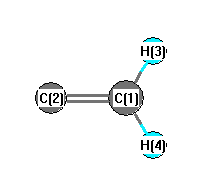 More geometry information
Calculated Bond Angles
| atom1 |
atom2 |
atom3 |
angle |
|
atom1 |
atom2 |
atom3 |
angle |
| C2 |
C1 |
H3 |
120.189 |
|
C2 |
C1 |
H4 |
120.189 |
| H3 |
C1 |
H4 |
119.621 |
|
Electronic energy levels
Charges, Dipole, Quadrupole and Polarizability
Jump to
S1C1
Energy calculated at QCISD/cc-pVDZ
| | hartrees |
|---|
| Energy at 0K | -76.969450 |
| Energy at 298.15K | -76.969517 |
| HF Energy | -76.741601 |
| Nuclear repulsion energy | 23.246353 |
The energy at 298.15K was derived from the energy at 0K
and an integrated heat capacity that used the calculated vibrational frequencies.
Vibrational Frequencies calculated at QCISD/cc-pVDZ
| Mode Number |
Symmetry |
Frequency
(cm-1) |
Scaled Frequency
(cm-1) |
IR Intensities
(km mol-1) |
Raman Act
(Å4/u) |
Dep P |
Dep U |
|---|
| 1 |
A1 |
3093 |
2968 |
3.56 |
|
|
|
| 2 |
A1 |
1567 |
1504 |
4.88 |
|
|
|
| 3 |
A1 |
1404 |
1347 |
2.61 |
|
|
|
| 4 |
B1 |
778 |
746 |
15.07 |
|
|
|
| 5 |
B2 |
3184 |
3054 |
5.15 |
|
|
|
| 6 |
B2 |
1002 |
961 |
1.51 |
|
|
|
Unscaled Zero Point Vibrational Energy (zpe) 5513.6 cm
-1
Scaled (by 0.9594) Zero Point Vibrational Energy (zpe) 5289.7 cm
-1
See section
III.C.1 List or set vibrational scaling factors
to change the scale factors used here.
See section
III.C.2
Calculate a vibrational scaling factor for a given set of molecules
to determine the least squares best scaling factor.
Geometric Data calculated at QCISD/cc-pVDZ
Point Group is C2v
Cartesians (Å)
| Atom |
x (Å) |
y (Å) |
z (Å) |
|---|
| C1 |
0.000 |
0.000 |
-0.493 |
| C2 |
0.000 |
0.000 |
0.846 |
| H3 |
0.000 |
0.946 |
-1.060 |
| H4 |
0.000 |
-0.946 |
-1.060 |
Atom - Atom Distances (Å)
| |
C1 |
C2 |
H3 |
H4 |
| C1 | | 1.3396 | 1.1023 | 1.1023 |
C2 | 1.3396 | | 2.1277 | 2.1277 | H3 | 1.1023 | 2.1277 | | 1.8912 | H4 | 1.1023 | 2.1277 | 1.8912 | |
More geometry information
Electronic energy levels
Charges, Dipole, Quadrupole and Polarizability
