Jump to
S1C2
Energy calculated at MP2/cc-pVDZ
| | hartrees |
|---|
| Energy at 0K | -417.655055 |
| Energy at 298.15K | -417.659188 |
| HF Energy | -417.341285 |
| Nuclear repulsion energy | 60.743151 |
The energy at 298.15K was derived from the energy at 0K
and an integrated heat capacity that used the calculated vibrational frequencies.
Vibrational Frequencies calculated at MP2/cc-pVDZ
| Mode Number |
Symmetry |
Frequency
(cm-1) |
Scaled Frequency
(cm-1) |
IR Intensities
(km mol-1) |
Raman Act
(Å4/u) |
Dep P |
Dep U |
|---|
| 1 |
A' |
3844 |
3662 |
59.09 |
|
|
|
| 2 |
A' |
2409 |
2295 |
109.96 |
|
|
|
| 3 |
A' |
1172 |
1117 |
21.45 |
|
|
|
| 4 |
A' |
1128 |
1074 |
36.00 |
|
|
|
| 5 |
A' |
919 |
876 |
49.11 |
|
|
|
| 6 |
A' |
803 |
765 |
119.28 |
|
|
|
| 7 |
A" |
2414 |
2299 |
167.29 |
|
|
|
| 8 |
A" |
921 |
877 |
18.69 |
|
|
|
| 9 |
A" |
428 |
408 |
104.02 |
|
|
|
Unscaled Zero Point Vibrational Energy (zpe) 7019.1 cm
-1
Scaled (by 0.9525) Zero Point Vibrational Energy (zpe) 6685.7 cm
-1
See section
III.C.1 List or set vibrational scaling factors
to change the scale factors used here.
See section
III.C.2
Calculate a vibrational scaling factor for a given set of molecules
to determine the least squares best scaling factor.
Geometric Data calculated at MP2/cc-pVDZ
Point Group is Cs
Cartesians (Å)
| Atom |
x (Å) |
y (Å) |
z (Å) |
|---|
| P1 |
-0.108 |
-0.577 |
0.000 |
| O2 |
-0.108 |
1.114 |
0.000 |
| H3 |
0.796 |
1.458 |
0.000 |
| H4 |
0.848 |
-0.858 |
1.030 |
| H5 |
0.848 |
-0.858 |
-1.030 |
Atom - Atom Distances (Å)
| |
P1 |
O2 |
H3 |
H4 |
H5 |
| P1 | | 1.6908 | 2.2272 | 1.4331 | 1.4331 |
O2 | 1.6908 | | 0.9680 | 2.4216 | 2.4216 | H3 | 2.2272 | 0.9680 | | 2.5357 | 2.5357 | H4 | 1.4331 | 2.4216 | 2.5357 | | 2.0600 | H5 | 1.4331 | 2.4216 | 2.5357 | 2.0600 | |
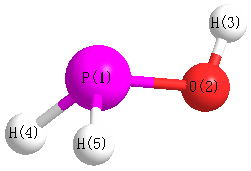 More geometry information
Calculated Bond Angles
| atom1 |
atom2 |
atom3 |
angle |
|
atom1 |
atom2 |
atom3 |
angle |
| P1 |
O2 |
H3 |
110.837 |
|
O2 |
P1 |
H4 |
101.324 |
| O2 |
P1 |
H5 |
101.324 |
|
H4 |
P1 |
H5 |
91.897 |
Electronic energy levels
Charges, Dipole, Quadrupole and Polarizability
Jump to
S1C1
Energy calculated at MP2/cc-pVDZ
| | hartrees |
|---|
| Energy at 0K | -417.655380 |
| Energy at 298.15K | -417.659317 |
| HF Energy | -417.340712 |
| Nuclear repulsion energy | 60.639590 |
The energy at 298.15K was derived from the energy at 0K
and an integrated heat capacity that used the calculated vibrational frequencies.
Vibrational Frequencies calculated at MP2/cc-pVDZ
| Mode Number |
Symmetry |
Frequency
(cm-1) |
Scaled Frequency
(cm-1) |
IR Intensities
(km mol-1) |
Raman Act
(Å4/u) |
Dep P |
Dep U |
|---|
| 1 |
A' |
3868 |
3685 |
101.42 |
|
|
|
| 2 |
A' |
2452 |
2335 |
89.19 |
|
|
|
| 3 |
A' |
1178 |
1122 |
54.10 |
|
|
|
| 4 |
A' |
1164 |
1109 |
61.48 |
|
|
|
| 5 |
A' |
919 |
876 |
14.48 |
|
|
|
| 6 |
A' |
795 |
757 |
91.71 |
|
|
|
| 7 |
A" |
2453 |
2336 |
131.56 |
|
|
|
| 8 |
A" |
940 |
895 |
2.39 |
|
|
|
| 9 |
A" |
247 |
236 |
83.19 |
|
|
|
Unscaled Zero Point Vibrational Energy (zpe) 7007.3 cm
-1
Scaled (by 0.9525) Zero Point Vibrational Energy (zpe) 6674.5 cm
-1
See section
III.C.1 List or set vibrational scaling factors
to change the scale factors used here.
See section
III.C.2
Calculate a vibrational scaling factor for a given set of molecules
to determine the least squares best scaling factor.
Geometric Data calculated at MP2/cc-pVDZ
Point Group is Cs
Cartesians (Å)
| Atom |
x (Å) |
y (Å) |
z (Å) |
|---|
| P1 |
0.038 |
-0.583 |
0.000 |
| O2 |
0.038 |
1.119 |
0.000 |
| H3 |
0.970 |
1.378 |
0.000 |
| H4 |
-0.925 |
-0.796 |
1.030 |
| H5 |
-0.925 |
-0.796 |
-1.030 |
Atom - Atom Distances (Å)
| |
P1 |
O2 |
H3 |
H4 |
H5 |
| P1 | | 1.7018 | 2.1704 | 1.4267 | 1.4267 |
O2 | 1.7018 | | 0.9668 | 2.3785 | 2.3785 | H3 | 2.1704 | 0.9668 | | 3.0622 | 3.0622 | H4 | 1.4267 | 2.3785 | 3.0622 | | 2.0608 | H5 | 1.4267 | 2.3785 | 3.0622 | 2.0608 | |
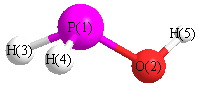 More geometry information
Calculated Bond Angles
| atom1 |
atom2 |
atom3 |
angle |
|
atom1 |
atom2 |
atom3 |
angle |
| P1 |
O2 |
H3 |
105.507 |
|
O2 |
P1 |
H4 |
98.592 |
| O2 |
P1 |
H5 |
98.592 |
|
H4 |
P1 |
H5 |
92.478 |
Electronic energy levels
Charges, Dipole, Quadrupole and Polarizability
