Jump to
S1C2
Energy calculated at CCD/cc-pVDZ
| | hartrees |
|---|
| Energy at 0K | -417.680391 |
| Energy at 298.15K | -417.684524 |
| HF Energy | -417.341503 |
| Nuclear repulsion energy | 60.769609 |
The energy at 298.15K was derived from the energy at 0K
and an integrated heat capacity that used the calculated vibrational frequencies.
Vibrational Frequencies calculated at CCD/cc-pVDZ
| Mode Number |
Symmetry |
Frequency
(cm-1) |
Scaled Frequency
(cm-1) |
IR Intensities
(km mol-1) |
Raman Act
(Å4/u) |
Dep P |
Dep U |
|---|
| 1 |
A' |
3885 |
3717 |
51.38 |
|
|
|
| 2 |
A' |
2381 |
2278 |
108.64 |
|
|
|
| 3 |
A' |
1168 |
1117 |
13.82 |
|
|
|
| 4 |
A' |
1140 |
1091 |
43.59 |
|
|
|
| 5 |
A' |
924 |
884 |
52.23 |
|
|
|
| 6 |
A' |
809 |
774 |
121.50 |
|
|
|
| 7 |
A" |
2384 |
2281 |
167.24 |
|
|
|
| 8 |
A" |
924 |
884 |
19.95 |
|
|
|
| 9 |
A" |
422 |
404 |
105.60 |
|
|
|
Unscaled Zero Point Vibrational Energy (zpe) 7018.4 cm
-1
Scaled (by 0.9567) Zero Point Vibrational Energy (zpe) 6714.5 cm
-1
See section
III.C.1 List or set vibrational scaling factors
to change the scale factors used here.
See section
III.C.2
Calculate a vibrational scaling factor for a given set of molecules
to determine the least squares best scaling factor.
Geometric Data calculated at CCD/cc-pVDZ
Point Group is Cs
Cartesians (Å)
| Atom |
x (Å) |
y (Å) |
z (Å) |
|---|
| P1 |
-0.108 |
-0.577 |
0.000 |
| O2 |
-0.108 |
1.112 |
0.000 |
| H3 |
0.790 |
1.465 |
0.000 |
| H4 |
0.852 |
-0.848 |
1.033 |
| H5 |
0.852 |
-0.848 |
-1.033 |
Atom - Atom Distances (Å)
| |
P1 |
O2 |
H3 |
H4 |
H5 |
| P1 | | 1.6893 | 2.2312 | 1.4362 | 1.4362 |
O2 | 1.6893 | | 0.9650 | 2.4149 | 2.4149 | H3 | 2.2312 | 0.9650 | | 2.5344 | 2.5344 | H4 | 1.4362 | 2.4149 | 2.5344 | | 2.0664 | H5 | 1.4362 | 2.4149 | 2.5344 | 2.0664 | |
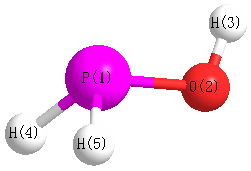 More geometry information
Calculated Bond Angles
| atom1 |
atom2 |
atom3 |
angle |
|
atom1 |
atom2 |
atom3 |
angle |
| P1 |
O2 |
H3 |
111.471 |
|
O2 |
P1 |
H4 |
100.876 |
| O2 |
P1 |
H5 |
100.876 |
|
H4 |
P1 |
H5 |
92.009 |
Electronic energy levels
Charges, Dipole, Quadrupole and Polarizability
Jump to
S1C1
Energy calculated at CCD/cc-pVDZ
| | hartrees |
|---|
| Energy at 0K | -417.680429 |
| Energy at 298.15K | -417.684364 |
| HF Energy | -417.340977 |
| Nuclear repulsion energy | 60.675867 |
The energy at 298.15K was derived from the energy at 0K
and an integrated heat capacity that used the calculated vibrational frequencies.
Vibrational Frequencies calculated at CCD/cc-pVDZ
| Mode Number |
Symmetry |
Frequency
(cm-1) |
Scaled Frequency
(cm-1) |
IR Intensities
(km mol-1) |
Raman Act
(Å4/u) |
Dep P |
Dep U |
|---|
| 1 |
A' |
3907 |
3738 |
84.79 |
|
|
|
| 2 |
A' |
2421 |
2316 |
89.37 |
|
|
|
| 3 |
A' |
1180 |
1129 |
97.04 |
|
|
|
| 4 |
A' |
1166 |
1115 |
24.58 |
|
|
|
| 5 |
A' |
924 |
884 |
14.93 |
|
|
|
| 6 |
A' |
800 |
766 |
93.28 |
|
|
|
| 7 |
A" |
2420 |
2316 |
133.09 |
|
|
|
| 8 |
A" |
939 |
898 |
2.99 |
|
|
|
| 9 |
A" |
243 |
233 |
84.14 |
|
|
|
Unscaled Zero Point Vibrational Energy (zpe) 7000.2 cm
-1
Scaled (by 0.9567) Zero Point Vibrational Energy (zpe) 6697.1 cm
-1
See section
III.C.1 List or set vibrational scaling factors
to change the scale factors used here.
See section
III.C.2
Calculate a vibrational scaling factor for a given set of molecules
to determine the least squares best scaling factor.
Geometric Data calculated at CCD/cc-pVDZ
Point Group is Cs
Cartesians (Å)
| Atom |
x (Å) |
y (Å) |
z (Å) |
|---|
| P1 |
0.039 |
-0.583 |
0.000 |
| O2 |
0.039 |
1.116 |
0.000 |
| H3 |
0.963 |
1.391 |
0.000 |
| H4 |
-0.928 |
-0.790 |
1.034 |
| H5 |
-0.928 |
-0.790 |
-1.034 |
Atom - Atom Distances (Å)
| |
P1 |
O2 |
H3 |
H4 |
H5 |
| P1 | | 1.6992 | 2.1790 | 1.4300 | 1.4300 |
O2 | 1.6992 | | 0.9639 | 2.3741 | 2.3741 | H3 | 2.1790 | 0.9639 | | 3.0654 | 3.0654 | H4 | 1.4300 | 2.3741 | 3.0654 | | 2.0671 | H5 | 1.4300 | 2.3741 | 3.0654 | 2.0671 | |
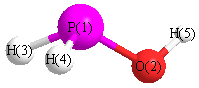 More geometry information
Calculated Bond Angles
| atom1 |
atom2 |
atom3 |
angle |
|
atom1 |
atom2 |
atom3 |
angle |
| P1 |
O2 |
H3 |
106.528 |
|
O2 |
P1 |
H4 |
98.330 |
| O2 |
P1 |
H5 |
98.330 |
|
H4 |
P1 |
H5 |
92.562 |
Electronic energy levels
Charges, Dipole, Quadrupole and Polarizability
