Jump to
S1C2
S2C1
S2C2
Energy calculated at QCISD/cc-pVDZ
| | hartrees |
|---|
| Energy at 0K | -131.061268 |
| Energy at 298.15K | -131.060679 |
| HF Energy | -130.691093 |
| Nuclear repulsion energy | 46.585934 |
The energy at 298.15K was derived from the energy at 0K
and an integrated heat capacity that used the calculated vibrational frequencies.
Vibrational Frequencies calculated at QCISD/cc-pVDZ
| Mode Number |
Symmetry |
Frequency
(cm-1) |
Scaled Frequency
(cm-1) |
IR Intensities
(km mol-1) |
Raman Act
(Å4/u) |
Dep P |
Dep U |
|---|
| 1 |
A' |
3342 |
3206 |
20.38 |
|
|
|
| 2 |
A' |
1844 |
1769 |
40.27 |
|
|
|
| 3 |
A' |
1146 |
1099 |
10.06 |
|
|
|
| 4 |
A' |
666 |
639 |
26.68 |
|
|
|
| 5 |
A' |
388 |
372 |
2.61 |
|
|
|
| 6 |
A" |
423 |
405 |
0.99 |
|
|
|
Unscaled Zero Point Vibrational Energy (zpe) 3903.8 cm
-1
Scaled (by 0.9594) Zero Point Vibrational Energy (zpe) 3745.3 cm
-1
See section
III.C.1 List or set vibrational scaling factors
to change the scale factors used here.
See section
III.C.2
Calculate a vibrational scaling factor for a given set of molecules
to determine the least squares best scaling factor.
Geometric Data calculated at QCISD/cc-pVDZ
Point Group is Cs
Cartesians (Å)
| Atom |
x (Å) |
y (Å) |
z (Å) |
|---|
| C1 |
0.050 |
-1.256 |
0.000 |
| C2 |
0.000 |
0.096 |
0.000 |
| N3 |
-0.150 |
1.292 |
0.000 |
| H4 |
0.756 |
-2.083 |
0.000 |
Atom - Atom Distances (Å)
| |
C1 |
C2 |
N3 |
H4 |
| C1 | | 1.3524 | 2.5549 | 1.0877 |
C2 | 1.3524 | | 1.2050 | 2.3062 | N3 | 2.5549 | 1.2050 | | 3.4940 | H4 | 1.0877 | 2.3062 | 3.4940 | |
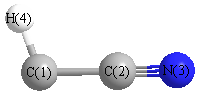 More geometry information
Calculated Bond Angles
| atom1 |
atom2 |
atom3 |
angle |
|
atom1 |
atom2 |
atom3 |
angle |
| C1 |
C2 |
N3 |
174.929 |
|
C2 |
C1 |
H4 |
141.632 |
Electronic energy levels
Charges, Dipole, Quadrupole and Polarizability
Jump to
S1C1
S2C1
S2C2
Energy calculated at QCISD/cc-pVDZ
| | hartrees |
|---|
| Energy at 0K | -131.058448 |
| Energy at 298.15K | |
| HF Energy | -130.688883 |
| Nuclear repulsion energy | 46.733580 |
The energy at 298.15K was derived from the energy at 0K
and an integrated heat capacity that used the calculated vibrational frequencies.
Vibrational Frequencies calculated at QCISD/cc-pVDZ
| Mode Number |
Symmetry |
Frequency
(cm-1) |
Scaled Frequency
(cm-1) |
IR Intensities
(km mol-1) |
Raman Act
(Å4/u) |
Dep P |
Dep U |
|---|
| 1 |
Σ |
3434 |
3294 |
70.52 |
|
|
|
| 2 |
Σ |
1677 |
1609 |
44.78 |
|
|
|
| 3 |
Σ |
1229 |
1179 |
5.36 |
|
|
|
| 4 |
Π |
425 |
408 |
0.01 |
|
|
|
| 4 |
Π |
425 |
408 |
0.01 |
|
|
|
| 5 |
Π |
447i |
429i |
44.57 |
|
|
|
| 5 |
Π |
447i |
429i |
44.57 |
|
|
|
Unscaled Zero Point Vibrational Energy (zpe) 3147.4 cm
-1
Scaled (by 0.9594) Zero Point Vibrational Energy (zpe) 3019.6 cm
-1
See section
III.C.1 List or set vibrational scaling factors
to change the scale factors used here.
See section
III.C.2
Calculate a vibrational scaling factor for a given set of molecules
to determine the least squares best scaling factor.
Geometric Data calculated at QCISD/cc-pVDZ
Point Group is C∞v
Cartesians (Å)
| Atom |
x (Å) |
y (Å) |
z (Å) |
|---|
| C1 |
0.000 |
0.000 |
-1.229 |
| C2 |
0.000 |
0.000 |
0.087 |
| N3 |
0.000 |
0.000 |
1.308 |
| H4 |
0.000 |
0.000 |
-2.308 |
Atom - Atom Distances (Å)
| |
C1 |
C2 |
N3 |
H4 |
| C1 | | 1.3161 | 2.5370 | 1.0788 |
C2 | 1.3161 | | 1.2209 | 2.3949 | N3 | 2.5370 | 1.2209 | | 3.6157 | H4 | 1.0788 | 2.3949 | 3.6157 | |
More geometry information
Calculated Bond Angles
| atom1 |
atom2 |
atom3 |
angle |
|
atom1 |
atom2 |
atom3 |
angle |
| C1 |
C2 |
N3 |
180.000 |
|
C2 |
C1 |
H4 |
180.000 |
Electronic energy levels
Charges, Dipole, Quadrupole and Polarizability
Charges from optimized geometry at QCISD/cc-pVDZ
Charges (e)
| Number |
Element |
Mulliken |
CHELPG |
AIM |
ESP |
| 1 |
C |
-0.015 |
|
|
|
| 2 |
C |
0.011 |
|
|
|
| 3 |
N |
-0.097 |
|
|
|
| 4 |
H |
0.101 |
|
|
|
Electric dipole moments
Electric dipole components in Debye
(What's a Debye? See section
VII.A.3)
| |
x |
y |
z |
Total |
| |
0.000 |
0.000 |
-3.098 |
3.098 |
| CHELPG |
|
|
|
|
| AIM |
|
|
|
|
| ESP |
|
|
|
|
Electric Quadrupole moment
Quadrupole components in D Å
Polarizabilities
Components of the polarizability tensor.
Units are
Å
3 (Angstrom cubed)
Change units.
| |
x |
y |
z |
| x |
0.000 |
0.000 |
0.000 |
| y |
0.000 |
0.000 |
0.000 |
| z |
0.000 |
0.000 |
0.000 |
<r2> (average value of r
2) Å
2
| <r2> |
36.888 |
| (<r2>)1/2 |
6.074 |
Jump to
S1C1
S1C2
S2C2
Energy calculated at QCISD/cc-pVDZ
| | hartrees |
|---|
| Energy at 0K | -131.036412 |
| Energy at 298.15K | -131.035812 |
| HF Energy | -130.628358 |
| Nuclear repulsion energy | 46.230947 |
The energy at 298.15K was derived from the energy at 0K
and an integrated heat capacity that used the calculated vibrational frequencies.
Vibrational Frequencies calculated at QCISD/cc-pVDZ
| Mode Number |
Symmetry |
Frequency
(cm-1) |
Scaled Frequency
(cm-1) |
IR Intensities
(km mol-1) |
Raman Act
(Å4/u) |
Dep P |
Dep U |
|---|
| 1 |
A' |
3055 |
2931 |
21.55 |
|
|
|
| 2 |
A' |
2107 |
2022 |
46.91 |
|
|
|
| 3 |
A' |
1062 |
1019 |
59.55 |
|
|
|
| 4 |
A' |
983 |
943 |
7.61 |
|
|
|
| 5 |
A' |
417 |
400 |
16.08 |
|
|
|
| 6 |
A" |
299 |
287 |
8.37 |
|
|
|
Unscaled Zero Point Vibrational Energy (zpe) 3961.3 cm
-1
Scaled (by 0.9594) Zero Point Vibrational Energy (zpe) 3800.5 cm
-1
See section
III.C.1 List or set vibrational scaling factors
to change the scale factors used here.
See section
III.C.2
Calculate a vibrational scaling factor for a given set of molecules
to determine the least squares best scaling factor.
Geometric Data calculated at QCISD/cc-pVDZ
Point Group is Cs
Cartesians (Å)
| Atom |
x (Å) |
y (Å) |
z (Å) |
|---|
| C1 |
0.006 |
-1.319 |
0.000 |
| C2 |
0.000 |
0.101 |
0.000 |
| N3 |
-0.159 |
1.278 |
0.000 |
| H4 |
1.075 |
-1.641 |
0.000 |
Atom - Atom Distances (Å)
| |
C1 |
C2 |
N3 |
H4 |
| C1 | | 1.4201 | 2.6024 | 1.1166 |
C2 | 1.4201 | | 1.1877 | 2.0477 | N3 | 2.6024 | 1.1877 | | 3.1698 | H4 | 1.1166 | 2.0477 | 3.1698 | |
More geometry information
Electronic energy levels
Charges, Dipole, Quadrupole and Polarizability
Jump to
S1C1
S1C2
S2C1
Energy calculated at QCISD/cc-pVDZ
| | hartrees |
|---|
| Energy at 0K | -131.036412 |
| Energy at 298.15K | -131.035812 |
| HF Energy | -130.628358 |
| Nuclear repulsion energy | 46.230947 |
The energy at 298.15K was derived from the energy at 0K
and an integrated heat capacity that used the calculated vibrational frequencies.
Vibrational Frequencies calculated at QCISD/cc-pVDZ
Geometric Data calculated at QCISD/cc-pVDZ
Point Group is Cs
Electronic energy levels
Charges, Dipole, Quadrupole and Polarizability
