Jump to
S1C2
S2C1
S2C2
Energy calculated at CCD/cc-pVDZ
| | hartrees |
|---|
| Energy at 0K | -131.040161 |
| Energy at 298.15K | -131.039678 |
| HF Energy | -130.690283 |
| Nuclear repulsion energy | 47.059582 |
The energy at 298.15K was derived from the energy at 0K
and an integrated heat capacity that used the calculated vibrational frequencies.
Vibrational Frequencies calculated at CCD/cc-pVDZ
| Mode Number |
Symmetry |
Frequency
(cm-1) |
Scaled Frequency
(cm-1) |
IR Intensities
(km mol-1) |
Raman Act
(Å4/u) |
Dep P |
Dep U |
|---|
| 1 |
A' |
3348 |
3203 |
19.59 |
|
|
|
| 2 |
A' |
1945 |
1861 |
39.40 |
|
|
|
| 3 |
A' |
1123 |
1074 |
31.60 |
|
|
|
| 4 |
A' |
727 |
696 |
13.13 |
|
|
|
| 5 |
A' |
419 |
401 |
2.68 |
|
|
|
| 6 |
A" |
480 |
460 |
3.41 |
|
|
|
Unscaled Zero Point Vibrational Energy (zpe) 4021.5 cm
-1
Scaled (by 0.9567) Zero Point Vibrational Energy (zpe) 3847.4 cm
-1
See section
III.C.1 List or set vibrational scaling factors
to change the scale factors used here.
See section
III.C.2
Calculate a vibrational scaling factor for a given set of molecules
to determine the least squares best scaling factor.
Geometric Data calculated at CCD/cc-pVDZ
Point Group is Cs
Cartesians (Å)
| Atom |
x (Å) |
y (Å) |
z (Å) |
|---|
| C1 |
-0.115 |
-1.250 |
0.000 |
| C2 |
0.000 |
0.110 |
0.000 |
| N3 |
0.023 |
1.282 |
0.000 |
| H4 |
0.525 |
-2.130 |
0.000 |
Atom - Atom Distances (Å)
| |
C1 |
C2 |
N3 |
H4 |
| C1 | | 1.3647 | 2.5356 | 1.0878 |
C2 | 1.3647 | | 1.1721 | 2.3003 | N3 | 2.5356 | 1.1721 | | 3.4481 | H4 | 1.0878 | 2.3003 | 3.4481 | |
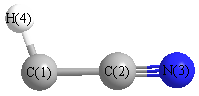 More geometry information
Calculated Bond Angles
| atom1 |
atom2 |
atom3 |
angle |
|
atom1 |
atom2 |
atom3 |
angle |
| C1 |
C2 |
N3 |
176.315 |
|
C2 |
C1 |
H4 |
139.136 |
Electronic energy levels
Charges, Dipole, Quadrupole and Polarizability
Jump to
S1C1
S2C1
S2C2
Energy calculated at CCD/cc-pVDZ
| | hartrees |
|---|
| Energy at 0K | -131.036892 |
| Energy at 298.15K | |
| HF Energy | -130.688951 |
| Nuclear repulsion energy | 47.214489 |
The energy at 298.15K was derived from the energy at 0K
and an integrated heat capacity that used the calculated vibrational frequencies.
Vibrational Frequencies calculated at CCD/cc-pVDZ
| Mode Number |
Symmetry |
Frequency
(cm-1) |
Scaled Frequency
(cm-1) |
IR Intensities
(km mol-1) |
Raman Act
(Å4/u) |
Dep P |
Dep U |
|---|
| 1 |
Σ |
3462 |
3312 |
73.79 |
|
|
|
| 2 |
Σ |
1572 |
1504 |
66.39 |
|
|
|
| 3 |
Σ |
1251 |
1197 |
35.17 |
|
|
|
| 4 |
Π |
473 |
452 |
0.14 |
|
|
|
| 4 |
Π |
473 |
452 |
0.14 |
|
|
|
| 5 |
Π |
425i |
407i |
46.88 |
|
|
|
| 5 |
Π |
425i |
407i |
46.88 |
|
|
|
Unscaled Zero Point Vibrational Energy (zpe) 3189.9 cm
-1
Scaled (by 0.9567) Zero Point Vibrational Energy (zpe) 3051.8 cm
-1
See section
III.C.1 List or set vibrational scaling factors
to change the scale factors used here.
See section
III.C.2
Calculate a vibrational scaling factor for a given set of molecules
to determine the least squares best scaling factor.
Geometric Data calculated at CCD/cc-pVDZ
Point Group is C∞v
Cartesians (Å)
| Atom |
x (Å) |
y (Å) |
z (Å) |
|---|
| C1 |
0.000 |
0.000 |
-1.218 |
| C2 |
0.000 |
0.000 |
0.093 |
| N3 |
0.000 |
0.000 |
1.293 |
| H4 |
0.000 |
0.000 |
-2.296 |
Atom - Atom Distances (Å)
| |
C1 |
C2 |
N3 |
H4 |
| C1 | | 1.3117 | 2.5110 | 1.0774 |
C2 | 1.3117 | | 1.1993 | 2.3891 | N3 | 2.5110 | 1.1993 | | 3.5884 | H4 | 1.0774 | 2.3891 | 3.5884 | |
More geometry information
Calculated Bond Angles
| atom1 |
atom2 |
atom3 |
angle |
|
atom1 |
atom2 |
atom3 |
angle |
| C1 |
C2 |
N3 |
180.000 |
|
C2 |
C1 |
H4 |
180.000 |
Electronic energy levels
Charges, Dipole, Quadrupole and Polarizability
Charges from optimized geometry at CCD/cc-pVDZ
Charges (e)
| Number |
Element |
Mulliken |
CHELPG |
AIM |
ESP |
| 1 |
C |
-0.017 |
|
|
|
| 2 |
C |
0.018 |
|
|
|
| 3 |
N |
-0.107 |
|
|
|
| 4 |
H |
0.106 |
|
|
|
Electric dipole moments
Electric dipole components in Debye
(What's a Debye? See section
VII.A.3)
| |
x |
y |
z |
Total |
| |
0.000 |
0.000 |
-3.298 |
3.298 |
| CHELPG |
|
|
|
|
| AIM |
|
|
|
|
| ESP |
|
|
|
|
Electric Quadrupole moment
Quadrupole components in D Å
Polarizabilities
Components of the polarizability tensor.
Units are
Å
3 (Angstrom cubed)
Change units.
| |
x |
y |
z |
| x |
0.000 |
0.000 |
0.000 |
| y |
0.000 |
0.000 |
0.000 |
| z |
0.000 |
0.000 |
0.000 |
<r2> (average value of r
2) Å
2
| <r2> |
36.392 |
| (<r2>)1/2 |
6.033 |
Jump to
S1C1
S1C2
S2C2
Energy calculated at CCD/cc-pVDZ
| | hartrees |
|---|
| Energy at 0K | -131.028057 |
| Energy at 298.15K | -131.027480 |
| HF Energy | -130.629526 |
| Nuclear repulsion energy | 46.300290 |
The energy at 298.15K was derived from the energy at 0K
and an integrated heat capacity that used the calculated vibrational frequencies.
Vibrational Frequencies calculated at CCD/cc-pVDZ
| Mode Number |
Symmetry |
Frequency
(cm-1) |
Scaled Frequency
(cm-1) |
IR Intensities
(km mol-1) |
Raman Act
(Å4/u) |
Dep P |
Dep U |
|---|
| 1 |
A' |
3056 |
2923 |
22.79 |
|
|
|
| 2 |
A' |
2262 |
2164 |
26.00 |
|
|
|
| 3 |
A' |
1083 |
1037 |
50.49 |
|
|
|
| 4 |
A' |
976 |
934 |
18.95 |
|
|
|
| 5 |
A' |
413 |
395 |
15.19 |
|
|
|
| 6 |
A" |
319 |
306 |
9.78 |
|
|
|
Unscaled Zero Point Vibrational Energy (zpe) 4054.9 cm
-1
Scaled (by 0.9567) Zero Point Vibrational Energy (zpe) 3879.3 cm
-1
See section
III.C.1 List or set vibrational scaling factors
to change the scale factors used here.
See section
III.C.2
Calculate a vibrational scaling factor for a given set of molecules
to determine the least squares best scaling factor.
Geometric Data calculated at CCD/cc-pVDZ
Point Group is Cs
Cartesians (Å)
| Atom |
x (Å) |
y (Å) |
z (Å) |
|---|
| C1 |
-0.039 |
-1.322 |
0.000 |
| C2 |
0.000 |
0.107 |
0.000 |
| N3 |
-0.113 |
1.280 |
0.000 |
| H4 |
1.024 |
-1.666 |
0.000 |
Atom - Atom Distances (Å)
| |
C1 |
C2 |
N3 |
H4 |
| C1 | | 1.4294 | 2.6026 | 1.1170 |
C2 | 1.4294 | | 1.1781 | 2.0470 | N3 | 2.6026 | 1.1781 | | 3.1569 | H4 | 1.1170 | 2.0470 | 3.1569 | |
More geometry information
Electronic energy levels
Charges, Dipole, Quadrupole and Polarizability
Jump to
S1C1
S1C2
S2C1
Energy calculated at CCD/cc-pVDZ
| | hartrees |
|---|
| Energy at 0K | -131.028057 |
| Energy at 298.15K | -131.027480 |
| HF Energy | -130.629526 |
| Nuclear repulsion energy | 46.300290 |
The energy at 298.15K was derived from the energy at 0K
and an integrated heat capacity that used the calculated vibrational frequencies.
Vibrational Frequencies calculated at CCD/cc-pVDZ
Geometric Data calculated at CCD/cc-pVDZ
Point Group is Cs
Electronic energy levels
Charges, Dipole, Quadrupole and Polarizability
