Jump to
S1C2
S2C1
S2C2
Energy calculated at CCSD(T)=FULL/cc-pVDZ
| | hartrees |
|---|
| Energy at 0K | -131.080103 |
| Energy at 298.15K | -131.079506 |
| HF Energy | -130.691061 |
| Nuclear repulsion energy | 46.565367 |
The energy at 298.15K was derived from the energy at 0K
and an integrated heat capacity that used the calculated vibrational frequencies.
Vibrational Frequencies calculated at CCSD(T)=FULL/cc-pVDZ
| Mode Number |
Symmetry |
Frequency
(cm-1) |
Scaled Frequency
(cm-1) |
IR Intensities
(km mol-1) |
Raman Act
(Å4/u) |
Dep P |
Dep U |
|---|
| 1 |
A' |
3337 |
3214 |
|
|
|
|
| 2 |
A' |
1837 |
1769 |
|
|
|
|
| 3 |
A' |
1144 |
1101 |
|
|
|
|
| 4 |
A' |
655 |
631 |
|
|
|
|
| 5 |
A' |
386 |
372 |
|
|
|
|
| 6 |
A" |
422 |
407 |
|
|
|
|
Unscaled Zero Point Vibrational Energy (zpe) 3890.0 cm
-1
Scaled (by 0.9632) Zero Point Vibrational Energy (zpe) 3746.8 cm
-1
See section
III.C.1 List or set vibrational scaling factors
to change the scale factors used here.
See section
III.C.2
Calculate a vibrational scaling factor for a given set of molecules
to determine the least squares best scaling factor.
Geometric Data calculated at CCSD(T)=FULL/cc-pVDZ
Point Group is Cs
Cartesians (Å)
| Atom |
x (Å) |
y (Å) |
z (Å) |
|---|
| C1 |
0.052 |
-1.256 |
0.000 |
| C2 |
0.000 |
0.096 |
0.000 |
| N3 |
-0.153 |
1.292 |
0.000 |
| H4 |
0.757 |
-2.084 |
0.000 |
Atom - Atom Distances (Å)
| |
C1 |
C2 |
N3 |
H4 |
| C1 | | 1.3523 | 2.5559 | 1.0877 |
C2 | 1.3523 | | 1.2061 | 2.3074 | N3 | 2.5559 | 1.2061 | | 3.4965 | H4 | 1.0877 | 2.3074 | 3.4965 | |
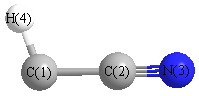 More geometry information
Calculated Bond Angles
| atom1 |
atom2 |
atom3 |
angle |
|
atom1 |
atom2 |
atom3 |
angle |
| C1 |
C2 |
N3 |
174.932 |
|
C2 |
C1 |
H4 |
141.813 |
Electronic energy levels
Charges, Dipole, Quadrupole and Polarizability
Jump to
S1C1
S2C1
S2C2
Energy calculated at CCSD(T)=FULL/cc-pVDZ
| | hartrees |
|---|
| Energy at 0K | -131.077371 |
| Energy at 298.15K | |
| HF Energy | -130.688823 |
| Nuclear repulsion energy | 46.698578 |
The energy at 298.15K was derived from the energy at 0K
and an integrated heat capacity that used the calculated vibrational frequencies.
Vibrational Frequencies calculated at CCSD(T)=FULL/cc-pVDZ
| Mode Number |
Symmetry |
Frequency
(cm-1) |
Scaled Frequency
(cm-1) |
IR Intensities
(km mol-1) |
Raman Act
(Å4/u) |
Dep P |
Dep U |
|---|
| 1 |
Σ |
3431 |
3304 |
|
|
|
|
| 2 |
Σ |
1671 |
1609 |
|
|
|
|
| 3 |
Σ |
1228 |
1183 |
|
|
|
|
| 4 |
Π |
424 |
409 |
|
|
|
|
| 4 |
Π |
424 |
409 |
|
|
|
|
| 5 |
Π |
443i |
427i |
|
|
|
|
| 5 |
Π |
443i |
427i |
|
|
|
|
Unscaled Zero Point Vibrational Energy (zpe) 3146.1 cm
-1
Scaled (by 0.9632) Zero Point Vibrational Energy (zpe) 3030.3 cm
-1
See section
III.C.1 List or set vibrational scaling factors
to change the scale factors used here.
See section
III.C.2
Calculate a vibrational scaling factor for a given set of molecules
to determine the least squares best scaling factor.
Geometric Data calculated at CCSD(T)=FULL/cc-pVDZ
Point Group is C∞v
Cartesians (Å)
| Atom |
x (Å) |
y (Å) |
z (Å) |
|---|
| C1 |
0.000 |
0.000 |
-1.230 |
| C2 |
0.000 |
0.000 |
0.087 |
| N3 |
0.000 |
0.000 |
1.309 |
| H4 |
0.000 |
0.000 |
-2.308 |
Atom - Atom Distances (Å)
| |
C1 |
C2 |
N3 |
H4 |
| C1 | | 1.3165 | 2.5389 | 1.0788 |
C2 | 1.3165 | | 1.2223 | 2.3953 | N3 | 2.5389 | 1.2223 | | 3.6177 | H4 | 1.0788 | 2.3953 | 3.6177 | |
More geometry information
Calculated Bond Angles
| atom1 |
atom2 |
atom3 |
angle |
|
atom1 |
atom2 |
atom3 |
angle |
| C1 |
C2 |
N3 |
180.000 |
|
C2 |
C1 |
H4 |
180.000 |
Electronic energy levels
Charges, Dipole, Quadrupole and Polarizability
Charges from optimized geometry at CCSD(T)=FULL/cc-pVDZ
Charges (e)
| Number |
Element |
Mulliken |
CHELPG |
AIM |
ESP |
| 1 |
C |
-0.021 |
|
|
|
| 2 |
C |
0.044 |
|
|
|
| 3 |
N |
-0.145 |
|
|
|
| 4 |
H |
0.122 |
|
|
|
Electric dipole moments
Electric Quadrupole moment
Quadrupole components in D Å
Polarizabilities
Components of the polarizability tensor.
Units are
Å
3 (Angstrom cubed)
Change units.
| |
x |
y |
z |
| x |
0.000 |
0.000 |
0.000 |
| y |
0.000 |
0.000 |
0.000 |
| z |
0.000 |
0.000 |
0.000 |
<r2> (average value of r
2) Å
2
| <r2> |
36.920 |
| (<r2>)1/2 |
6.076 |
Jump to
S1C1
S1C2
S2C2
Energy calculated at CCSD(T)=FULL/cc-pVDZ
| | hartrees |
|---|
| Energy at 0K | -131.059849 |
| Energy at 298.15K | -131.059231 |
| HF Energy | -130.627094 |
| Nuclear repulsion energy | 46.147528 |
The energy at 298.15K was derived from the energy at 0K
and an integrated heat capacity that used the calculated vibrational frequencies.
Vibrational Frequencies calculated at CCSD(T)=FULL/cc-pVDZ
| Mode Number |
Symmetry |
Frequency
(cm-1) |
Scaled Frequency
(cm-1) |
IR Intensities
(km mol-1) |
Raman Act
(Å4/u) |
Dep P |
Dep U |
|---|
| 1 |
A' |
3045 |
2932 |
|
|
|
|
| 2 |
A' |
2062 |
1986 |
|
|
|
|
| 3 |
A' |
1048 |
1010 |
|
|
|
|
| 4 |
A' |
980 |
944 |
|
|
|
|
| 5 |
A' |
407 |
392 |
|
|
|
|
| 6 |
A" |
294 |
283 |
|
|
|
|
Unscaled Zero Point Vibrational Energy (zpe) 3918.1 cm
-1
Scaled (by 0.9632) Zero Point Vibrational Energy (zpe) 3773.9 cm
-1
See section
III.C.1 List or set vibrational scaling factors
to change the scale factors used here.
See section
III.C.2
Calculate a vibrational scaling factor for a given set of molecules
to determine the least squares best scaling factor.
Geometric Data calculated at CCSD(T)=FULL/cc-pVDZ
Point Group is Cs
Cartesians (Å)
| Atom |
x (Å) |
y (Å) |
z (Å) |
|---|
| C1 |
0.093 |
-1.314 |
0.000 |
| C2 |
0.000 |
0.098 |
0.000 |
| N3 |
-0.247 |
1.268 |
0.000 |
| H4 |
1.177 |
-1.581 |
0.000 |
Atom - Atom Distances (Å)
| |
C1 |
C2 |
N3 |
H4 |
| C1 | | 1.4153 | 2.6037 | 1.1167 |
C2 | 1.4153 | | 1.1951 | 2.0509 | N3 | 2.6037 | 1.1951 | | 3.1850 | H4 | 1.1167 | 2.0509 | 3.1850 | |
More geometry information
Electronic energy levels
Charges, Dipole, Quadrupole and Polarizability
Jump to
S1C1
S1C2
S2C1
Energy calculated at CCSD(T)=FULL/cc-pVDZ
| | hartrees |
|---|
| Energy at 0K | -131.059849 |
| Energy at 298.15K | -131.059231 |
| HF Energy | -130.627094 |
| Nuclear repulsion energy | 46.147528 |
The energy at 298.15K was derived from the energy at 0K
and an integrated heat capacity that used the calculated vibrational frequencies.
Vibrational Frequencies calculated at CCSD(T)=FULL/cc-pVDZ
Geometric Data calculated at CCSD(T)=FULL/cc-pVDZ
Point Group is Cs
Electronic energy levels
Charges, Dipole, Quadrupole and Polarizability
