Jump to
S1C2
S2C1
S2C2
Energy calculated at QCISD(T)=FULL/cc-pVDZ
| | hartrees |
|---|
| Energy at 0K | -131.081480 |
| Energy at 298.15K | -131.080880 |
| HF Energy | -130.690988 |
| Nuclear repulsion energy | 46.525911 |
The energy at 298.15K was derived from the energy at 0K
and an integrated heat capacity that used the calculated vibrational frequencies.
Vibrational Frequencies calculated at QCISD(T)=FULL/cc-pVDZ
| Mode Number |
Symmetry |
Frequency
(cm-1) |
Scaled Frequency
(cm-1) |
IR Intensities
(km mol-1) |
Raman Act
(Å4/u) |
Dep P |
Dep U |
|---|
| 1 |
A' |
3334 |
3197 |
|
|
|
|
| 2 |
A' |
1835 |
1760 |
|
|
|
|
| 3 |
A' |
1142 |
1095 |
|
|
|
|
| 4 |
A' |
657 |
630 |
|
|
|
|
| 5 |
A' |
385 |
369 |
|
|
|
|
| 6 |
A" |
420 |
403 |
|
|
|
|
Unscaled Zero Point Vibrational Energy (zpe) 3885.8 cm
-1
Scaled (by 0.959) Zero Point Vibrational Energy (zpe) 3726.5 cm
-1
See section
III.C.1 List or set vibrational scaling factors
to change the scale factors used here.
See section
III.C.2
Calculate a vibrational scaling factor for a given set of molecules
to determine the least squares best scaling factor.
Geometric Data calculated at QCISD(T)=FULL/cc-pVDZ
Point Group is Cs
Cartesians (Å)
| Atom |
x (Å) |
y (Å) |
z (Å) |
|---|
| C1 |
0.060 |
-1.256 |
0.000 |
| C2 |
0.000 |
0.095 |
0.000 |
| N3 |
-0.162 |
1.292 |
0.000 |
| H4 |
0.771 |
-2.080 |
0.000 |
Atom - Atom Distances (Å)
| |
C1 |
C2 |
N3 |
H4 |
| C1 | | 1.3523 | 2.5579 | 1.0880 |
C2 | 1.3523 | | 1.2081 | 2.3077 | N3 | 2.5579 | 1.2081 | | 3.4990 | H4 | 1.0880 | 2.3077 | 3.4990 | |
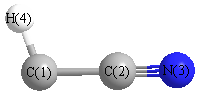 More geometry information
Calculated Bond Angles
| atom1 |
atom2 |
atom3 |
angle |
|
atom1 |
atom2 |
atom3 |
angle |
| C1 |
C2 |
N3 |
174.860 |
|
C2 |
C1 |
H4 |
141.817 |
Electronic energy levels
Charges, Dipole, Quadrupole and Polarizability
Jump to
S1C1
S2C1
S2C2
Energy calculated at QCISD(T)=FULL/cc-pVDZ
| | hartrees |
|---|
| Energy at 0K | -131.078715 |
| Energy at 298.15K | |
| HF Energy | -130.688761 |
| Nuclear repulsion energy | 46.663990 |
The energy at 298.15K was derived from the energy at 0K
and an integrated heat capacity that used the calculated vibrational frequencies.
Vibrational Frequencies calculated at QCISD(T)=FULL/cc-pVDZ
| Mode Number |
Symmetry |
Frequency
(cm-1) |
Scaled Frequency
(cm-1) |
IR Intensities
(km mol-1) |
Raman Act
(Å4/u) |
Dep P |
Dep U |
|---|
| 1 |
Σ |
3430 |
3289 |
|
|
|
|
| 2 |
Σ |
1677 |
1608 |
|
|
|
|
| 3 |
Σ |
1224 |
1174 |
|
|
|
|
| 4 |
Π |
422 |
405 |
|
|
|
|
| 4 |
Π |
422 |
405 |
|
|
|
|
| 5 |
Π |
447i |
428i |
|
|
|
|
| 5 |
Π |
447i |
428i |
|
|
|
|
Unscaled Zero Point Vibrational Energy (zpe) 3141.2 cm
-1
Scaled (by 0.959) Zero Point Vibrational Energy (zpe) 3012.4 cm
-1
See section
III.C.1 List or set vibrational scaling factors
to change the scale factors used here.
See section
III.C.2
Calculate a vibrational scaling factor for a given set of molecules
to determine the least squares best scaling factor.
Geometric Data calculated at QCISD(T)=FULL/cc-pVDZ
Point Group is C∞v
Cartesians (Å)
| Atom |
x (Å) |
y (Å) |
z (Å) |
|---|
| C1 |
0.000 |
0.000 |
-1.230 |
| C2 |
0.000 |
0.000 |
0.087 |
| N3 |
0.000 |
0.000 |
1.310 |
| H4 |
0.000 |
0.000 |
-2.309 |
Atom - Atom Distances (Å)
| |
C1 |
C2 |
N3 |
H4 |
| C1 | | 1.3169 | 2.5408 | 1.0788 |
C2 | 1.3169 | | 1.2239 | 2.3958 | N3 | 2.5408 | 1.2239 | | 3.6196 | H4 | 1.0788 | 2.3958 | 3.6196 | |
More geometry information
Calculated Bond Angles
| atom1 |
atom2 |
atom3 |
angle |
|
atom1 |
atom2 |
atom3 |
angle |
| C1 |
C2 |
N3 |
180.000 |
|
C2 |
C1 |
H4 |
180.000 |
Electronic energy levels
Charges, Dipole, Quadrupole and Polarizability
Charges from optimized geometry at QCISD(T)=FULL/cc-pVDZ
Charges (e)
| Number |
Element |
Mulliken |
CHELPG |
AIM |
ESP |
| 1 |
C |
-0.021 |
|
|
|
| 2 |
C |
0.044 |
|
|
|
| 3 |
N |
-0.145 |
|
|
|
| 4 |
H |
0.122 |
|
|
|
Electric dipole moments
Electric Quadrupole moment
Quadrupole components in D Å
Polarizabilities
Components of the polarizability tensor.
Units are
Å
3 (Angstrom cubed)
Change units.
| |
x |
y |
z |
| x |
0.000 |
0.000 |
0.000 |
| y |
0.000 |
0.000 |
0.000 |
| z |
0.000 |
0.000 |
0.000 |
<r2> (average value of r
2) Å
2
| <r2> |
36.957 |
| (<r2>)1/2 |
6.079 |
Jump to
S1C1
S1C2
S2C2
Energy calculated at QCISD(T)=FULL/cc-pVDZ
| | hartrees |
|---|
| Energy at 0K | -131.060680 |
| Energy at 298.15K | -131.060062 |
| HF Energy | -130.626914 |
| Nuclear repulsion energy | 46.130588 |
The energy at 298.15K was derived from the energy at 0K
and an integrated heat capacity that used the calculated vibrational frequencies.
Vibrational Frequencies calculated at QCISD(T)=FULL/cc-pVDZ
| Mode Number |
Symmetry |
Frequency
(cm-1) |
Scaled Frequency
(cm-1) |
IR Intensities
(km mol-1) |
Raman Act
(Å4/u) |
Dep P |
Dep U |
|---|
| 1 |
A' |
3044 |
2919 |
|
|
|
|
| 2 |
A' |
2053 |
1969 |
|
|
|
|
| 3 |
A' |
1047 |
1004 |
|
|
|
|
| 4 |
A' |
979 |
939 |
|
|
|
|
| 5 |
A' |
407 |
391 |
|
|
|
|
| 6 |
A" |
294 |
282 |
|
|
|
|
Unscaled Zero Point Vibrational Energy (zpe) 3911.8 cm
-1
Scaled (by 0.959) Zero Point Vibrational Energy (zpe) 3751.5 cm
-1
See section
III.C.1 List or set vibrational scaling factors
to change the scale factors used here.
See section
III.C.2
Calculate a vibrational scaling factor for a given set of molecules
to determine the least squares best scaling factor.
Geometric Data calculated at QCISD(T)=FULL/cc-pVDZ
Point Group is Cs
Cartesians (Å)
| Atom |
x (Å) |
y (Å) |
z (Å) |
|---|
| C1 |
0.107 |
-1.313 |
0.000 |
| C2 |
0.000 |
0.098 |
0.000 |
| N3 |
-0.262 |
1.265 |
0.000 |
| H4 |
1.193 |
-1.570 |
0.000 |
Atom - Atom Distances (Å)
| |
C1 |
C2 |
N3 |
H4 |
| C1 | | 1.4153 | 2.6044 | 1.1168 |
C2 | 1.4153 | | 1.1960 | 2.0516 | N3 | 2.6044 | 1.1960 | | 3.1873 | H4 | 1.1168 | 2.0516 | 3.1873 | |
More geometry information
Electronic energy levels
Charges, Dipole, Quadrupole and Polarizability
Jump to
S1C1
S1C2
S2C1
Energy calculated at QCISD(T)=FULL/cc-pVDZ
| | hartrees |
|---|
| Energy at 0K | -131.060680 |
| Energy at 298.15K | -131.060062 |
| HF Energy | -130.626914 |
| Nuclear repulsion energy | 46.130588 |
The energy at 298.15K was derived from the energy at 0K
and an integrated heat capacity that used the calculated vibrational frequencies.
Vibrational Frequencies calculated at QCISD(T)=FULL/cc-pVDZ
Geometric Data calculated at QCISD(T)=FULL/cc-pVDZ
Point Group is Cs
Electronic energy levels
Charges, Dipole, Quadrupole and Polarizability
